Middle Eastern debt capital markets (DCM) in 2025 were defined by scale, diversification and execution discipline. HSBC led across all three.
It finished the year as the region’s number-one DCM house, with more than $130 billion of issuance and approximately 12% market share, maintaining a leadership position built in more than a decade. But volume alone does not explain its edge. The more important point is how that volume was delivered – and what it reveals about the bank’s role in shaping the market.
The sovereign calendar provides the clearest evidence. Kuwait’s return to international markets after an eight-year absence was one of the year’s defining transactions. The $11.25 billion triple-tranche bond, where HSBC acted as joint global coordinator, was upsized significantly from its initial target and drew peak demand of more than $28 billion. Pricing outcomes were equally notable, with a flat spread between the three- and five-year tranches and only a marginal extension on the 10-year – evidence of careful bookbuilding and strong investor alignment.

It’s not just about scale, it’s about excellence
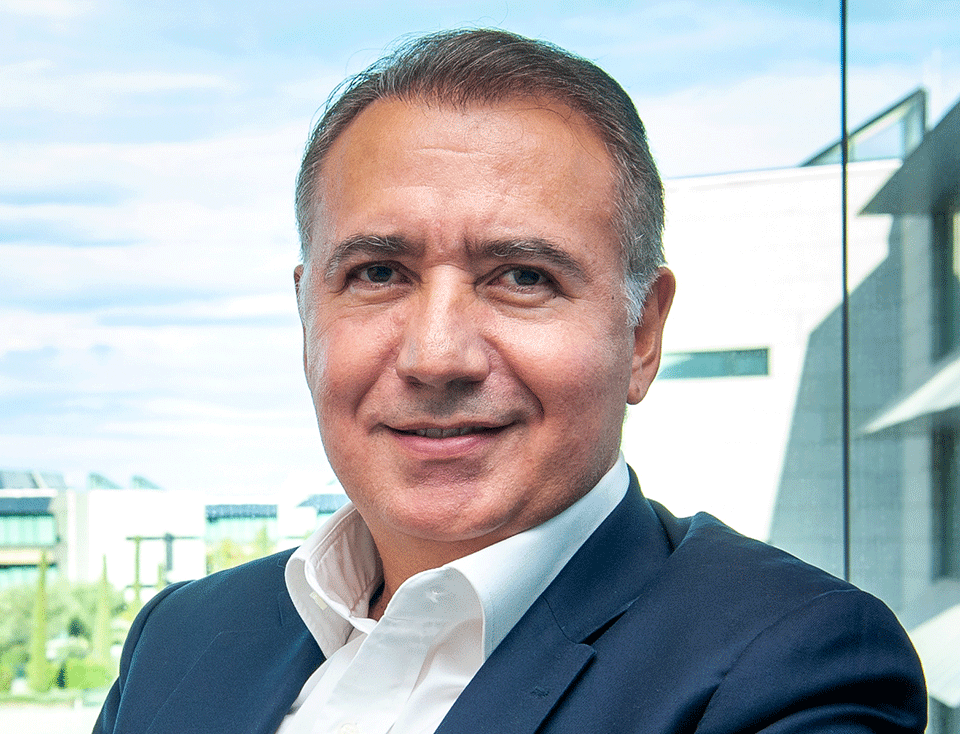
Samer Deghaili
Saudi Arabia’s $5.5 billion dual-tranche sukuk tells a more structural story. This was the Kingdom’s first fully Accounting and Auditing Organisation for Islamic Financial Institutions (AAOIFI)-compliant issuance under a newly established programme, with HSBC leading the structuring and coordination efforts across regional Islamic banks. The transaction tightened materially from initial price thoughts, generated more than $17 billion of orders and achieved the tightest spreads ever recorded by the sovereign on those maturities. It set a new benchmark for both structure and execution in high-grade sukuk.
“It’s not just about scale, it’s about excellence,” stresses Samer Deghaili, co-head of capital markets and advisory, MENAT. The bank was not simply present on the region’s largest deals – it was frequently defining how those deals were brought to market.
Superior execution
Nowhere is this clearer than in sukuk. HSBC ranked number-one in GCC sukuk league tables, executing more than $60 billion of issuance across sovereign, financial institution and corporate borrowers. Just as important is the depth of its issuer relationships. It has acted on every public debt issuance by Saudi Aramco since debut and remains a core coordinator across the Public Investment Fund’s funding programme. That continuity reflects execution capability and strategic trust.
Execution technique was another differentiator. In a year characterised by volatility, HSBC helped introduce intraday execution strategies into sukuk markets. Transactions for the Kingdom, PIF, Aramco and Mubadala were executed on shortened timelines, reducing exposure to market swings while still delivering aggressive pricing. This shift signals a more mature and responsive primary market, with HSBC often leading that evolution.
Investor diversification also advanced. HSBC continued to expand the MENA–Asia funding corridor, increasing participation from Asian accounts across benchmark transactions and leading a range of Formosa and local-currency deals. As capital flows continue to rebalance globally, this ability to connect Gulf issuers with Asian liquidity has become a strategic advantage.
At the same time, the bank broadened the scope of DCM itself. It led the region’s first digitally native bond issuance and replicated the model for subsequent issuers, while continuing to deliver across tier-1 and tier-2 capital, ESG-labelled bonds and sukuk, and private placements. The result is a platform capable of supporting issuers across the full capital structure, rather than a franchise focused purely on benchmark issuance.
Sustainable finance is now embedded within that framework. HSBC led around $19 billion of ESG-related debt issuance during the year, across sovereigns, financial institutions and corporates, reflecting how quickly investor expectations have shifted and how firmly ESG is now embedded into the mainstream of Gulf debt capital raising.
What ultimately sets HSBC apart is not just market share but consistency across issuer types, instruments and conditions. It operates at scale across sovereigns, banks and corporates, while maintaining a level of structuring expertise and execution discipline that allows it to lead the most complex transactions.