If 2025 marked the coming of age of the Middle East as a global capital markets powerhouse, HSBC was at the centre of the action – advising on the region’s most consequential deals, structuring its largest financings and shaping the direction of capital flows between MENA and the rest of the world.
From advising Saudi Aramco on its $8.9 billion acquisition of an additional stake in Petro Rabigh, to supporting Masdar’s €5.2 billion acquisition of a 50% stake in East Anglia Three, and ADNOC Logistics & Services’ expansion through Navig8, HSBC was consistently mandated on the transactions that defined the year. These were not isolated highlights, but emblematic of a broader leadership position that spans advisory, capital markets and financing.

We’re not transactional in nature
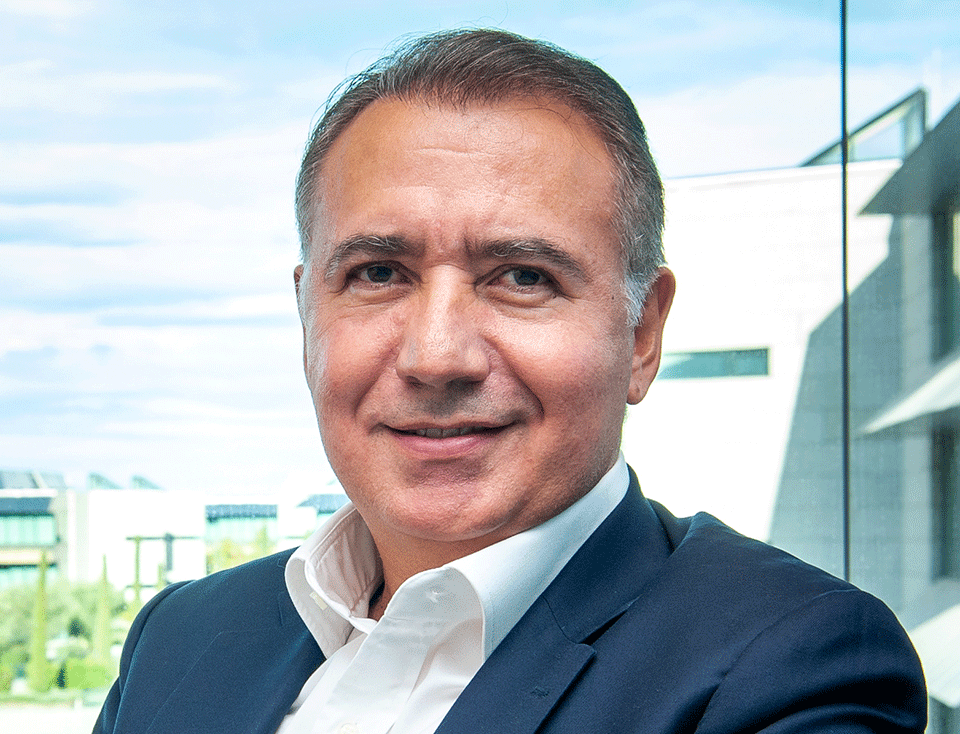
Mohammed Fannouch
The 2026 Middle East’s best investment bank award reinforces a position HSBC has sustained across cycles. In 2025, it had emerged as the region’s leading investment banking platform, topping Euromoney’s Best Investment Banks Middle East MarketMap and winning the overall AfE award, extending a track record that has made it the most frequently recognised franchise in the Middle East during the past 15 years.
What distinguishes HSBC is its consistency across products. The bank maintained its position as the region’s leading debt capital markets (DCM) house for a fifth consecutive year, while also ranking among the top firms in equity capital markets (ECM) and advisory. That breadth has become critical as the region’s largest clients increasingly demand coordinated execution across balance sheet, capital markets and strategic advisory.
Unmatched footprint
Mohammed Fannouch, co-head of capital markets and advisory, MENAT, notes that 2025 saw the region emerge as “a major importer of capital”, with Asian investors increasingly viewing Gulf credits as a secure and liquid destination.
Performance is underpinned by scale. HSBC operates the largest on-the-ground investment banking platform among international banks in the Middle East, with more than 100 bankers across Dubai and Riyadh, and continued investment in senior sector expertise in energy, infrastructure, technology and real estate. As Samer Deghaili, co-head of capital markets and advisory, MENAT, puts it: “Doing more on the ground servicing for our client does pay off.”
The value of that model is most evident in execution. In debt and financing, HSBC delivered a leading performance across sovereign, financial institution and corporate issuance, while also supporting landmark structured and syndicated transactions, including Abu Dhabi Developmental Holding Company (ADQ)’s upsized $5 billion Greater China term loan facility. That deal – marketed to more than 60 institutions, with participation from more than 40 Chinese and Greater China banks – illustrates a defining theme of 2025: the institutionalisation of Asian capital flows into the Gulf.

Doing more on the ground servicing for our client does pay off
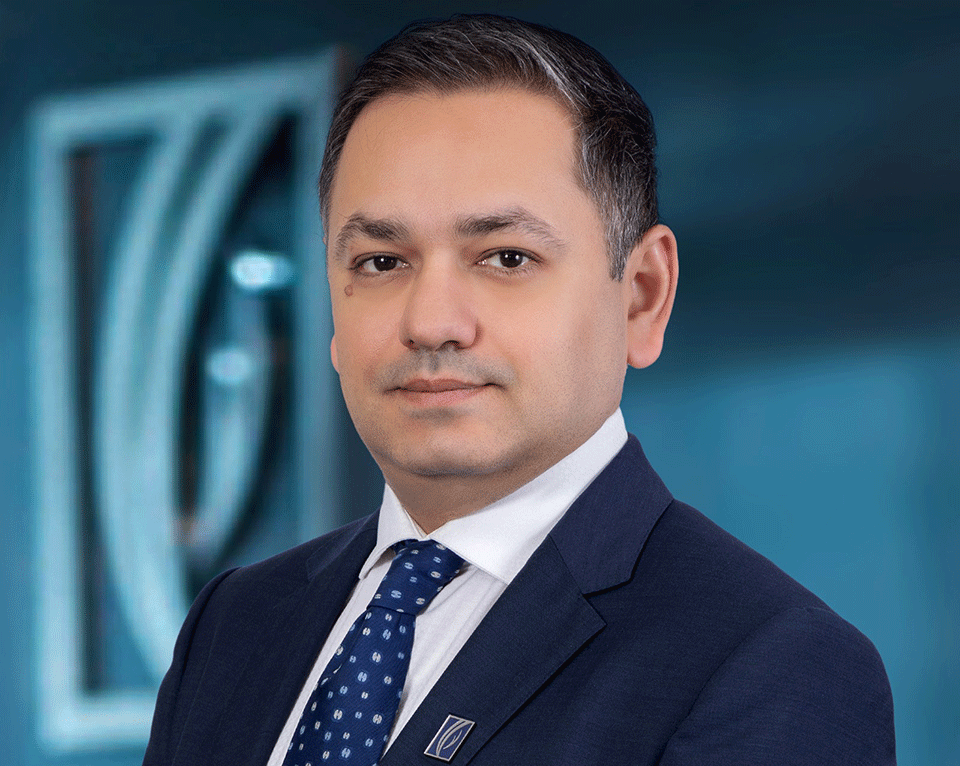
Samer Deghaili
In ECM, HSBC played a central role in the evolution of regional market infrastructure. Transactions such as ADNOC Gas’s $2.8 billion marketed follow-on offering in the UAE and Ooredoo’s transaction in Qatar introduced and scaled follow-on structures in markets where secondary activity had historically been limited. The strategic importance of those deals lies not just in size but in their role in developing more liquid and flexible capital markets.
Advisory remained equally strong. Beyond the headline Aramco transaction, HSBC advised on ADQ’s offer for Aramex, Elm’s acquisition of Thiqah and a series of sovereign and corporate restructurings. Many of these transactions required direct engagement with regulators to establish new frameworks – whether around share structures or valuation methodologies – positioning the bank not just as a participant but as a driver of market evolution.
Green pillar
Sustainable finance is another pillar. The bank led approximately $19 billion of ESG-related issuance in the region during 2025, spanning sovereign, financial institution and corporate transactions. More importantly, these flows are no longer peripheral. Has ESG moved into the mainstream? “The answer is a big yes,” emphasises Deghaili.
Across all of this, a consistent feature is client stickiness. HSBC’s largest counterparties – sovereigns, sovereign wealth funds and leading corporates – repeatedly return across products and cycles. “We’re not transactional in nature,” stresses Fannouch, reflecting a model built on long-term partnerships rather than isolated mandates.
Ultimately, HSBC’s leadership is defined by its ability to operate as a fully integrated platform in a market that is becoming more complex, more international and more competitive. In 2025, the bank was not only present on the region’s most important transactions – it was shaping the structures, investor base and execution standards that defined them.