
Santander is Latin America’s best investment bank given the consistency and scope of its execution across a diverse and often challenging regional landscape. In 2025, the bank demonstrated a clear competitive advantage through its integrated model, combining advisory, capital markets, financing and markets capabilities into a single, coordinated platform.
At the core of Santander’s success is a model built on deep local expertise, supported by regional orchestration and global distribution. Local teams maintain close client relationships and market insight, while regional coordination enables cross-border execution and delivery across multiple jurisdictions. This approach has proved particularly effective in Latin America, where regulatory, macroeconomic and liquidity conditions vary widely from market to market.
“Santander CIB’s unparalleled presence across Latin America is a key differentiator versus global competitors, combining local knowledge with regional leadership, connectivity and global execution capabilities. Through our integrated platform, we deliver seamless advisory, financing and capital markets solutions across the region’s most strategic sectors. Our leading positions in M&A, DCM and project finance underscore the strength of our franchise and execution capabilities. From landmark infrastructure financings to transformational cross-border M&A transactions, we consistently support clients on the region’s most complex opportunities. This unique combination of local expertise, regional scale and global reach enables Santander to create value for clients across Latin America and beyond,” says José M Linares, global head of Santander CIB.
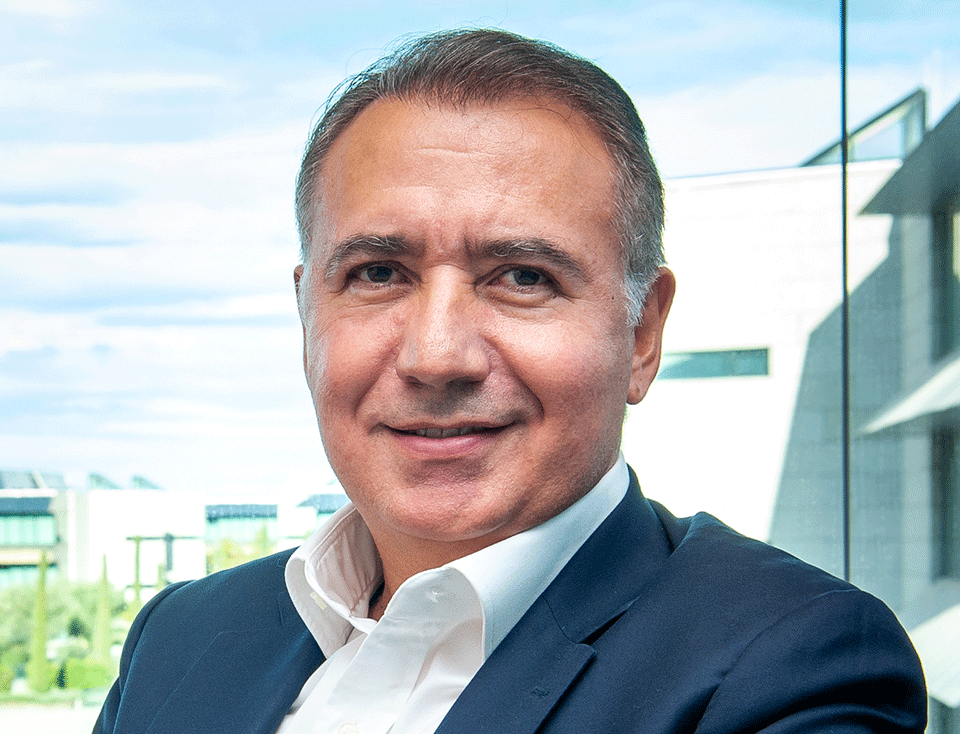
Through our integrated platform, we deliver seamless advisory, financing and capital markets solutions across the region’s most strategic sectors
José M Linares
Santander’s advisory franchise was a standout contributor in the review period. The bank supported a broad range of domestic and cross-border M&A activity across sectors including energy, infrastructure, natural resources and financial services. Its emphasis on senior-level engagement and sector expertise enabled it to lead complex transactions requiring careful timing, stakeholder management and financing coordination. This strength is reflected in its league table performance: Santander captured a 23% market share and €19.6 billion in announced transaction volume across 50 deals.
Across capital markets, Santander delivered similarly strong results in both equity and debt issuance. In equity capital markets, it focused on selective, high-impact transactions requiring disciplined investor education and placement, ranking second in the regional league tables with a 19% market share. In debt capital markets, the bank executed across both local and international markets, including benchmark bonds, hybrid instruments and ESG-linked structures, achieving a 14% market share and ranking second in the region. Its ability to combine onshore execution with offshore distribution enabled issuers to access diversified investor bases and secure funding during volatile market windows.
A further differentiator was Santander’s strength in financing, particularly in project and infrastructure finance. The bank ranked first in Latin America in this segment, arranging €3.6 billion across 32 transactions. Its involvement in long-tenor, risk-mitigated financing structures for energy and infrastructure projects highlights its capacity to deliver complex funding solutions that are closely aligned with client requirements and local market conditions. This capability has been critical in enabling transactions that may otherwise have struggled to reach financial close.
Integrated delivery across markets
Santander’s execution highlights illustrate how its integrated model translates into tangible outcomes across the region. In Brazil, it acted as bookrunner on a BRL5.7 billion ($1.1 billion) financing for Aena’s 11-airport concession, combining local execution with international distribution. In Chile, it supported innovative capital markets activity, including Arauco’s inaugural hybrid bond issuance, which expanded the domestic market’s range of funding instruments. In Colombia, the bank contributed to the sovereign’s €2 billion international bond issuance, while in Argentina it participated in the $2 billion financing of the Vaca Muerta Oil Sur pipeline. In Mexico, it delivered high-profile advisory work, including the $2.6 billion sale of CBX and CMA to Grupo Aeroportuario del Pacífico.
These transactions demonstrate the bank’s ability to coordinate advisory, financing, capital markets and markets capabilities, underpinned by integrated research. Santander embeds macroeconomic, FX and sector research into its execution process, informing product structuring, investor targeting and timing. Santander also continued to invest in operational improvements, including electronic execution tools, pre-trade analytics and enhanced client reporting.
Santander’s performance in Latin America reflects a disciplined and scalable investment banking model that consistently delivers for clients. By integrating product capabilities, leveraging deep regional expertise and maintaining execution reliability, the bank has reinforced its position as a leading investment banking partner in the region.