Bank of America is the world’s best bank for SMEs for the second year in a row, proving that global scale and local specialisation work hand in hand. The bank’s Global Commercial Banking (GCB) division combines the personalised coverage of a local relationship bank with the balance sheet, technology, sector expertise and international reach of a global financial institution.
BofA’s edge is especially important for SMEs and mid-sized companies whose needs increasingly resemble those of large corporates: cross-border payments, foreign exchange, liquidity management, M&A advice, digital treasury connectivity and access to specialist industry knowledge.
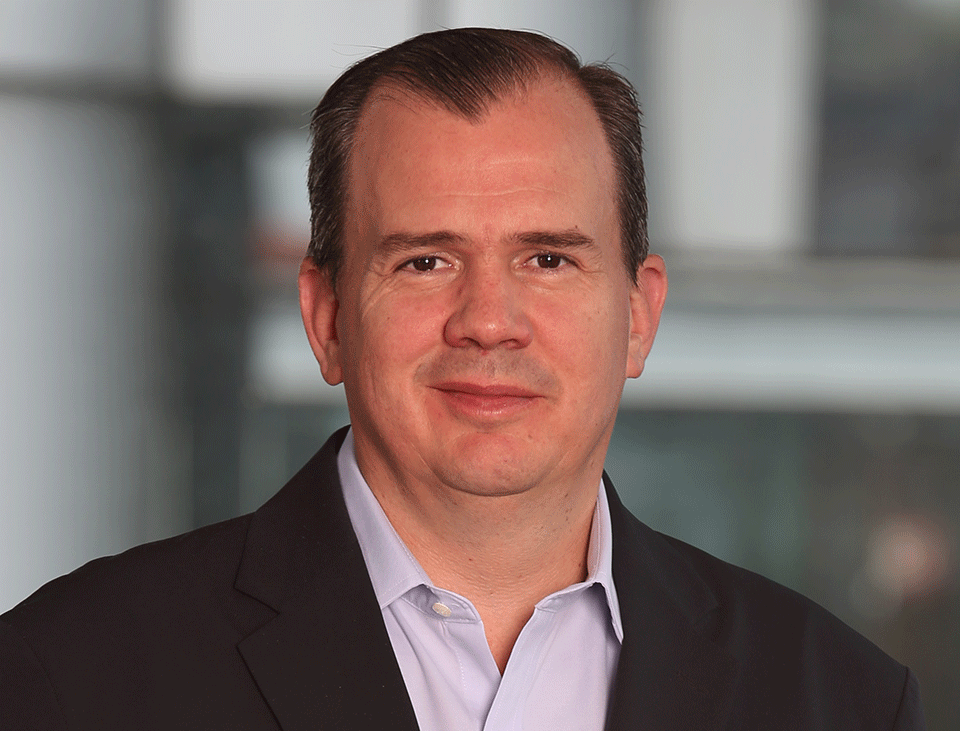
“Geopolitical uncertainty, shifting trade policies and supply chain disruptions create complexity for companies looking beyond their home markets, says Wendy Stewart, president, global commercial bank. “Global Commercial Banking offers end-to-end support that helps clients manage and mitigate risk.”

Our bankers, in more than 20 countries, bring local knowledge of regulations, customs and economic conditions to help our clients navigate new markets
Wendy Stewart
The bank has built a genuinely global SME franchise, serving US and Canadian companies with annual revenues of $50 million to $2 billion, as well as their international subsidiaries, across more than 20 countries. In 2025, the bank delivered growth while investing in its digital proposition for this segment. The GCB franchise achieved a total revenue of $8.8 billion, delivering a 11% growth in deposits to $215 billion, while loans grew by 1% to $198 billion.
A network of networks
For many growth companies, international expansion no longer begins after they have become large corporates. Supply chains, customers, investors and acquisition targets can all become cross-border much earlier in the business lifecycle and Bank of America’s strength is that it can support clients before, during and after that transition.
“Our bankers, in more than 20 countries, bring local knowledge of regulations, customs and economic conditions to help our clients navigate new markets,” Stewart explains. “We pair that with real-time transactional visibility through CashPro and targeted FX and interest rate hedging strategies, so clients can transact in local currencies, protect their earnings and execute cross-border plans with confidence and control.”
Rather than referring them to an offshore desk, the bank connects each client to a relationship manager in its community, who acts as a single point of entry into specialists across credit, treasury, foreign exchange, investment banking, wealth management and other specialised products. Scale gives that model credibility: more than one-third of Fortune 1,000 companies are Global Commercial Banking clients, while national industry specialists add depth across sectors such as healthcare, technology, aerospace and defence, higher education and professional sports.
The clearest test of that proposition is international expansion. Bank of America describes its cross-border model as a “network of networks”, combining traditional wire systems with fintech-enabled closed-loop technologies to give clients the speed and transparency associated with fintech providers, while preserving the control, compliance and integration expected from a regulated global bank.
Mexico illustrates the value of this approach. As nearshoring accelerated in 2025, US-based companies needed to manage supplier relationships, production flows and currency exposures in a market where local terms matter. Bank of America helped clients negotiate local currency arrangements, manage foreign exchange risk and support cross-border operations with the discipline of a local player.
Supporting the new economy
Bank of America’s specialised coverage is another important reason for its win. Its new economy team focuses on companies in transformative technology and healthcare, working with later-stage startups as they move from founder-led growth towards more complex financing, risk management and international operating needs.
For these businesses, the relationship is rarely about one product. They may need capital raising advice, liquidity management, cashflow enhancement, foreign exchange support and introductions into new markets at the same time. Bank of America’s advantage is that it can assemble that expertise around the client without making the client manage the bank’s internal complexity.
Advisory is the other side of the story. In 2025, middle-market companies used M&A both to accelerate growth and to build resilience. Bank of America’s bankers acted as strategic matchmakers across a largely private market, connecting buy and sell-side clients where opportunities were not always visible through public channels.
The bank also has a dedicated advisory framework for family-owned companies, covering succession planning, governance, philanthropic strategy and employee stock ownership plan-based liquidity options where there is no obvious next-generation owner. These are not peripheral services.
Digital adoption at scale
By the end of 2025, 86% of GCB clients were digitally active. CashPro, the bank’s treasury platform, is used by more than 35,000 companies worldwide across online, host-to-host, API and mobile app channels. In 2025, it processed a record $1.2 trillion in mobile-approved payments, equivalent to an average of $38,000 every second.
“Digital tools, including AI, are already reshaping SMEs. Manual processes are being automated, decisions are getting made faster and teams are rebalancing their workloads,” Stewart notes.
Bank of America has also used AI in areas where it can make client service faster and more useful. CashPro Chat, powered by the Erica virtual assistant, handled more than 40% of client enquiries directly. At the same time, API adoption continued to grow, with most clients transacting through the bank’s network of more than 70 treasury management systems and ERP providers.
“The companies seeing the greatest results are thinking about this enterprise-wide, taking the time to understand their end-to-end processes and how their data is organized before making major changes,” Stewart adds. “But the most effective companies are also clear-eyed about what technology cannot replace. The judgment, the relationships and the strategic thinking behind the most important decisions still require people. Getting that balance right is a competitive advantage.”
The model ultimately depends on the relationship manager. To keep that high-touch approach scalable, Bank of America is investing in AI-driven internal tools that help bankers synthesise market commentary and retrieve information from lengthy financial documents. The purpose is practical: reduce administrative work and give relationship managers more time for strategic conversations.
That combination of human coverage and digital infrastructure is why Bank of America stands out. Its SME proposition is a connected franchise built for companies whose ambitions, suppliers, customers and risks increasingly cross borders.