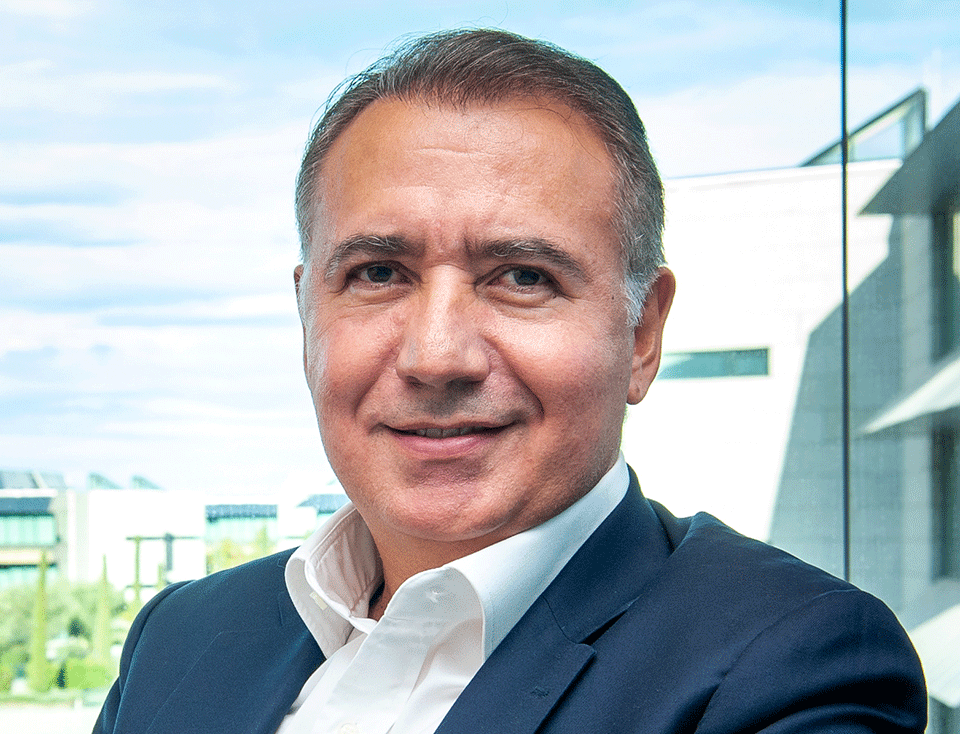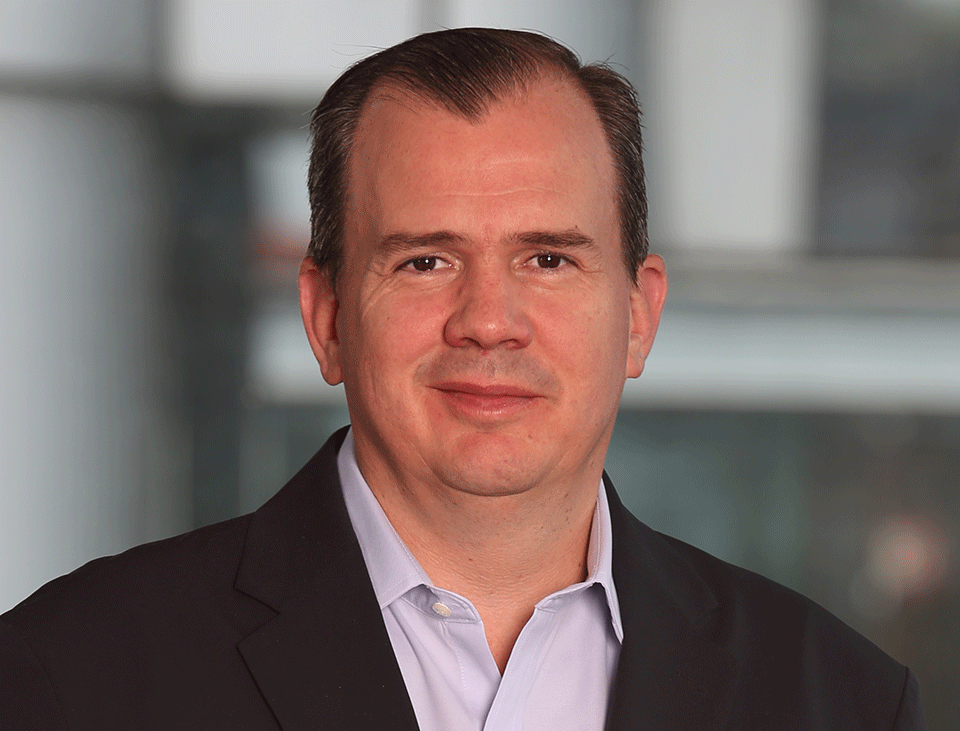
Best bank: Akbank
In 2025, Akbank strengthened its position in Turkey through fast-growing digital customer acquisition and the expansion of embedded, data-driven banking capabilities.
Momentum in customer acquisition and usage continued to shift decisively toward digital channels, with three-quarters of new retail and SME customers onboarded digitally and newly acquired users increasing product engagement year-on-year. This translated into significantly higher uptake of core products through mobile, including the majority of loan, card and deposit sales. Activity levels also intensified, with mobile users exceeding 30 logins per month and almost all non-cash transactions migrating to digital channels, supporting more stable, customer-driven revenue generation.
Development of Akbank Mobile focused on embedding real-time decisions and behavioural design into the user journey. A conversational, context-based engagement layer lifted conversion rates to 18%, significantly above traditional offers, while more than 55 personalised insights were generated to guide financial decisions.
The bank extended this approach through a tiered loyalty model reaching over three million users, increasing engagement, product holdings and balances among active customers. Lending innovations, including flexible repayment options and single-payment structures, added new volume while aligning credit usage more closely with customer cashflow patterns.
Further enhancements broadened functionality and ecosystem reach. The Live Markets interface consolidated multi-asset data and analytics within the app, while the launch of a centralised Security Centre brought over 40 controls into a single, user-managed environment with rapid uptake.
Corporate and ecosystem initiatives, including expanded API services, open banking integrations and the growth of the Juzdan wallet, increased transaction volumes, external connectivity and embedded finance adoption.
Best digital bank: Isbank
Isbank’s digital banking development was driven by largescale AI deployment, deeper ecosystem integration and platform enhancements, improving efficiency and increasing digital service use across the bank in 2025.
A key advance came with the bank’s internal AI platform, built on its proprietary large language model, which was deployed organisation-wide in May and reduced information retrieval times from 20 to 30 minutes to a few seconds. The platform handled around 1,800 daily interactions from nearly 800 users, embedding decision support across credit, HR and operations while standardising processes at a time of workforce transition. Its modular architecture allowed business units to deploy domain-specific agents within a unified interface, accelerating adoption without fragmenting governance.
Externally, the bank expanded its open and embedded banking infrastructure, integrating application programming interfaces into e-commerce platforms and digital marketplaces so that financial products could be accessed within non-bank environments. This widened distribution while increasing transaction volumes across existing channels, supporting a 47% annual rise in fee income, a reflection of growing digital activity and product utilisation.
Digital development was complemented by new service models linking physical and digital access. The launch of the IsVapur floating branch introduced deployable infrastructure capable of scaling from three to 13 service points and maintaining banking access in disrupted areas, while still operating as a digitally enabled branch in normal conditions.
In parallel, enhancements to wealth and SME propositions integrated banking, investment and insurance services into unified digital journeys, while sector-specific platforms, including those serving startups, extended the bank’s reach into digitally native client segments representing around a quarter of the country’s startup ecosystem.
Best bank for ESG: QNB Bank
Rapid growth in sustainable financing, increasingly sophisticated ESG-linked instruments and demonstrable improvements in environmental performance metrics underpinned the strength of QNB Bank’s ESG offering in 2026.
Activity in 2025 was marked by a clear expansion of sustainable finance, with volumes reaching $4 billion as lending shifted further towards transition and impact-aligned sectors, supported by formalised 2030 decarbonisation targets across hard-to-abate industries. This was reinforced by tighter portfolio selection, including the extension of coal exclusions, and by more granular emissions tracking under PCAF, where data quality improvements were driven through deeper client engagement.
External benchmarks reflected this progress, with the MSCI rating moving back to AA, Sustainalytics risk scores improving to 16.7, and CDP coverage expanding to forests alongside climate and water, resulting in triple-A scores across all three categories.
Capital markets activity broadened in both scale and structure, with sustainable bond volumes rising 34% year-on-year to $920 million. This included a $100 million climate transition bond aligned with ICMA guidance and targeted at high-emitting sectors, as well as a further $100 million triple-impact bond allocating over a third of proceeds to women and youth-led SMEs. A TRY250 million ($5.3 million) domestic issuance added a local currency dimension, while a $500 million sustainable Eurobond channelled funding into renewable energy and resilient infrastructure.
The product set widened further through sustainability-linked syndications, including a $650 million dual-tranche deal with rollover ratios exceeding 170%, as well as the introduction of blue finance structures and Turkey’s first sustainability-linked interest rate swap, embedding ESG performance metrics directly into project financing.
Best bank for corporate responsibility: Garanti BBVA
Garanti BBVA’s 2025 performance was driven by continued investment, verifiable impact and ongoing programme evolution across priority social themes, supported by structured governance and full delivery against predefined targets.
Community investment reached TRY376.3 million ($8.03 million) in 2025, with 625,729 direct beneficiaries, marking a clear increase in scale while maintaining alignment with the bank’s 2021 to 2025 strategy and delivering 100% of its stated KPIs.
Execution was underpinned by board-level oversight, formal reporting lines and independent assurance of non-financial disclosures, with social impact analysis used to assess outcomes rather than activity levels.
Education initiatives remained central, particularly through the Teachers Academy Foundation, while cultural investment through Salt sustained access to research and artistic production. Environmental efforts advanced through Blue Breath, combining marine waste collection with scientific monitoring of underwater ecosystems, extending the scope beyond awareness to measurable ecological intervention.
Enhancements in 2025 were most evident in financial literacy outreach. The bank expanded its branch-based education model to 94 locations across 45 provinces, engaging around 2,400 students and more than 100 teachers. Sessions incorporated applied learning, including digital banking tools, budgeting practices and operational exposure within branches, adding a practical element to programme delivery.
Corporate responsibility activity was managed by a dedicated specialist team, integrating NGO experience and social science expertise into programme design, implementation and evaluation, with a consistent emphasis on measurable outcomes, stakeholder alignment and repeatable delivery frameworks.
Best bank for D&I: Garanti BBVA
Garanti BBVA stood out for embedding diversity and inclusion into clearly defined and consistently tracked workforce outcomes, governance and programmes, with clear progress across representation, pay equity and access in 2025.
Representation continued to be a central focus of the bank’s workforce strategy, with women accounting for 56% of employees and 40% of senior and middle management, supported by structured leadership pipelines and the return-to-work rate after maternity leave rising to 98%. Pay transparency continued to be disclosed in detail, with mean and median gender pay gap ratios close to parity alongside tightly managed bonus gaps.
Last year saw a shift towards more structured access and inclusion pathways. TalentAccess was expanded to include interns, broadening early-career entry routes through more inclusive recruitment channels and linking early-career development to longer term employability.
Recruitment, onboarding and career processes were further redesigned to embed accessibility requirements as a standard part of process design, while dedicated events and workshops focused on accessibility and inclusive design reached more than 500 participants.
Training remained central to implementation, with over 18,000 employees completing violence prevention and equality-focused programmes and more than 20,000 participating in gender equality training modules. These were complemented by immersive learning formats and targeted leadership training, aligning behavioural change with formal policies. Oversight was embedded through a dedicated D&I team and integration into control frameworks, and inclusion indicators tracked alongside broader sustainability metrics.
Best bank for sustainable finance: Akbank
Akbank rapidly expanded its sustainable finance volumes in Turkey while strengthening transition-linked capabilities and launching execution-focused products across lending and funding in 2025.
Cumulative sustainable financing reached TRY681 billion ($14.5 billion) by year-end 2025, representing a substantial increase of over 60% since 2024. Sustainability-linked instruments accounted for 46% of wholesale funding, supported by transactions including a $500 million tier 2 bond, a $650 million syndicated loan with a new three-year tranche, and multiple bilateral and multilateral facilities targeting SMEs and inclusive growth.
Product breadth increased to 26 offerings, with 2025 launches focused on implementation: an AI-based energy management platform with potential energy savings of up to 20%, sustainable cooling finance developed with international partners, and CBAM-aligned carbon reporting tools integrated into client services.
The introduction of a Green Transformation Score marked a shift toward embedding transition metrics in credit allocation, initially applied to large corporate, commercial and SME exposures and linked to lending decisions. In project finance, the share of sustainable loans rose to 42% from 38% in 2024, while renewable energy maintained a 91% share of the energy portfolio, spanning 193 projects and more than six gigawatts of financed capacity.
Social and inclusion-linked activity expanded alongside environmental finance. ESG-themed assets under management reached TRY36 billion with 392,000 investors, while targeted instruments included a $100 million gender-focused issuance and dedicated funding for women-led businesses, where customer numbers increased 11% year-on-year, alongside training reach exceeding 21,000 SMEs.
Best investment bank: Citi
Citi’s Turkish investment-banking franchise turned a difficult 2025 into a year of momentum. Drawing on the largest bulge-bracket team in Istanbul and its global distribution network, the bank dictated the pace in M&A, equity and debt markets.
Its equity capital markets business executed $524 million of secondary placements during the year. In August Citi acted as sole global coordinator on the $236 million sell-down in private hospital operator MLP Care on behalf of private equity owner Turkven. In September, it advised on a $238 million placement in power transformer manufacturer Astor Enerji – Turkey’s largest block trade in more than two years – and closed the year with a $50 million sell-down in real estate investment vehicle Rönesans Gayrimenkul Yatırım, on behalf of Singapore sovereign wealth fund GIC.
On the advisory side, Citi served as exclusive sell-side adviser to Trendyol, the leading Turkish e-commerce platform, on its roughly $700 million sale of meal and grocery delivery unit Trendyol GO to Uber and advised Blackstone Tactical Opportunities on the debt financing backing CVC’s strategic investment in Istanbul-based mobile games studio Dream Games.
In debt capital markets the firm led more than $10 billion of issuance for sovereign, financial institution and corporate borrowers. It re-opened the Turkish market in May with cement producer Çimko’s $300 million debut, underpinned by $110 million of development finance anchor support. It also pioneered sustainable structures as green structuring bank on Aydem Renewables’ $550 million green bond and as joint bookrunner on Vakifbank’s $750 million sustainability offering.
Landmark capital instruments included the Turkish Wealth Fund’s $1 billion dual-tranche deal, one of the largest non-sovereign CEEMEA orderbooks of the year, and Halkbank’s $700 million additional tier 1 issue, the largest AT1 ever from Turkey and the bank’s first return to international markets since 2016.
Best investment bank for ECM: HSBC
HSBC’s equity capital markets team continued to match distribution with deep local insight in Turkey’s volatile market. Its strategy of combining one of the country’s largest on-the-ground sales forces with the firm’s domestic brokerage, HSBC Yatırım, allowed the bank to court both Istanbul’s fast-growing retail base and long-term international funds.
This dual access proved decisive in September when HSBC steered a $238 million accelerated bookbuild for power equipment maker Astor Enerji. Coming only days after Ankara lifted a short-sale ban, the transaction priced at a tight discount despite heightened political noise and became the biggest Turkish corporate follow-on since 2017. Books were covered within 15 minutes and eventually upsized to 9% of Astor’s share capital, underlining investors’ confidence in HSBC’s execution under pressure.
A fortnight later the bank advised SASA Polyester, a flagship chemical producer. Acting as sole global coordinator, HSBC built a club of anchor investors during a two-day wall-cross, then fixed price early in the book to prioritise demand generation. The $142 million sale cleared with a 7.7% discount and again balanced sizeable domestic orders with cross-border interest.
Both deals illustrate a broader franchise: eight Turkish ECM mandates since the 2023 elections and the ability, unique among international banks, to channel domestic and foreign liquidity through HSBC Yatırım’s platform.
By combining local market intelligence, repeat sponsor relationships and disciplined pricing tactics, HSBC has positioned itself as the arranger of choice for Turkish issuers seeking depth without sacrificing speed.
Best investment bank for M&A: ÜNLÜ & Co
ÜNLÜ & Co’s M&A franchise demonstrated that a locally rooted investment bank can dominate the big-ticket end of Turkish deal making.
Since inception the firm’s senior-led model has helped it advise on 140 transactions worth around $20 billion, ranking first in Türkiye by completed deal count. This leadership was underscored in 2025. While macro volatility dampened financing markets, ÜNLÜ & Co still closed five strategically significant deals spanning consumer, industrials, infrastructure, healthcare and technology.
ÜNLÜ & Co advised the car-sharing arm of delivery giant Getir on its $22 million sale to TikTak, Istanbul’s largest short-term car-share platform. The consolidation created a single national operator able to invest in fleet electrification at scale, illustrating the bank’s knack for timing exits when international investors are repositioning.
In another landmark mandate, the firm steered İzmir-based brewer Türk Tuborg into the $56 million purchase of Antalya Alkollü İçecek. ÜNLÜ & Co helped its longstanding client capture premium shelf space ahead of tourist-season demand.
Industrial consolidation tested the team’s regulatory dexterity. Arkoz Madencilik’s €51 million merger with Kars Çimento knit together mineral feedstock and downstream cement capacity, a deal cleared despite overlapping quarry licences.
ÜNLÜ & Co also linked Ankara-based Burgeon Biotechnology, an aesthetics-focused R&D house, with French dermal-filler leader Laboratoires VIVACY, securing cross-border knowhow and export channels in one stroke.
Threading these transactions together is the bank’s tight integration of local insight and global process. With roughly 90 cross-border deals already on the books and managing directors leading every mandate from pitch to signing, ÜNLÜ & Co continues to set the standard for complex, value-creating M&A in Turkey.
Best investment bank for financing solutions: Doğan Investment Bank
Doğan Investment Bank has emerged as a pivotal arranger of capital for Turkey’s post-earthquake recovery and its private-sector growth ambitions. In its fourth year of operations, the Istanbul-based lender is using a blend of structured, Islamic and green instruments to match international liquidity with domestic needs.
In October 2025 the bank acted as sole adviser on the €485 million inaugural borrowing of the Disaster Reconstruction Fund of Türkiye, a special-purpose public vehicle set up to channel long-term funding into rebuilding declared disaster zones. By mobilising a syndicate led by Abu Dhabi Commercial Bank, the transaction opened a new sovereign-linked asset class for foreign investors and set pricing benchmarks for further reconstruction finance.
Weeks earlier, the bank broadened Turkey’s trade finance channels by securing a $5 million one-year revolving facility from DP World Trade Finance, the first ever bilateral exposure to a Turkish bank.
Advisory activity also accelerated. Doğan steered Yum! Brands-owned KFC through a franchising partnership with HD Holding, bringing the quick-service giant a locally anchored platform for nationwide expansion. The firm also advised on two landmark cross-border financings: one for biscuit maker ETİ on its $173 million purchase of U.S. protein-bar producer TRUBAR and arranged the European Fund for Southeast Europe’s debut investment in a Turkish non-bank lender.
Behind these headline transactions, Doğan has deepened local capital markets by issuing sukuk and commercial paper for its own funding. It also pioneered the country’s first fully digital SME lending platform KobiKrediDensuring, which channels long-term international resources down to small businesses and climate-focused projects nationwide.
Best for research: Kuveyt Türk Investment
Kuveyt Türk Yatırım’s research desk spent 2025 turning participatory finance analysis into a genuine market-moving franchise. The Istanbul-based unit combined academic depth with relentless publishing to become one of the most closely followed voices on Borsa Istanbul.
The five-person team produced 701 pieces of research and unveiled Türkiye’s first Shariah-compliant Participation Model Portfolio. The portfolio returned 43.6% versus 17% for the BIST100, generating a 26.6% alpha and helping the firm’s equity-commission market share quadruple to 1.69% by year-end. A decisive overweight in defence-electronics champion Aselsan drove much of the outperformance, surging 238%.
Kuveyt Türk Yatırım’s analyses did more than beat benchmarks, they moved liquidity. A strong-buy report on Emlak Konut, the state-backed housing developer, prompted Bank of America to purchase 36 million shares, lifting the stock more than 5% in a single session. Follow-up notes on aviation software specialist Hitit and mid-market ERP leader Logo Yazılım triggered record volumes as global investors piled in alongside local clients.
The team also widened its lens, expanding formal company coverage to 17 strategically important Turkish issuers, ranging from Turkish Airlines to oil refiner Tüpraş, and supplementing stock picks with thematic papers on rare earth elements and the national defence industry. To reach a broader capital markets audience it launched a weekly bulletin in English, pushing participatory finance research to overseas investors and reinforcing visibility through 25 CNBC-e and 13 Bloomberg HT TV appearances plus 43 interactive webinars.
Best retail bank: Garanti BBVA
A digitally led retail model drove strong customer growth, continuous product innovation and resilient profitability for Garanti BBVA in Turkey in 2025.
Retail banking was reshaped through end‑to‑end digital journeys that absorbed the majority of customer activity, with 86% of sales and 98% of non‑cash transactions completed digitally, alongside the onboarding of more than a million new retail customers through remote channels. Mobile was repositioned as the primary interface, integrating payments, lending and daily banking into a single platform while redesigned pre and post‑login dashboards introduced context‑driven content and next‑best actions.
Product and service innovation centred on embedding banking into everyday use. Payment ecosystem enhancements, including BonusFlaş and GarantiPay, supported a 50% increase in commission income, with payment‑related fees the main contributor. New features such as smart payment routing and expanded wallet functionality increased transaction volumes and engagement without adding operational complexity.
Customer experience metrics improved through infrastructure and service redesign. The bank handled 121 million interactions with an 89% first‑contact resolution rate in 2025, supported by proactive notifications and callback systems that reduced service friction and shifted routine demand to digital channels. Integration across mobile, branch and contact centre preserved continuity of customer journeys, while personalisation deepened through AI‑driven insights.
Generative AI capabilities were embedded into retail distribution via the upgraded UGI assistant, enabling conversational execution of more than 300 transactions and supporting scaled, real‑time engagement.
This translated into financial outcomes, with net profit rising 21% to TRY111.3 billion ($2.37 billion), a 29% return on equity and a 48.8% cost‑to‑income ratio.
Best bank for SMEs: TEB
TEB stood out for combining strong increases in SME digital adoption with clear improvements in execution speed, lending flows and embedded banking capabilities in 2025.
Improvements to the bank’s online banking interface, alongside continued development of CEPTETEB İŞTE, drove stronger engagement across its digital channels, with active SME web users rising to 71% from 64% the previous year. The rebuild focused on simplifying high-frequency tasks – particularly payments, approvals and account monitoring – which coincided with self-service handling 87% of SME requests, up from 80%, and approximately 85% of comparable transactions shifting to digital channels.
Digitally originated SME lending doubled to 20% of total originations, while progress in end-to-end onboarding further strengthened digital uptake. Fully digital account openings increased and average completion times improved to around 12 minutes, supported by upgrades to front and back-end architecture that accelerated processing and enabled real-time transaction handling. Enhanced system performance, scalability and availability also ensured the platforms could support rising transaction volumes without disruption.
The introduction of richer in-app financial management tools added further depth. Upgraded dashboards consolidated balances, credit exposure and transaction data, alongside integrated financial calendars and automated reminders tied to loan repayments and trade finance deadlines. These tools provided SME clients with real-time financial visibility and proactive reminders, helping them better manage cashflow and avoid missed obligations.
At the same time, API-enabled integrations through the CEPTETEB İŞTE Super Platform connected SME clients with ERP and logistics providers, embedding banking services directly into operational workflows and extending usage.
Best digital bank for SMEs: QNB Bank
QNB Bank strengthened its SME digital proposition in 2025 through its expansion of Digital Bridge – combining new operational tools, enhanced onboarding and activation capabilities – and rising customer engagement across a broader business ecosystem.
Digital Bridge evolved beyond a banking platform into a wider SME operating environment. During the year, the bank added five new solutions, expanding the ecosystem to 23 active partners and broadening support for key business activities such as e-commerce, profitability analysis, inventory management, logistics and equipment financing.
Among the most significant launches were T-Soft, enabling businesses to establish and manage e-commerce operations, and Melontik, which provides automated profitability analytics for marketplace sellers. The bank also introduced Skala, delivering real-time production and inventory management capabilities. QNB Leasing was incorporated directly into the ecosystem, giving SMEs access to digital equipment financing, while Navlungo Domestic extended logistics services to support both domestic and international transport management.
The bank also focused on improving digital engagement. Its new Activation Journey feature targeted customers that had registered for solutions but were not actively using them, combining proactive reminders with guided support and educational content. Alongside wider interface enhancements, this contributed to a 17% year-on-year increase in active users of Digital Bridge.
Digital onboarding was extended to single-member limited liability companies, expanding access to a core SME segment, while improvements to open banking functionality enabled businesses to manage accounts and transaction activities across multiple banks from a single interface.
Best bank for consumer lending: Garanti BBVA
Garanti BBVA won on the strength of a consumer credit franchise that has completed the bank’s long transition from a corporate lender into a consumer-led business, with credit cards and general-purpose loans now driving both balance-sheet growth and customer acquisition in Turkey.
At the centre sits Bonus Card, the chip-based multi-brand programme that introduced the loyalty-linked card model to the country and remains its largest card scheme. Cards are also the bank’s main route for bringing new customers in, alongside corporate salary mandates won at employer level.
Despite a sector-wide slowdown in newly bankable adults, Garanti BBVA finished 2025 having added more new credit customers than any rival, helped by an inflationary backdrop that pushed households to spend sooner and made credit cards the single biggest contributor to loan growth across the sector.
Growth came with conservative asset quality. Provisioning ratios are among the highest in the sector, and only around 30% of card balances carry interest, a share that has held steady through the cycle.
Delivery was quick too: mortgages disburse in three to five working days against the multi-month norm elsewhere in the BBVA group, with a single branch visit. Roughly 90% of active retail clients bank digitally, and most product sales complete end to end online, routed through an AI-led model that reads customer intent and flags dissatisfaction in real time.
The bank rose to the top of Turkey’s retail and mobile NPS rankings in 2025 after four years in second.