
Last year, this report argued that, for many retail customers, the app is the bank. This year, the best digital banks – neobanks and incumbents alike – are going further. Their apps are increasingly intelligent, woven into customers’ daily lives and able to hold almost any asset.
The analysts

A year ago, this report argued that the price of entry into digital banking is a fast, well-designed app that customers use daily. Now, more than ever, what separates the best from the rest is what sits behind the app: the artificial intelligence (AI) that completes tasks rather than merely answering questions, the ecosystems that give customers a reason to open the app when they are not thinking about money and, for banks with international ambitions, the licences that let them hold deposits and lend across borders.
The evidence of the past 12 months is striking. Lloyds Banking Group, the UK’s largest digital bank by active users, launched what it describes as the country’s first multi-feature agentic AI assistant inside its app. Banks are reaching well beyond banking: Revolut began selling mobile plans in the UK and Poland, and Chase booked $13 billion of leisure travel in 2025. And the best are becoming part of the plumbing of daily life – between 25% and 30% of all Pix transactions in Brazil now pass through Nubank.
For some banks, growth also means crossing borders. Revolut launched a fully licensed bank in the UK, opened a bank in Mexico in January 2026 and won preliminary approval for a US charter. Nubank, which now serves 131 million customers across Brazil, Mexico and Colombia, has also won conditional approval for a US national bank charter. Incumbents are exporting their digital models, too: BBVA built and launched a digital-only bank in Germany in under a year, and Chase, whose UK bank made a profit of £114 million in 2025, launched in Germany on the same platform in May 2026. But international expansion is one route to success, not a requirement. WeBank, with more than 440 million customers, and State Bank of India, with around 100 million registered users of its YONO app, have built digital franchises of enormous scale in their home markets.
This report looks at what sets the world’s best digital banks apart through four lenses, reflecting Euromoney’s digital banking benchmarking criteria.
1. Paths to success. How are neobanks and incumbents turning customer growth into primary relationships and profit? And, for those expanding abroad, what does it take to win licences and export a digital model?
2. Ecosystems and open banking. How far are banks moving beyond banking into telecoms, travel and commerce? How are rewards and national payment rails binding in customers?
3. Customer experience in the agentic age. How are banks using generative and agentic AI in onboarding and service, and where do they keep a human in the loop? What are the best banks doing to stay ahead of fraudsters?
4. Financial health and inclusion. Which banks are reaching people that incumbents have overlooked, and how are digital tools turning savers into investors?
The regional lesson of 2025 still holds, and the evidence for it is stronger. Asia leads on integrating banking into consumer ecosystems and on governing AI. Brazil and the UK remain the best breeding grounds for scaled neobanks. Latin America, Indonesia and South Africa show most clearly how digital models can bring new customers into the formal financial system. Banks can and should learn from peers in other countries and regions.
The MarketMap methodology
This report is based on Euromoney’s assessment of retail banks worldwide as part of its annual research cycle. It combines written submissions from institutions with qualitative insights from interviews with senior executives – chief executives, chief financial officers, heads of retail and digital banking, and heads of strategy, technology and customer experience. The research covers digitally focused incumbents and their digital-only subsidiaries, as well as standalone digital challengers.
The world’s best digital banks MarketMap 2026 highlights 20 top-performing retail banks. Each is scored from 0 to 10 on seven criteria, using evidence from submissions, interviews, results and usage data, with gaps in evidence counting against a bank. The criteria are grouped into two axes.
Strategy and product development. This axis covers the strategic execution of digital banking strategies, including growth and financial success; investment in digital products and distribution; and end-to-end digital onboarding and know-your-customer processes.
Customer experience and relationship outcomes. This axis covers digital customer service, including virtual assistants; reliability, security and anti-fraud measures; the integration of digital consumer ecosystems; and tools and strategies that promote financial health and inclusion.
Because of its general-purpose nature, the adoption of AI – including generative and agentic AI – was considered within each criterion rather than separately.
Based on their performance across the pillars, the top-performing institutions feature in one of three tiers:
» Leaders, who are ahead on both axes.
» Outstanding, who demonstrate excellence in one of these two axes.
» Distinguished, who offer strong capabilities across multiple fronts.
Euromoney MarketMap: The world’s best digital banks 2026
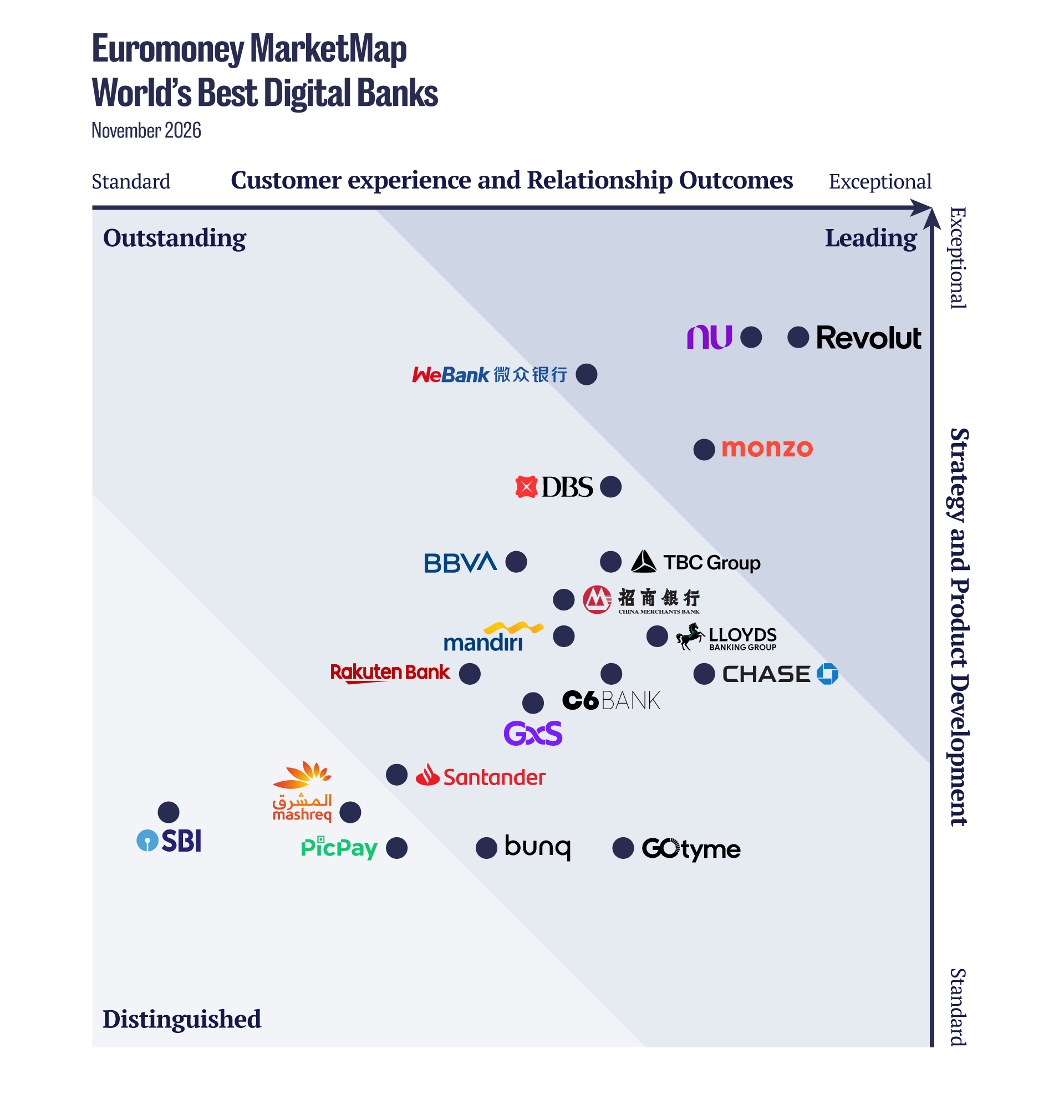
Leaders: Revolut, Nubank, Monzo and WeBank.
Outstanding: DBS, Mandiri, BBVA, TBC Group, C6, China Merchants Bank, Lloyds Banking Group, bunq, Santander, Chase, Rakuten Bank, GXS Group and GoTyme.
Distinguished: Mashreq, PicPay and State Bank of India.
Revolut
Revolut’s retail customer base grew from 52.5 million to 68.3 million in 2025, while revenue rose 46% and deposits reached $67.5 billion, in a fifth consecutive year of net profit. Its year was defined by licences: a UK bank, local branches across the EU with local payment rails from Bizum to BLIK, and a bank in Mexico built from scratch. It also continues to set the pace on product design against fraud, with in-app calls that impersonators cannot fake and warnings when the app detects an active phone call. Its generative AI chatbot resolved more than three-quarters of support interactions by the end of the year, even if its lending book – $2.9 billion against $67.5 billion of customer balances – remains small for a bank of its scale.
Nubank
Nubank added almost 17 million customers in 2025 to reach 131 million, with revenue up 45% to $16.3 billion, net income of $2.9 billion and an efficiency ratio of 19.9% in the fourth quarter. Its pace of launches remains extraordinary: tap-to-pay and automatic Pix, a fully digital private payroll loan open to 47 million formal workers, and daily rewards on USDC balances. Between 25% and 30% of all Pix transactions in Brazil now pass through it. Its Recomeço campaign helped more than 6 million customers renegotiate debts. Tens of millions of customers have received their first credit card from Nubank. In Mexico, where it now has 14 million customers, nearly four in 10 had previously been rejected by other lenders, according to the bank.
Monzo
Monzo has built one of the most loyal customer bases in banking. Almost 80% of new customers in the year to March 2026 arrived by word of mouth, it reports a net promoter score far above the peer average and it tops the UK competition regulator’s service rankings for both personal and business accounts. Undo payments, which lets customers reverse a payment within seconds, reversed more than £323 million in under a year, and the acquisition of the broker Habito brings mortgages into the app. With an EU licence held in Ireland and a launch in Spain under way, its ambitions are now international.
WeBank
WeBank delivers financial inclusion at a scale and cost no other bank matches: more than 440 million individual customers, IT running costs of RMB1.9 ($0.28) per account and AI agents handling about 98% of service interactions. It has lent to millions of micro, small and medium-sized businesses, and more than 70% of its personal loans cost borrowers less than RMB100 in total interest. Its systems are available more than 99.999% of the time, though it earns a relatively low revenue per customer
DBS
DBS remains a benchmark for a digital incumbent. In 2025, it extended its generative AI digibot to more than 5 million customers in Singapore, using one model to check another’s answers, and it puts the annual economic value of its AI and data work at around S$1 billion. Its anti-scam suite – digiVault, mobile-wallet controls and Customer Call Verification – is one of the most complete in this report.
Mandiri
Mandiri shows how a highly scaled incumbent can become a digital platform. Its Livin’ app has 37.2 million registered users, and more than nine in 10 new customers open accounts digitally. It has brought developers, car dealers and Indonesia’s high-speed railway into the app.
BBVA
BBVA combines global scale with credible AI execution. It has 62.6 million mobile customers, and 79% of its unit sales and two thirds of its new customers came through digital channels in 2025. Its new shared app is up to six times faster, its Blue assistant resolves calls in Mexico in under a minute and its branchless model has expanded from Italy to Germany.
TBC Group
TBC runs two different digital franchises well. In Georgia, 95% of consumer loans and 85% of deposits are sold digitally, and onboarding takes less than a minute. In Uzbekistan, its digital bank built on the Payme app has 6 million monthly active users and grew loans 51% in 2025.
C6
C6 is a frontrunner on customer-facing AI. A single assistant handles service, transactions, sales and personal finance – turning a WhatsApp screenshot into a Pix transfer. More than 100 products sit in one app, including US-dollar and euro accounts.
China Merchants Bank
China Merchants Bank remains a leading retail digital bank in China, with 129 million monthly active users across its two apps. It has written a minimum level of fintech investment into its articles of association and spends RMB12.9 billion on IT. Much of its AI work is staff-facing, though.
Lloyds Banking Group
Lloyds is the UK’s largest digital bank, with 23.6 million digitally active customers, and its net income rose 7% to £18.3 billion in 2025. Its agentic AI assistant, acquisitions of the Curve and Schroders Personal Wealth, and its new Thought Machine core put it among Europe’s most ambitious incumbents.
bunq
bunq has built Europe’s second-largest neobank around internationally mobile customers, even if it is some way behind Revolut in terms of scale and profitability. Its Finn assistant resolves around 80% of enquiries without human help and support runs in 38 languages. It also won the right to use AI in anti-money-laundering (AML) screening in the Netherlands, though its financial health and ecosystem offer is thinner than its peers’.
Santander
Santander shows how a global platform can modernise across different markets. In Brazil, for example, around 98% of transactions are digital and it has led on Pix innovation, letting customers pay by Pix on a credit card in up to 12 instalments. In Spain, it has moved onto Gravity, its cloud-based core banking platform, and its Santander Key signing system protects customers against fraud using stolen credentials. Despite some inconsistency between country performance up to now, its transformation programme makes its digital capabilities increasingly global.
Chase
Chase pairs the largest branch expansion in the US with a strong digital franchise. It serves 86.6 million consumers, earned $76 billion of retail revenue in 2025 and reports record satisfaction in both branches and digital channels. Overdraft Assist and Secure Banking support customers’ financial health.
Rakuten Bank
Rakuten Bank is Japan’s largest digital bank by accounts and deposits, with more than 18 million accounts and deposits above ¥13 trillion by early 2026. Integration with the Rakuten Group ecosystem has lifted its primary accounts to about 5.9 million, a third of the total, and it has added securities-backed loans and a fully online reverse mortgage.
GXS Group
GXS, backed by Grab and Singtel, is one of Asia’s fastest-growing digital banks despite its young age. It more than tripled its Singapore loan book in 2025, reaching customers with thin credit files at loss rates it says are below typical levels for personal lending.
GoTyme
GoTyme has become South Africa’s first digital-first bank at scale, with more than 12 million customers in under seven years and a profit in under five. In South Africa, kiosks in Boxer and TFG stores open accounts in under five minutes, and since March 2026 mall-based customer hubs have replaced its kiosks in Pick n Pay stores. In the Philippines, where it launched in 2022 as a joint venture with the Gokongwei Group, GoTyme Bank has around 11.5 million customers, is adding 450,000 to 500,000 a month and is targeting profit in 2027.
Mashreq
Mashreq has taken its digital model from the UAE into a branchless proposition in Egypt and a new cloud-native digital bank in Pakistan, where it opens accounts in under five minutes. It is rolling out digital mortgage capabilities and is moving customers from SMS one-time passwords to device-bound biometrics.
PicPay
PicPay has grown from a payments wallet into a full digital bank with real momentum, reaching 67 million accounts and 42.7 million quarterly active clients by the end of 2025. Its credit book more than doubled (+128%) to BRL24.1 billion ($4.16 billion), with secured products accounting for 69% of its growth in the fourth quarter, and active insurance policies rose 76% to 9 million. AI is now built into service. It reports that while all customer service chat interactions start with AI, gen AI has helped it lift its resolution rate by 20%, and more than 10 million people use its WhatsApp payments assistant.
State Bank of India
State Bank of India is rebuilding its digital franchise at a scale few banks could attempt, with around 530 million customers and roughly registered 100 million users of its YONO app. The new YONO unifies mobile and internet banking on one cloud-native platform in 12 Indian languages, and the bank is extending digital access to more than 150 million basic accounts.
Paths to success: Licences, scale and the race for primacy
Almost every bank in this report can open an account in minutes, and many have added millions of customers. What matters today is what banks do next: winning the customer’s salary and primary relationship, turning that relationship into profit and, for banks with international ambitions, securing the licences that let them hold deposits and lend in new markets.
Global ambition, local licences
The leading neobanks are becoming multi-licence banks. Revolut now operates in 40 markets and is a licensed bank in 30 of them, with an ambition to reach 100. Once the restrictions on its UK licence were lifted, it launched its UK bank, and in January 2026 it opened a fully licensed bank in Mexico – obtained from scratch rather than by acquisition. It has also applied for a US banking charter; it already serves more than a million customers there through a partner bank.
Launching the UK bank was a watershed moment for Revolut but also for the group. It unlocks the next stage of global growth
Francesca Carlesi, chief executive, Revolut Bank UK
Nubank is following a similar path from a different starting point. It has 14 million customers in Mexico – 15% of the adult population – and it has secured a banking licence there, with plans to invest $4.2 billion in the country by 2030. Its Colombian business grew 70% to 4.2 million customers, and it won preliminary approval for a US national bank charter.
bunq, now Europe’s second-largest neobank, has grown by focusing on internationally mobile customers and lifted deposits to €8.4 billion in 2025. Monzo, licensed in the EU through Ireland, has launched there and entered Spain as its next market, with local teams and local payment rails rather than a one-size-fits-all launch.
Incumbents go digital abroad
Some of the most instructive expansion comes from incumbents exporting digital-only banks to markets where they have no branches. BBVA’s Italian bank, launched in 2021, has more than 800,000 customers and offers mortgages, consumer loans and insurance. Its German bank was built and launched in under a year, in June 2025, and within six months accounted for almost 40% of the €12.2 billion of deposits held by the two units.
Chase has taken a similar approach from a US base. Its UK bank has reached 2.8 million customers and £26.7 billion of deposits and recorded £501 million in revenue in 2025. It has added a credit card, packaged insurance and an investment platform based on Nutmeg, and launched in Germany on a single platform designed to serve several markets. Its executives are clear that a foreign digital bank must present itself as local, particularly in a market where loyalty to the home bank runs deep.
The model is travelling between emerging markets, too. Mashreq, from the UAE, opened a cloud-native bank in Pakistan that signed up more than 100,000 customers in about three months, alongside a branchless business in Egypt. Georgia’s TBC bought the Uzbek payments app Payme in 2019, launched a digital bank the following year and now counts 23 million registered users and 6 million monthly active users in Uzbekistan, with loans up 51% to $946 million in 2025.
Challengers old and new
Where a first generation of neobanks has already become dominant, challengers old and new are still finding room to grow. In Brazil, Inter – a much older bank than Nubank that has reinvented itself as a digital player – grew its customer base faster in percentage terms in 2025 than any other bank, with more than 20 million clients. C6, another neobank, competes on breadth, with more than 100 products in a single app.
Elsewhere, newer digital banks are building scale quickly. In Asia, Maya reached 10.7 million bank customers in the Philippines and the group reached its first full year of profit, and Trust Bank reached 1 million customers – one in five Singaporean adults – within three years of launch. In South Africa, GoTyme has more than 12 million customers, adds around 150,000 a month and became profitable in under five years.
From growth to primacy
The average Brazilian holds around six bank accounts, Inter notes, so the real contest is for primacy rather than account opening. The best banks track it closely. The number of customers using Revolut as their primary bank rose 45% in 2025. Rakuten Bank’s primary accounts have grown to about 5.9 million, and it says they are markedly more profitable and hold larger deposits than other accounts.
Primacy brings in the revenue, but the economics also depend on keeping the cost low of winning and serving customers. Nubank’s cost to serve is $0.80 per active customer a month, and Monzo spends little on marketing because most of its customers arrive by recommendation.
How incumbents keep up
The best incumbents are using scale and modern platforms to match neobank speed. Santander moved Spain onto Gravity, its cloud-based core banking platform, in 2025, part of a shift to shared global platforms that the group says had saved almost €550 million by mid-2025. In Spain, it posted record profit of €4.3 billion in 2025.
Lloyds Banking Group now opens 85% of personal current accounts through its app, and its number of mobile app users has risen by about 45% since 2021.
Others are earlier in the journey. Bradesco moved its mass-market customers to a fully digital service at the end of 2024, closing branches as it did so. State Bank of India is rebuilding its YONO app on a single cloud-native platform shared with its branches – one of the largest transformations in its history – for around 100 million registered app users.
In the US, branches remain part of the answer. Chase serves 86.6 million consumers and plans to open more than 160 branches in 2026, adding to a network of more than 5,000, even as its digitally engaged customers rose 5% to 75 million in 2025. For the largest US banks, digital leadership means excelling in the app without abandoning the high street.
Ecosystems and open banking: From digital high street to daily utility
Last year, this report described the best digital banks as part of a digital high street rather than digital islands visited only for basic transactions. This applies more than ever. Increasingly, the leaders are no longer content to point customers towards the shops on that street. Instead, they own the till: selling mobile plans, flights and train tickets inside the app, and using rewards and national payment rails to make the app the place where everyday spending starts.
Selling beyond banking
Telecoms has become an unexpected battleground. Revolut began selling mobile plans in the UK and Poland in 2025, and Nubank sells mobile plans through NuCel. The logic is the same in each case: a service used every day keeps the bank’s app on the home screen.
Travel is the other prize. Chase booked $13 billion of leisure travel in 2025, making it the third-largest consumer leisure travel provider in the US. Lloyds became the first UK high street bank to offer flight and hotel booking in its app, through Hopper.
The most ambitious ecosystems build on assets that rivals cannot easily copy. Mandiri has used its wholesale relationships to bring developers, car dealers and transport operators into its Livin’ app, where customers can buy tickets for Indonesia’s Whoosh high-speed railway. Lloyds is building Home and Transport hubs in its app, from bringing in mortgages held elsewhere to car leasing through its Lex Autolease business.
In Asia, close ties with consumer groups remain the most powerful route. Rakuten Bank draws on more than 70 Rakuten Group services, rewarding customers with extra points and higher interest rates when they use more of them. Four in five GXS customers are Grab users, and its credit models draw on Grab transaction and Singtel utility data.
We are giving our customers a level of convenience that other banks may not be able to give
Pei-Si Lai, group chief executive, GXS Bank
Rewards as the glue
Rewards programmes have moved from marketing tools to the glue of the relationship. Bank of America’s rewards programme retains 99% of its members, and Revolut has taken RevPoints, its debit-card loyalty programme, from Europe to Australia, with points redeemable across 45 airlines.
Some banks are rethinking rewards altogether. Lloyds pays them in pounds rather than points, and DBS launched its first programmable rewards on a permissioned blockchain in July 2025, letting customers spend points at 40,000 small merchants, including hawker stalls.
Payment rails as the engine
National instant-payment systems have become the engine of daily engagement. In Brazil, between 25% and 30% of all Pix transactions pass through Nubank, which added tap-to-pay and automatic Pix in 2025. Santander Brasil now lets customers pay by Pix on a credit card in up to 12 instalments. In Europe, Revolut has integrated local rails from Bizum in Spain to BLIK in Poland.
In Asia, the same pattern holds through QR payments. Mandiri’s app users can pay by QR at home through Indonesia’s QRIS standard and abroad in Thailand, Malaysia and Singapore.
Open finance and banking-as-a-service
Open banking is increasingly a tool for winning primacy rather than a regulatory chore. Santander Brasil’s Bring Money feature, launched in June 2025, lets customers pull funds from other banks into its app and schedule recurring transfers. Monzo is fostering engagement with an open-banking mortgage tracker. C6 is combining Brazil’s open-finance rails with AI to give customers a single view of their accounts at other banks.
The traffic also runs the other way. Rakuten Bank provides banking infrastructure to the rail group JR East and the insurer Daiichi Life. Starling’s Engine platform powered the 2024 launch of Salt Bank in Romania and the 2025 launch of AMP Bank GO in Australia, and Mashreq’s software sits inside the app of the telecoms group e& in Egypt.
Ecosystem breadth is not the same as revenue, though. Few banks could say how much income their partnerships generate, and bunq deliberately prefers a single subscription bundle to a marketplace of partner offers. The best ecosystems are those that customers use daily, not those with the longest list of partners.
Customer experience in the agentic age
Customer service is moving from banks answering questions to AI completing tasks. Revolut’s generative AI chatbot resolved around 75% of support interactions by the end of 2025. WeBank says AI agents now handle about 98% of its service interactions. At C6, a customer can screenshot a payment request in WhatsApp and the bank’s assistant turns it into a Pix transfer, ready to confirm in the app. What distinguishes the leaders is less the models they use than the guardrails they put around them.
We’re never satisfied with the product. We’re always asking: could it be a better user experience? Could there be less friction?
Gustavo Torres, chief innovation officer, C6
Onboarding excellence: Speed is now the baseline
Fast digital account opening has become the global standard. TBC shows how far it can go: it cut onboarding in Georgia from 25 steps and up to 40 minutes to seven steps and an average of less than a minute, using a selfie, a liveness check and the national identity database.
The best banks now compete on what happens around that speed. Mashreq’s Pakistani bank onboards customers in under five minutes, with more than 85% processed without manual intervention. GoTyme opens accounts and prints a personalised card in under five minutes at kiosks in South African retailers and its new mall-based customer hubs, checking biometrics against Home Affairs records in real time. bunq has added deepfake detection to its onboarding checks.
Customer support: From chatbots to resolution
AI-driven service has moved from novelty to norm, and the best banks now measure it by resolution rather than volume. bunq’s assistant Finn answers enquiries in an average of 47 seconds and resolves around 80% without human help, with 90% satisfaction; its real-time speech-to-speech translation supports customers in 38 languages. BBVA replaced its traditional phone menus in Mexico with its Blue assistant, which understands more than 90% of requests from the start of a call and resolves them in under a minute across 63 million calls a year.
DBS shows how to scale safely. It rolled out its generative AI digibot in stages to more than 5 million customers in Singapore, and uses one large language model to check another’s answers. Mashreq took a similarly cautious path, testing its AI chatbot internally for 18 months before rolling it out to customers in phases.
From assistant to agent
The next step is AI that acts. Lloyds Banking Group launched what it calls the UK’s first multi-feature agentic in-app AI assistant, offering tailored insights on spending, budgeting, savings and investments, with full rollout in 2026. It is also building an internal platform for creating AI agents.
C6 has taken a single-assistant approach. Since December 2024, its assistant has handled service, transactions, sales and retention in one place rather than through multiple agents. Transfers it prepares are confirmed in the app, with a passcode or liveness check depending on the amount. The platform is model-agnostic, so C6 can swap between AI providers as they improve.
In China, the approach is more cautious but no less ambitious. By early 2026, WeBank had more than 60 ‘digital employees’ – agents running on large language models – across every function. In China Merchants Bank’s app, customers can say “transfer 100 yuan to my friend” and the app prepares the transfer for them to confirm.
Keeping a human within reach
The rise of AI is making human access a differentiator. Enpara guarantees that customers reach a human adviser within 30 seconds, with no phone menus, and reports a net promoter score of 77. Chase UK has made easy access to real people a feature of its proposition, and Revolut launched in-app calls so that customers can speak to an agent securely.
Security: Five steps revisited
Last year, this report set out five ingredients of banks’ defences against fraud. All five still apply, and the frontier has moved even closer to the moment a customer decides to pay.
1. Put security in the hands of your customers. DBS’s digiVault lets customers lock funds in the app so that they can be released only at an ATM or branch, and more than 1.5 million customers use its self-managed security tools. Its cardholders can lock cards and set limits in real time, and mobile wallets are switched off by default, with a 10-minute window to activate them.
2. Take authentication to the next stage. C6 requires a face check to transact, so a stolen phone cannot send money even if the passcode is known, and Santander’s Santander Key signing system protects customers in Spain against fraud using stolen credentials. Revolut’s Street Mode delays transfers above a chosen limit away from trusted locations – an idea Nubank introduced in Brazil and has now taken to Colombia.
3. Use data and AI to prevent criminals from winning. bunq challenged the Dutch central bank and won the right to use AI and machine learning in AML screening. Chase uses AI to flag unusual transactions and blocks Zelle payments linked to contact on social media.
4. Build multiple walls to ensure cyber resilience. WeBank, which uses AI to monitor its infrastructure, reports availability above 99.999%. China Merchants Bank, which has completed its migration to the cloud, reports a similar level of cloud availability.
5. Stop the scam before the money moves. Monzo’s Undo payments feature reversed more than £323 million of payments in under a year. Starling’s Scam Intelligence analyses photos of marketplace listings for signs of fraud before a customer pays. DBS’s Customer Call Verification sends a push notification to prove that a call really comes from the bank, and Revolut displays a warning when the app detects an active phone call.
Culture still underpins all five. DBS embeds staff in the Singapore Police Force’s Anti-Scam Centre, and Mashreq places fraud prevention within a customer-experience function that reports to its chief executive. Security, in the best banks, is designed into the customer journey rather than bolted on afterwards.
Financial health and inclusion: From access to wealth
Digital banking’s promise of inclusion is being kept at a scale few would have predicted a decade ago. Lower fixed costs let digital banks serve customers whose branch-based models could not serve profitably, and data from everyday transactions lets them lend to people with no credit history. The leading banks are now taking the next step: turning access into savings, and savings into wealth.
How digital banks reach the overlooked
No bank illustrates the economics better than WeBank. It serves more than 440 million individuals and has lent to millions of micro, small and medium-sized businesses, at an IT running cost of RMB1.9 ($0.28) per account. More than 70% of its personal loans cost borrowers less than RMB100 in total interest.
Over the past decade, WeBank has used technology to reshape financial services. More than 60% of WeBank’s employees are IT and AI experts, or data engineers
Lipeng Wang, chief financial officer, WeBank
In Latin America, tens of millions have received their first credit card from Nubank. In Mexico, nearly four in 10 of its customers had previously been rejected by other lenders. Its Recomeço campaign offered discounts of up to 99.9% on overdue debts; more than 6 million customers renegotiated, and three quarters of previously defaulted customers had normalised their finances within 12 months.
Asia’s newer digital banks are using alternative data to similar effect. More than half of Maya’s 2.1 million borrowers in the Philippines were first-time formal borrowers, in a country where only 15% of adults owned a credit card in 2023.
Others are lowering the barriers to entry. In South Africa, GoTyme charges no monthly fees and offers free instant payments. Mandiri charges no subscription fee for its Livin’ Merchant app, and 62% of its users are small businesses outside cities. State Bank of India is extending digital access to more than 150 million basic Jan Dhan accounts.
The innovations boosting financial health
Incumbents remain at the forefront of tools that help customers manage money better. Lloyds Banking Group’s credit score tool is used by 12 million people, and its benefits calculator has identified tens of millions of pounds in potential support. BBVA has launched an AI financial coach that diagnoses savings capacity and debt health.
In the US, the focus is on avoiding the fees that hit customers hardest. Chase’s Overdraft Assist waives fees for customers overdrawn by $50 or less at the end of the day, and its low-cost Secure Banking account charges no overdraft fees. Bank of America’s Balance Assist offers a $500 loan for up to three months for a flat $5 fee as an alternative to payday lending.
Even though Chase is an established market leader, we have an underdog mentality. Nobody here takes our position for granted
Chris Stang, chief product officer, digital, Chase
Neobanks are adding their own twist. Monzo’s Flex Build secured credit card helps customers with thin credit files build a history, and its communications are written so a broad range of society will understand them. Revolut rewards customers with RevPoints for completing money-health challenges, such as sticking to a budget.
From better habits to greater wealth
Digital banks are democratising investment products that were once the preserve of private banks. In Mexico, where only 4.4% of people invest, Ualá now offers fractional US shares from MXN 20.
Incumbents are combining digital access with advice. At DBS, customers who use its digital financial planner save twice as much, invest five times more and are nearly three times more insured than those who do not. Lloyds has bought Schroders Personal Wealth to combine advice with its digital offer.
Starting young
More banks are building relationships from childhood, teaching good money habits early through financial education – the foundation of financial health in adult life. Nubank launched a credit card for 16 and 17-year-olds whose limit is set by what they have saved, and DBS’s POSB Smart Buddy watch lets children pay for things in 335 Singapore schools, with unspent allowance swept into savings.
Access for all
Improving an app is of little use if customers cannot use it. Santander became the first IBEX-listed company to obtain AENOR’s 360º accessibility certification. DBS offers a SilverSmart mode with larger fonts and icons for older customers and a Simple Mode used by migrant workers.
The evidence on outcomes remains uneven, though. Few banks could show how their financial health tools changed customers’ savings or debt, and financial health and inclusion were among the weakest areas for several otherwise strong digital banks. The best banks measure what their tools achieve, not just how many people use them.
Looking ahead: Agents, tokens and the next fight for primacy
Last year, this report closed by pointing to generative AI and stablecoins as the next likely source of disruption. Both have since moved from the horizon onto banks’ roadmaps and, in places, into customers’ hands. The question now is which banks are best positioned to benefit.
Digital assets in the retail app
Stablecoins have reached retail customers fastest in Latin America. Nubank extended a 4% annual reward on USDC balances to all users of Nubank Cripto in Brazil, and more than half of its new crypto users chose USDC as their first digital asset. In Europe, Revolut’s licence under the EU’s Markets in Crypto-Assets regulation lets it offer crypto services across 30 markets to more than 14 million crypto users, and BBVA launched bitcoin and ether trading and custody in its Spanish app.
Tokenisation is advancing in parallel, mostly behind the scenes. DBS has processed about S$10 billion of tokenised payments over two years and used a permissioned blockchain to power its programmable rewards. Lloyds Banking Group issued tokenised deposits with Archax, which it describes as a UK first on a public blockchain, and is taking part in the Great British Tokenised Deposits pilot.
Governing the agents
The industry has been rightly cautious about letting AI act for customers without close human oversight, and the best banks are turning that caution into a capability. DBS governs its AI under a set of principles – purposeful, unsurprising, respectful and explainable – and has created new roles, from generative AI evaluators to AI agent monitoring managers who review chat logs. C6 has built governance into the platform its teams use to create agents.
These controls will matter more as agents gain the power to act. DBS, which made its corporate assistant agentic in Singapore in July 2026, was also planning to extend agentic AI to retail customers, starting with tasks such as checking card usage and blocking or replacing cards, while Lloyds was also rolling out its agentic assistant.
What to watch
The coming year will test several of the strategies in this report. Revolut and Nubank are pursuing US bank charters, Revolut is setting up a bank in Colombia and seeking a licence in Peru, and Mashreq is pursuing a banking licence in Saudi Arabia.
If banking is increasingly done by agents in the background, banking products risk becoming even more commoditised. The banks best placed are those that customers already trust as their primary bank, whose services are plugged into the ecosystems where customers spend their time, and whose controls let AI act safely. For many retail customers today, the app is still the bank; the next contest will be decided when it is the customer’s agent, rather than the customer, that opens it.
Lessons for banks: Seven imperatives
The best digital banks of 2026 differ in size, ownership and geography, but their success rests on a common set of choices. Banks of every kind can learn from them.
1. Treat licences as product infrastructure. A licence is what turns an app user into a depositor and a borrower. Revolut’s Mexican bank and Enpara’s spin-off from QNB Türkiye show that the effort of securing full licences pays off in deposits, lending and trust, even for digital-only banks.
2. Export what works at home. BBVA and Chase have taken digital-only models built for one market into Germany, reusing platforms rather than starting again.
3. Measure AI in money, not pilots. DBS puts the economic value of its AI and data initiatives at around S$1 billion, and Lloyds Banking Group delivered around £50 million from about 50 generative AI use cases in 2025. Banks that cannot quantify the return on AI will struggle to justify scaling it.
4. Keep a human within reach. Automation works best when customers know they can reach a person. Enpara’s 30-second guarantee and DBS’s use of one model to check another’s answers show how to combine efficiency with trust.
5. Make primacy, not downloads, the key performance indicator. Rakuten Bank says its primary accounts are markedly more profitable than other accounts. Salary accounts, daily use and products per customer say far more about a digital bank’s health than the number of people who have opened an account.
6. Turn savers into investors. DBS and Ualá show that mass-market customers will invest when products are simple, cheap and close at hand. Digital investing deepens relationships and diversifies revenue at a time when interest rates are falling in many markets.
7. Build security into the moment of payment. Monzo’s Undo payments, Nubank’s and Revolut’s Street Mode and DBS’s Customer Call Verification all intervene before money leaves the account. In an age of social engineering and stolen phones, the best fraud defence is one the customer sees at the point of decision.