
Whether it’s in New York or São Paulo, banks in the Americas have produced an extraordinary range of digital banking innovation over the past year. Sales, customer service and security are all changing rapidly. The best banks are also integrating new third-party and non-banking services into their platforms, offering richer insights on customers’ financial wellbeing and doing more to open access to banking services.
The analysts


As elsewhere in the world, digital banking excellence in the Americas is grounded in the specificities of the national economy, regulation and consumer culture. The most effective banks are those that build digital business models and innovate in response to local customer demands – and not just with a view to rolling out the latest technological development.
The level of wealth differs greatly between countries in the Americas, and that partly informs the economics of serving customers on lower incomes. A related concern is the feasibility of branch networks, which remain crucial for retail customer relationships in the US and Canada, notably at the acquisition stage. Levels of account ownership and formal credit penetration also differ greatly, even though this has risen dramatically in Latin America over the past decade. The US and Canada continue to enjoy account ownership rates of almost 100%, while Brazil has much higher account ownership and credit penetration than Mexico, Colombia or Peru, for example.
Across the Americas, consumer credit is important for relationship acquisition and the economics of retail banking generally. Caps on credit card interchange fees are less stringent than in Europe. Nevertheless, state policy and national financial infrastructure are still determining factors for what banks can do – both in terms of local instant payments rails such as Pix and Zelle, and on the credit side. Usury laws limit credit-led neobank growth in Colombia, for example. In Brazil, the social security system and state banks have recently played important roles in payroll lending and consumer debt renegotiation, requiring banks to effectively adapt their technology.
What this report shows
In this report, Euromoney focuses on 20 banks leading the digital transformation of retail banking in the Americas. To do this, we separate the report into sections that reflect our digital banking benchmarking criteria. We identify the best digital banking business models, as well as best practices and innovation in onboarding, customer service and the fight against fraud. We explore what banks are doing to integrate third-party services and services beyond banking, and how they are using digital means to promote financial health and financial inclusion.
Given the extent to which local factors have slowed the growth of branch-free banks in the US and Canada, there is a natural weighting towards Latin America, and especially Brazil, due to the growth of neobanks there.
Throughout the Americas, incumbents are responding to the opportunity to deepen customer relationships via the app: via financial and non-financial products, and increasingly through the use of generative and agentic AI to improve services and help customers manage their money. This report identifies the best of what those incumbents are doing, as well as the best of the neobank world. We also include the Americas operations of BBVA and Santander.
The MarketMap methodology
This report is based on Euromoney’s assessment of retail banks worldwide as part of its annual research cycle. It combines written submissions from institutions with qualitative insights from interviews with senior executives – chief executives, chief financial officers, heads of retail and digital banking, and heads of strategy, technology and customer experience. The research covers digitally focused incumbents and their digital-only subsidiaries, as well as standalone digital challengers.
The best digital banks in the Americas MarketMap 2026 highlights 20 top-performing retail banks. Each is scored from zero to 10 on seven criteria, using evidence from submissions, interviews, results and usage data, with gaps in evidence counting against a bank. The criteria are grouped along two axes.
Strategy and product development. This axis covers the strategic execution of digital banking strategies, including growth and financial success; investment in digital products and distribution; and end-to-end digital onboarding and know-your-customer processes.
Customer experience and relationship outcomes. This axis covers digital customer service, including virtual assistants; reliability, security and anti-fraud measures; the integration of digital consumer ecosystems; and tools and strategies that promote financial health and inclusion.
Because of its general purpose nature, the adoption of AI – including generative and agentic AI – was considered within each criterion rather than separately.
Euromoney MarketMap: Best digital banks in the Americas
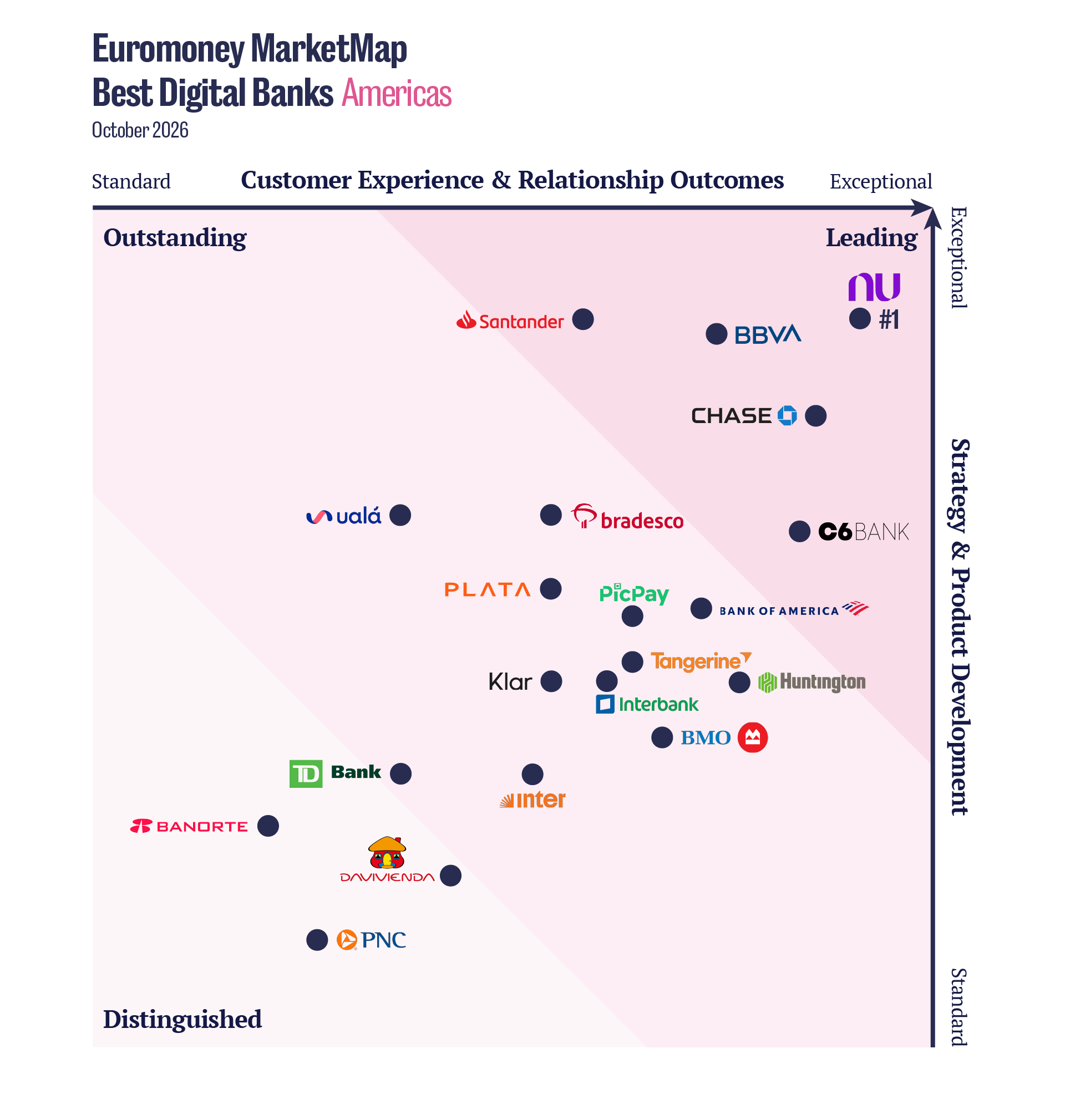
Nubank
Nubank pairs huge scale with profitable growth. Customers rose from 114 million to 131 million in 2025, FX-neutral revenue grew 45% to $16.3 billion and net income reached $2.9 billion, with a 4Q25 efficiency ratio of around 20%. It kept launching products, from Tap-to-Pay and automatic Pix (a large portion of Pix transfers flow through Nu) to the fully digital Worker’s Credit payroll loan and USDC rewards. Its inclusion record is just as strong: 28 million people got their first credit card and about 37 million people entered the formal financial system via Nubank.
BBVA
Digital is now the main way customers join BBVA. In Mexico, 81% of its 4.7 million new customers in 2025 were onboarded through digital channels. Its new app went live in Mexico, recording important speed increases, including biometric access. The gen AI-enabled assistant Blue has largely replaced the traditional phone menu, resolving calls in under a minute across 63 million calls a year. Mexico’s fully digital account for 12 to 17 year olds, Colombia’s interoperable instant-transfer keys and Argentina’s Dynamic Limits show innovation reaching across the region.
Chase
Chase combines vast US retail scale with service that keeps improving. It has 94 million customers, $76 billion of retail revenue, record-high customer advocacy for deposit and card customers, and record branch and digital satisfaction. It has 74.6 million active digital customers and 61.7 million active mobile customers (mobile up 7% year-on-year). It cut critical tech incidents by close to a third and Zelle fraud and scam claim rates by 26%. Customer-friendly products include Overdraft Assist (fees avoided on over three quarters of overdraft transactions) and Secure Banking.
C6
C6 is one of the most AI-forward banks in the field. It is built around a single C6 Assistant that handles service, Pix and bill payments, money management and sales. Since 2024, Assistant volumes have risen while AI processing costs have fallen. Features such as paying Pix from a WhatsApp screenshot and one of the first Pix connections to Google Wallet remove real friction for customers. Face-based liveness checks protect transfers even if a passcode is stolen, and the bank earned BRL2.5 billion ($502 million) in 2025 at a 45% return on average equity.
Santander
Santander has been through an important transformation with the aim of becoming a digital bank with branches and making retail banking a global business. Its One App began its roll out in Brazil, with input from tens of thousands of customers across multiple surveys. New features in Brazil include showing balances from other banks on a single home screen, and new Pix features allowing payments by credit card in up to 12 instalments and setting up the Automatic Pix scheme for recurring bills. The Prospera microfinance arm adds to Santander’s inclusion story.
Bradesco
Bradesco is running one of the boldest transformations in the region, changing technology, products, segments and culture all at once, with agile teams now live across the bank. Results are coming, including a rising number of fully digital clients and a gen AI assistant, BIA, that can handle a large portion of digital channel interactions without handing off. Customers can also receive approved credit through WhatsApp instantly. AI credit models have supported double-digit loan growth with stable defaults, and recurring net income rose 26.1% to BRL24.7 billion.
PicPay
PicPay has grown from a payments wallet into a full digital bank with real momentum, reaching 67 million accounts and 42.7 million quarterly active clients by the end of 2025. Alongside deposit inflows, its credit book more than doubled to BRL24.1 billion (+128%), with an significant portion of new lending secured, and active insurance policies rose 76% to nine million. PicPay integrated gen AI into its in-app service conversations as early as 2023, recording gains in customer satisfaction as well as efficiency. AI is now built into service: every chat starts with AI, resolution rates are up more than 20%, and over 10 million people use its WhatsApp payments assistant.
Bank of America
Bank of America brings formidable scale and a proven ‘high-tech, high-touch’ model. It has around 69 million clients, holds the number one position in US consumer deposits ($956.3 billion) and grew consumer net income 14% to $12.2 billion. Digital engagement is a real strength: Erica handled over 693 million interactions in 2025, 69% of consumer banking sales were digital by 4Q25. AI fraud models have helped cut the fraud loss rate by around 50% since 2018, and its rewards programme (11.4 million members, 99% retention) now has a baseline tier open to all deposit clients.
Plata
Plata is one of the world’s fastest-scaling challengers and much of that is thanks to referrals. Its flagship card offers up to 15% cashback in categories the customer picks and a 60-day interest-free period, with bill payments and investments in the same app. Logins happen in an instant, customers can activate debit cards with a QR code, an in-app chat sits on the home screen and AI chatbots handle service and collections. More than 800 in-house engineers run core banking and card processing platforms, CRM and risk models.
Tangerine
Tangerine’s client-led strategy took a major step in November 2025 with a 10-year agreement to move its over two million clients onto Engine by Starling’s cloud-native core. That sets the stage for faster launches around things like scenario planning in the future. Recent digital additions include a net-worth view that can bring in external assets such as homes and accounts held elsewhere, as well as tiered savings that reward clients for bringing more of their banking balances to Tangerine, rather than simply looking at each individual savings account.
BMO
BMO stands out as one of Canada’s fastest-growing big five retail banks in terms of organic chequing account acquisitions. The bank puts its net customer growth at around 1.8 times that of the market, alongside an improving retail efficiency ratio. AI is delivering real returns: the Next Best Offer engine generated around CAD85 million ($60.6 million) in annualised revenue by late 2025, and the steps involved in account opening were cut by more than 50%, allowing customers to complete the process in less than eight minutes. My Financial Progress, Credit Coach and the NewStart offer for newcomers give it a strong financial health and inclusion story.
Inter
Inter’s single app covers banking, Pix, savings, investments, credit, a marketplace and cross-border services. Total clients rose from 36.1 million to 43.1 million in 2025, including 4.4 million net new active clients. Products such as the in-app Global Account for US banking and investing, the goal-based Piggy Bank Gold savings and the InterShop marketplace give it unusual breadth for a digital bank. The growth was profitable, with revenues up 31% to BRL8.4 billion, net income up 45% to BRL1.3 billion and Pix market share above 8.5%. Stronger evidence on service and security would help it move up the matrix.
Klar
Klar is one of the most efficient challengers in the field, with a small number of employees and customer service cost at a fraction of what the incumbents spend. It moves quickly on product, with interest-free instalments at thousands of merchants across Mexico, flexible credit line features, a new affluent card and an important secured-card portfolio for customers earning under $500 a month. The $190 million raise in June 2025 and the agreed acquisition of Banco Bineo give it a clear route to a full banking licence.
Huntington
Huntington stands out for thoughtful, life-stage product design, led by Caregiver Banking. Trusted caregivers can monitor and help manage money with shared account visibility and spending controls that protect vulnerable customers, sitting alongside Teen Banking in a ‘My Circle’ hub inside the main app. The same focus on financial wellbeing runs through Fair Play features such as the $50 Safety Zone and Early Pay, while One-Tap origination lets existing customers open a savings or money market account in a median time of 22 seconds, further fuelling its relatively high rates of digital acquisitions.
Interbank
Interbank has one of the region’s most complete digital ecosystems and enjoys integration with the Intercorp group. At Interbank, a large majority of retail customers are now digital, and a large proportion of retail sales go through digital channels. Its integration of the Plin payments network keeps broadening, with Lima Metropolitano top-ups, WhatsApp payments and hundreds of online merchants. The Shopstar loyalty programme and the wider Intercorp network help to deepen engagement.
Ualá
Ualá has built one of Latin America’s fastest-growing digital banks. It has more than11 million customers across Argentina, Mexico and Colombia in under eight years, including nearly one in five Argentine adults, with banking licences in all three markets and a sophisticated approach to alternative credit analysis. In 2025, several of its products offered some of Argentina’s best savings and investment yields, it added term savings and wider cash access through OXXO and Kiosko stores in Mexico, and launched Uali, an AI support assistant built with OpenAI.
TD Bank
TD brings real scale to its digital offer: a record 8.8 million Canadian customers use its mobile app in a 90-day period, and it also stands out in terms of the number of Canadians that use it as their primary bank. In 2025 it posted record digital sales of everyday products, extended its Amazon co-branded card and added Uber One benefits, while its fraud upgrade was credited with a 26% fall in fraud losses. It has recently rolled out in-app payroll switching and youth digital account opening, making its onboarding capabilities stand out in a Canadian context.
PNC
PNC has been laying strong digital foundations. It rebuilt its mobile app and moved 11.5 million clients to a new online banking platform, while using AI agents in development to save build time. Digital is becoming its main growth driver, especially in terms of the share of new consumer accounts opened digitally. In-app direct-deposit switching, digital investing and the growing Total Rewards programme point to a deepening offer.
Banorte
Banorte earns its place among the top 20 digital banks through disciplined, data-led personalisation and improving customer satisfaction. Its personalised offers have improved its conversion rates and lifted Banorte’s customer lifetime value while cutting abandonment rates. Its ‘bank in minutes’ journeys cover mobile credit cards, payroll loans and much more. Adding convenience chain OXXO as a banking correspondent in December 2025 took its service network to tens of thousands of locations.
Davivienda
Davivienda’s SuperApp-led transformation has produced some strong conversion and service numbers. It has deployed its VIVI virtual assistant resolves to resolve queries without human assistance and invested in its digital mortgage capabilities. The bank’s acquisition of Scotiabank’s former banks in Colombia and Central America offer both the challenges of integration and opportunities in terms of scale. A new app upgrade focusing on topics such as personalisation are already in progress.
Winning digital strategies
Even for incumbents, growth in active digital users is a basic measure of success in retail banking, but it is not enough. As individuals increasingly hold multiple bank accounts and loans, banks need to show they are gaining multi-product relationships and ideally becoming the primary bank.
Mobile banking has powered growth in new digital-only banks in Brazil like nowhere else in the world. Nubank added 16.7 million customers in 2025 to reach 131 million at the end of last year, after becoming the first neobank outside China to reach 100 million in 2024. Others are also growing rapidly in Brazil. PicPay, for example, reached 67 million customers at the end of last year, exemplifying a wider trend of payments apps becoming banks. Both Nubank and PicPay grew retail deposits by around 46% last year, albeit from a lower base at PicPay.
Now, due to a confluence of factors, Mexico is becoming a battleground. Nubank reached 14.2 million customers there last year and launched this summer as a fully licensed bank in the country. Revolut also launched full banking operations in Mexico in early 2026. Local neobank Banco Plata, founded in 2022 by former insiders from what was Tinkoff Bank in Russia, has seen explosive growth in customers, albeit slightly lower in absolute terms in 2025 than Klar, another Mexican neobank. However, Plata has moved more quickly in becoming a fully licensed Mexican bank this year; Klar is acquiring the former in-house neobank of Banorte as its route to a full license. All this has made advanced digital capability in Mexico even more critical for the incumbents.
Our expertise in building financial digital infrastructure means anything we want to do is under our control; we don’t have to negotiate a supplier’s product roadmap
Neri Tollardo, CEO, Banco Plata
The costs of growth
The neobanks’ lower costs to serve are a vital part of their ability to offer better value and thereby grow rapidly, although in markets like Mexico competition between neobanks is hard to manage, notably on deposit rates. Turning new digital customer acquisitions into profitable relationships in a year or two is especially important for standalone neobanks such as Klar. At a group level, Nubank reduced its cost-to-income ratio to 20.7% last year while increasing return on equity to 30%.
Cost of risk is, of course, another vital metric for success at any bank. This is especially true in Brazil, given relatively deep credit penetration and typically high interest rates. However, Nubank and others have invested in less traditional credit analysis to try to grow digital credit origination without causing problems later. The acquisitions earlier this decade of AI companies Hyperplane by Nubank, and of Kunumi by Bradesco, are part of a similar strategy. Others, meanwhile, are focusing more on secured lending and wealthier customers – notably Brazil’s C6, even if it is not growing its customer base as rapidly as other neobanks.
Incumbent strategies
Front-end design, including smoother logins and personalised space, has been a factor in winning business at Santander – notably in Brazil, where the roll out of its new global One App preceded launches later in Mexico, Chile and Spain. Santander has also rolled out its in-house core banking cloud technology, Gravity, enabling post-mainframe migration. Starting with Chile, the bank integrated Gravity in Mexico in 2025, before moving onto Brazil in 2026. Particularly in Mexico, Santander’s rollout of Gravity and OneApp, including gen AI upgrades to its customer service, have led to above-market increases in profitability and a rising net promoter score.
At BBVA, similarly, product-level rethinking has involved more than 170 initiatives across Europe and Latin America to ask ‘what if’ it had to redesign each product from scratch based entirely on the customer’s view. This has sparked new customer-friendly features for savings, travel money, credit cards and shared spending accounts. Its new global app, rolled out first in Spain and Mexico, adapts to the most-used functions, such as easy access to most frequent contacts for instant payments.
Santander and BBVA show that even for incumbents, an outstanding digital proposition can be a means to grow and not just to retain relationships. Another example is Huntington Bank, which has marked up higher organic growth than peers largely thanks to consistently rolling out customer-friendly features, such as its Caregiver Banking and Teen Banking products. It sees the growth and cost efficiency that comes with an outstanding digital product as a virtuous loop, as it allows more investment back into those channels.
Digital rewards features are another vital ingredient of any bank’s ability to gain and retain customers, while fostering deeper relationships. The relaunch of arewards programme by Bank of America this year – extending the programme to all checking account customers, not just preferred – came with a redesigned tier-specific digital front-end, as well as new anti-fraud and credit score monitoring features. This year PNC also launched a tiered rewards programme which, like BofA Rewards, is structured around the entire relationship.
In Canada, another interesting example came with the launch of a new premium credit card by digital bank Tangerine, born out of what was ING Canada and which is now owned by Scotiabank. The new card included an app-based feature, called Benefinder, to help customers access card benefits and offers, such as whether they have car hire insurance as part of the card offer.
You shouldn’t have to choose between a bank that’s innovating quickly and a bank that you trust
Terri-Lee Weeks, president and CEO, Tangerine
For incumbent banks, focusing on affluent customers is one part of their response to the growing strength of the neobanks, especially in the lower-income space where cost is a bigger differentiator. At the same time, however, incumbents are seeking to ensure that the neobanks do not capture the next generation of customers by launching new propositions for children and young people. Mexico’s Banorte, for example, launched a new standalone app this year targeting younger customers to prevent too much of an association of its brand with older people.
Making first impressions count
Digital government identity programmes and increased smartphone usage have made rapid, remote onboarding increasingly common for banks in the Americas. Meanwhile, even incumbent banks are making digital cross-selling journeys smoother.
Fully digital onboarding has been slower to take hold in the US and Canada than in Europe. Nevertheless, banks with good digital capabilities are increasingly seeing digital onboarding become the norm, even in the US. The benefits include cost efficiency and a greater ability to penetrate deeper into US states where they have historically been less present.
Growth strategies in the US still revolve largely around new branch openings, because even national banks still have large gaps in their networks, due to historic limits on expanding inter-state. Banks with major branch expansion programmes see large rises in digital acquisitions within a few miles of a new branch, due to the increase in visibility associated with a branch, and particularly when digital marketing efforts concentrate on that new locality. Huntington Bank, for example – headquartered in Ohio – saw particularly high digital account acquisition in Texas, even before its acquisition of Texas-based Cadence Bank in 2025.
In Canada, TD Bank shows how banks can push forward from existing norms, with the announcement this year of Canada’s first in-app direct-deposit switching service, dramatically reducing the effort involved in switching – which is one of the most sought-after avenues for new customer acquisition in Canada. The new programme allows customers to switch payroll deposits in about a minute with most employers, thanks to a partnership with Atomic, a US embedded finance fintech.
TD has also focused on improving its digital mortgage capabilities, since the launch of a new digital acquisition engine, TD Mortgage Direct, in 2023 and after the launch of an earlier click-to-renew programme. This year, TD has focused on agentic AI capabilities in mortgages, cutting the time taken to prepare application summaries for underwriters from 15 hours to three minutes. The agents can classify client documents, extract information, calculate client income and validate figures against policy requirements, while performing consent checks and searching for discrepancies.
Mortgage origination is also a focus for RBC. RBC’s acquisition of Pinch Financial in 2026 was also designed to enhance its ability to verify borrower information digitally and streamline the qualification process, bringing a faster and more transparent experience to clients.
Getting up to speed
Increasingly, forcing customers to go to a branch to open accounts, even for teen accounts, is becoming a disadvantage and another factor pushing customers to neobanks and other firms that can offer remote account opening. The same is true for cross-selling journeys that might involve existing customers having to leave the app to complete applications for additional products.
Implementing rapid, fully remote onboarding and improving cross-selling journeys within the app has consequently been an important part of banks’ digital transformation in the past two years. This was notably the case at Bradesco,which hasimproved its ability to compete against the rampant growth of Brazilian neobanks. In Mexico, Banorte, has been through a similar journey: reducing digital account opening to five minutes and introducing real time credit card decisions on its app. Colombia’s Davivienda also offers onboarding on its app within five minutes, and is now redesigning its app with a view to being able to configure it according to the customer profile at the onboarding stage.
Local infrastructure – such as digital identity systems and costly private delivery services – and regulatory standards, naturally affect what is possible, although banks can also turn these factors to their advantage. Banco Plata, for example, is a fully digital bank, but it has deployed a network of what it calls ambassadors to visit new customers and deliver their cards in person at their home, boosting engagement and reducing fraud risks, in a model that Tinkoff previously deployed in Russia.
Next-gen customer experience
Across digital banking, generative and agentic AI has perhaps the greatest potential to change customer service. An era in which the AI becomes customers’ main interaction with the bank is already in sight. Customers should now be able to interact with virtual assistants on the app by voice, getting information that is personalised to them and increasingly having the assistant resolve the query without human intervention.
Even before the boom in generative AI, Bank of America had already moved decisively in this direction with its Erica assistant. Today, Erica still stands out for its scale, having logged more than 3.2 billion interactions between its launch in 2018 and early 2026. Wells Fargo has deployed a similar strategy with its Fargo assistant, launched in 2023. However, Fargo’s cumulative and implied annual interactions are much lower than Erica’s – the bank says Fargo had reached more than one billion client interactions by March 2026.
Bank of America still views Erica’s ability to seamlessly and quickly hand over to human agents as key to the bank’s reputation, however. It is not relying on AI alone. Erica can now schedule branch appointments, pass over to call centre staff in less than a minute, as well as consolidate information for client-facing staff.
The drive for hyper-personalisation has also driven much of the thinking behind a redesigned and relaunched app by BBVA, initially in Mexico, including an increasingly close global partnership with OpenAI. Its digital assistant, Blue, is at the centre of the redesigned app, capable of answering questions and balance checks but also of helping customers to prepare transfers. The assistant has helped BBVA improve the experience of calling the bank, including by recognising callers from within the app and avoiding the need to reauthenticate, as well as by better understanding requests to save customers from having to navigate a complex traditional menu.
The use of gen AI in customer service is especially advanced among neobanks, where cost efficiency is central to their competitive advantages, notably in Latin America – although the ability to switch between models is also important for their ability to manage costs in any part of the world, as the AI platform at C6 demonstrates. Customer service innovation around WhatsApp, integrating bank assistants, and the Pix peer-to-peer payment rails, has also moved ahead in Brazil, with C6 allowing customers to prepare transfers using a digital assistant, whether by writing, speaking, or by sending photos and screenshots of the payee’s details.
Meanwhile, the Chat Concierge tool at Capital One was one of the global industry’s first examples of a sophisticated proprietary agentic AI system being put into production. Chat Concierge was up and running on car-dealership websites in the US in early 2025. It allows customers on participating dealer websites to compare cars and look at financing options. It also gives them an estimated price for a trade-in vehicle and can schedule a test drive by plugging into the dealers’ customer relationship systems.
C6 Assistant is our vision of the future of our bank, and it’s already happening. Our vision is to have a fully AI-driven banking app
Gustavo Torres, chief innovation officer, C6
Fighting fraud through innovation
Robust security systems and effective anti-fraud features are another fundamental part of digital banking. The potential for direct financial losses is important, but more important still is the potential reputational impact of whether a bank is known for having good protections or not.
Above all, as technology and consumer financial habits change, security protections must change with it. The rise of the Zelle peer-to-peer payments system in the US is one example. Chase was able to point to a 26% annual reduction in Zelle fraud and scam claim rates last year, thanks to a concerted education, detection and prevention push. Technology itself is also part of the answer. Bank of America has seen a 50% reduction in its fraud-loss rate after developing more than 50 fraud detection AI models since 2018.
Mobile banking has put a bank in every consumer’s hand – a problem that is especially large where personal security is weaker. As a result, Latin America – and above all Brazil – provides some of the most innovative examples of strategies to fight fraud anywhere. An example is the limits that apply, for example on Pix transfers, when the user is away from a trusted Wi-Fi network – notably pioneered by Nubank but now adopted by others, including some neobanks in the UK, where phone snatching is a problem. Last year Nubank introduced a similar feature to Colombia and launched a bundled insurance product in Brazil for Pix transfers.
Also in Brazil, C6 has built similar security protections based on the potential for a phone to end up in the wrong person’s hands, particularly because of physical crime outside the customer’s home. Its app limits transactions, as well as the extent to which investments are viewable, based on geolocation tracking: applying when the customer is away from trusted addresses. Behavioural data can also trigger restrictions and it requires a biometric login to process transactions.
Peru’s Interbank has added some innovation of its own to this approach by allowing customers to camouflage the bank’s app. Customers can also limit the accounts the app displays and the amount available for transactions periods of between two and 48 hours, and removing those limits early requires a facial biometric login.
Banks are also introducing new features to prevent customers inadvertently transferring money to thieves because of scams, such as calls from fake bank employees. This includes a feature in the Brazilian business of Santander, for example, which can alert customers and then potentially block payments, when the customer opens the bank’s app during a phone or WhatsApp call.
Ecosystems and beyond banking
The ability to offer services beyond traditional banking products and to seamlessly weave the bank’s environment into that of other digital businesses – both financial and non-financial – are increasingly important differentiating factors for digital banks today.
Benefits from partner businesses have long been a vital part of credit card offers. And these offers are increasingly important for current account acquisition in the digital era. Last year BMO, for example, started to offer a 12-months free subscription to Walmart Canada’s Delivery Pass programme for new customers.
Some banks are taking this approach much further in terms of their range of third-party and non-financial products, and in terms of the degree to which those products are integrated into the bank’s digital experience. This includes owning loyalty programmes that are not only open to customers of the bank. A notable recent example is BMO’s acquisition of LoyaltyOne’s Air Miles, one of Canada’s biggest coalition points programmes, which transitioned this year to Blue Rewards and is available both as a standalone rewards app and in BMO’s app. In addition to gaining traction in the US in part thanks to a new rewards partnership with Verizon, Santander has also recently opened its loyalty programme in Brazil, Esfera, to non-clients via a separate app.
Another Canadian bank, RBC has continued to build out its rewards platform, including a strategic alliance with retailer Canadian Tire. RBC also agreed a partnership with Hopper Technology Solutions to launch a travel platform that combines its point Avion programme with an AI-driven booking engine to provide predictive pricing insights and flexible travel options.
When basic banking is not enough
In the US, Chase is perhaps the most notable example of a bank that has turned its app into a portal for a much wider range of services. This partly originates from its status as one of the biggest credit card issuers in the US, but it is also because of its importance in mortgages and auto finance. Today, the Chase app is a gateway for everything from basic banking to payments, lending, travel, rewards and investments.
Since the pandemic, Chase Travel has grown into one of the biggest consumer leisure travel providers in the US. Millions of customers booked $13 billion-worth of travel on the platform last year. Its hotel collection, The Edit, has grown to more than 1,000 hotels. Chase also introduced a new feature in 2025 called Points Boost – raising the value of its Sapphire credit card points spent on Chase Travel. It also developed an exclusive dining reservations partnership with OpenTable, building on its 2021 acquisition of restaurant recommendations platform The Infatuation.
When I benchmark Chase Travel, I’m benchmarking it against the best of breed in travel, not the best among other financial services organisations
Allison Beer, CEO of card and connected commerce, Chase
Integration with home and car search engines is also becoming a crucial part of banks’ digital arsenals. RBC, for example, has sealed a partnership with REALTOR.ca, integrating property searches and AI-enabled insights.
Back in the US, the home search function of Chase MyHome, where customers can shop for homes, see their home’s value and apply for mortgages, has seen rising popularity as anxiety around mortgages has risen along with house prices and interest rates. Finance & Drive, Chase’s digital car shopping and financing platform, also saw 24% year-on-year growth to 15 million unique users in 2025.
Making open finance work
Being able to plug into customers’ wider financial picture is also increasingly important. Open banking and open finance frameworks have helped banks to move some way towards this goal – and not only with a view to making better credit decisions. Having that wider picture of individual’s finances will become even more critical as banks increasingly compete as digital financial advisers, thanks to gen AI, as we explore in the next section.
As ever, banks must balance their ability to give customers the best options in an open architecture framework with their ability to retain greater revenue by promoting in-house propositions.
Brazil boasts one of the most scaled open banking frameworks globally, which has been particularly important for PicPay due to its origins. PicPay evolved from being a payments app in the 2010s towards a financial marketplace strategy in the early 2020s. It obtained a banking license in 2022 and is now increasingly serving clients from its own balance sheet and with in-house products, including those from a recent insurance acquisition. But much of its strength still lies in its ability to act as a digital wallet across card issuers and to offer easy payments capabilities for multiple institutions – using open finance while cross-selling its in-house propositions.
Financial health philosophy
With the advent of generative AI, banks have a growing opportunity to help customers manage their money via their apps, eventually democratising access to the sort of financial planning services that might previously have been restricted only to the wealthiest customers. Particularly when banks can access wider information on a customer’s finances, including through open banking frameworks, AI can offer digital assistants to offer new insights about their spending – and how customers can better manage their debts and investments.
If gen AI-powered assistants become the main point of contact between banks and their customers, the capacity to help customers manage their money in a trusted manner will be even more central to what banks offer their customers – and how they can differentiate themselves from other banks and non-bank platforms.
In Canada, BMO has been moving forward along these lines, notably with the launch of My Financial Progress, which allows customers to set and track financial goals. It offers personalised recommendations, including by adding in details of other assets and accounts with other banks. The bank also launched BMO Credit Coach last year, showing customers’ credit scores in real time and allowing them to simulate how certain actions would affect the score. That followed an earlier launch of SmartProgress, an interactive digital financial education tool. Its financial education content also features in the Welcome to Canada app for immigrants. The NOMI tool at RBC also offers AI-powered insights on spending, savings opportunities, recommended budgets and cash flow forecasts.
Other banks are making similar improvements to their digital offerings. Among the most notable is BBVA, which launched a new financial coach as part of its global app upgrades, with the tool recently arriving in Mexico after a previous rollout in Spain. The tool helps customers to analyse their income, spending and savings potential, while allowing them to set specific goals such as reducing their spending, boosting an emergency fund or saving for a specific goal. It offers proactive notifications on spending patterns and can implement automatic savings rules.
The educational benefits these tools offer are also part of the value of launching new banking propositions for children and young people. Targeted savings envelopes are a central part of the new app for younger bank customers launched by Banorte, for example.
In the US, Huntington Bank was an early mover in helping consumers avoid overdraft fees with products such as a 24-hour grace period. More recently, it has strengthened this approach with a fee-free buffer and by introducing Standby Cash: giving immediate access to up to $1,000 with no interest or fees based on checking account usage, rather than on credit reports. Now, using AI, Huntington is developing an increasingly granular and forward-looking approach to balance checking – helping customers see how cash flow can inform spending decisions such as a holiday, at the same time as making it easier for customers to segment savings pockets within their account – and building on its earlier Money Scout and Heads Up features.
We’re trying to give customers the confidence to understand how a purchase fits into their broader financial picture
Brant Standridge, president of consumer and regional banking, Huntington Bank
Larger US banks are making similar efforts. Bank of America, for example, has added an increasing number of products to help customers manage their balances and avoid overdraft fees or costly payroll loans. This includes low-fee accounts without overdrafts and, more recently, short-term micro-loans for checking account customers. It also offers an overdraft protection service that allows customers to link their checking accounts to other Bank of America accounts and pre-authorise transfers if a payment would otherwise see them become overdrawn.
Tools that allow customers to check, monitor and improve their credit scores are becoming increasingly widespread. Credit Journey, launched by Chase, is open to anyone in the US, not just Chase customers. Working with Experian, its Score Planner gives a personalised action plan against specific goals (such as buying a house) and explains why the score has changed. Chase recorded an average 35-point improvement in the Experian scores of users who completed the plan.
In Brazil, alongside its My Piggy Bank savings features, Banco Inter offers a tool that focuses specifically on giving customers transparency on how it perceives their risk – and what customers can do to improve that perception, such as by authorising open banking access and setting up savings pots or authorising open finance data sharing. It also launched a social media feature on its app in 2025 that allows users to share ideas about finances, work, shopping and investing.
Banking for everyone
Digital banking has been an important tool for financial inclusion over the past decade, and perhaps nowhere more so than Latin America. Almost 90% of adults own an account in Brazil according to the World Bank’s 2025 financial inclusion report – up from around 55% in 2011. Other countries, such as Mexico, are coming from a lower base, and now stand roughly where Brazil stood in the early 2010s in terms of financial inclusion.
Neobanks have been an important part of this story and financial inclusion has been a central part of investment case of the region’s neobank champion, Nubank. According to Nubank, it had brought 37 million people into the formal financial system by early 2026, including 31.5 million in Brazil. Yet Nubank is not alone. Exceptionally low costs, even compared to Nubank, have allowed other neobanks to serve lower-income customers profitably.
Credit, not just low-cost bank accounts, is another vital part of the inclusion story. Especially in Latin America, the low costs-to-serve of neobanks have made it financially viable to serve small borrowers by offering very small starting levels of credit, as well as credit cards secured against deposit balances: allowing customers to build their credit profiles gradually. Starter and secured credit cards have been an important element in the growth of neobanks Klar in Mexico and PicPay in Brazil, for example, especially among lower-income groups.
We can underwrite pockets of the population that mainstream banks cannot, and we can bring people into the system that they cannot serve profitably
Stefan Möller, co-founder and CEO, Klar
Nubank also says it gave more than 28 million customers their first credit card, including 18.4 million in Brazil and 9.3 million in Mexico. But tools that help customers manage debt are also valuable in Brazil, given the country’s high levels of consumer indebtedness by emerging market standards. Nubank has embedded features into its app that have helped millions of customers with overdue credit not just to renegotiate the debt but also to rebuild their credit profiles, including via a new card product for that purpose, allowing former defaulters to access credit.
Alternative credit scoring is another area in which neobanks have innovated to make a difference to financial inclusion, especially in countries where credit bureaus are less developed. While the economics of credit cards have been tough in Argentina due to hyper-inflation, Ualà, for example, has invested heavily in a proprietary engine for credit analysis based on everything from transaction data to the customer’s type of phone, helping it to extend small-ticket personal loans in the mass market.
In Peru, Interbank connects with the wider Intercorp group – spanning supermarkets, pharmacies, shopping malls, healthcare and education – to improve its view on individuals’ propensity to repay; in a country where formal employment is the exception and not the norm.
Even in richer countries, products that serve customers on lower incomes can play an important part of fulfilling banks’ promises to serve all parts of society. Chase, for example, enhanced its Secure Banking low-cost checking account product in 2025, removing monthly service fees for 17 to 24 year olds. Its Freedom Rise cards have also continued to grow since it launched the product in 2023 for customers new to credit.
Allowing all customers to access banks’ digital banking capabilities is also an important part of financial inclusion. One notable example of recently is the Caregiver Banking proposition at Huntington Bank. Research commissioned by Huntington and conducted by the Harris Poll found that almost a third of Americans are having to help an aging or disabled adult manage their finances. Caregiver Banking sought to get around standard informal approaches in the industry, such as sharing passwords, by tailoring access to both the caregiver and the person being cared for.
New competition, new channels
Digital banking and digital banks have radically altered the banking landscape in much of the Americas, and nowhere more so than Brazil, which has produced some of the world’s biggest neobanks, mainly thanks to the opportunity in its domestic market, especially in credit.
Despite the growth of firms like Chime – non-banks which offer digital accounts via partner banks – the change has been felt to a much lesser extent in the US and Canada. But with Revolut and Nubank moving ahead with getting a license in the US, digital banking could be about to enter a new era in one of the world’s biggest banking markets. Incumbents are already starting to worry about it – and with less complacency than European banks exhibited until recently about new rivals like Revolut, given what these firms have shown they can do in other markets.
Meanwhile, radical change is underway in Mexico. Revolut, Nubank and Plata started to operate as fully licensed banks in Mexico in 2026. European neobank bunq and the fintech arm of Argentinian e-commerce player Mercado Libre, Mercado Pago, have now moved towards getting a license. Ualá already had one and Klar has agreed to acquire Bineo from Banorte. These banks are hoping that the degree of financial exclusion in Mexico means there is room for growth by all. However, competition in deposit rates suggest they may also be vying for parts of the population that already enjoyed ample access to banking services.
As elsewhere, banks in Mexico will need to be extraordinary innovative and customer-focused if they are to beat players with greater commitment and investment capacity.
The future in AI
Perhaps the most fundamental topic in digital banking today is how quickly the industry is moving towards a future in which customers conduct their financial lives primarily by speaking to AI. Ideally, this will allow banks to converse with their customers in way that was impossible with traditional mobile apps and is perhaps more reminiscent of the sort of relationship customers once had with branch staff.
However, aside from the cost of AI, there is also a question of why customers would speak to their banks at all, rather than to their normal AI platform. OpenAI’s partnership with US open banking player Plaid this year could be a sign of things to come. Banks, in other words, face a new disintermediation risk. They may not be able to continue to own relationships as easily as before, as customers bypass their apps and make more of their financial moves via conversations with the large AI platforms.
The big AI platforms already have larger user bases even than the largest banks. They could have a wider view on people’s finances than the banks and be better able to enact decisions via agents. Millions of consumers already consult ChatGPT and Claude on financial matters. The question then could become how to integrate the bank’s services into those AI platforms and to succeed in that environment.
We’re living in the first innings of one of the greatest technological transformations that humanity has lived through. What is true today very well may not be true tomorrow. We’ve got to make sure that we’re building with flexibility in mind
Chris Stang, chief product officer, digital, Chase