
Europe’s retail banking efficiency leaders are most often in the periphery: Southern and Eastern European banks, plus digital challengers. Some banks with higher costs are achieving equally high profitability, thanks to outstanding cross-selling capabilities. But digital banks with fundamentally lower costs to serve are deepening their relationships and product capabilities. Can technology, including AI, help incumbents to change the dynamic?
The analysts


Good efficiency is crucial to building a competitive business in retail banking. But legacy-cost burdens, saturated markets and low economic growth make it harder for many established European banks to achieve good efficiency. Meanwhile, digital banks are rapidly gaining market share, especially among younger customers, by offering better-value transaction and investment products.
The result is that a low cost to serve (CTS), calculated as total retail operating costs divided by the total number of retail customers, is becoming more important for future competitiveness. But it is not sufficient. Even banks with a low CTS today – typically digital, mutual and emerging-market banks – need commensurate revenue streams to match.
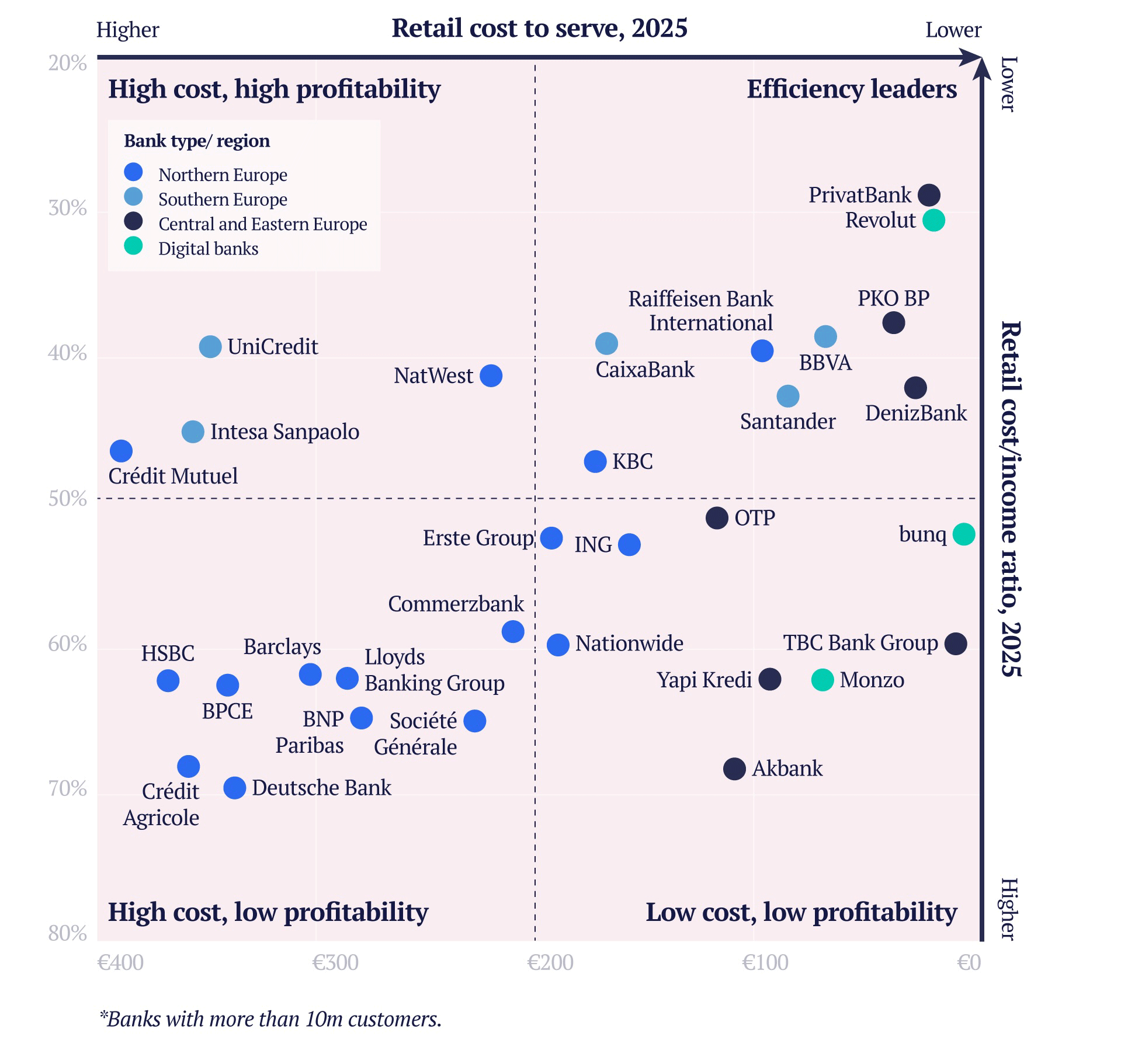
While the retail leaders of Euromoney’s most efficient banks ranking have a variety of business models, they all combine a low CTS with a low cost-to-income ratio – reflecting relatively well-developed and protected business models. We also highlight banks with a low CTS but a high cost-to-income ratio. These are often young banks and almost always showing strong growth, but with less developed or temporarily deprioritised revenue models.
Banks with higher costs to serve are almost all established banks. Some of these have low cost-to-income ratios, which puts them in a good position today, but leaves them possibly vulnerable to lower-cost players in the future, especially neobanks. Finally, cost transformation is most urgent where banks with a high CTS also have high cost-to-income ratios, due to weaker revenue streams.
Euromoney’s most efficient banks ranking leverages data gathered directly from banks coupled with public data. To compare like for like, we define retail as all individuals, excluding businesses. Where data is not available according to this definition and the calendar year, we have used standardised estimates, based on our data. The rankings can be filtered by country. See the methodology for more detail.
Covering every major bank in all the major European retail banking markets, we rank the combined retail businesses of banking groups headquartered in Europe. We also provide market-specific rankings for domestic businesses within the UK in the relevant section below.
Median CTS for banks in the ranking is just under €150, as of 2025. ING is closest to that median. (For the banks in the chart above, which are limited to those with more than 10 million customers, the median is slightly higher, around €170.)
The median retail cost-to-income ratio is around 52%. Erste Group and ING are closest to that median. This makes ING the closest bank to the overall median efficiency across the set.
The median bank has a total cost base of around €1.4 billion, typified by İşbank. The median bank saw a 1.4% drop in CTS in euro terms in 2025, typified by UniCredit. The median change in cost-to-income ratio was negligible, typified by Santander. Crédit Agricole was closest to the median in terms of its overall cost trajectory, up 2.5% year-on-year.
Retail efficiency leaders
European banking’s efficiency leaders are almost all operating in faster-growing markets or they are digital banks. Combining low CTS, with a low cost-to-income ratio, they include a strong contingent from Central and Eastern Europe, and Southern Europe, except Italy.
Southern banks, in other words, are reaping the benefit of this decade’s faster economic growth in Southern Europe (except Italy) compared with Northern Europe, as well as the restructuring and deleveraging in their banking sectors in the 2010s.
All the biggest Spanish banks consequently feature among the efficiency leaders. This partly reflects the success of BBVA and Santander’s business models in Latin America. Yet it also reflects a relatively benign operating environment in Spain, including higher economic growth than elsewhere in Western Europe and an end to the last decade’s deleveraging in Spain, plus a continued benefit from the prevalence of floating-rate mortgages in Spain, and the effect of greater industry consolidation compared to other big eurozone countries. All this primarily affects domestic champion CaixaBank. Mid-tier Spanish bank Unicaja is now among the efficiency leaders, too. Unicaja maintained a low cost-to-income ratio in 2025 and saw a 7% fall in its retail cost base, alongside some customer growth.
The largest European retail bank by revenue, Santander is also in this group. It recorded one of the biggest absolute reductions in retail costs in 2025 – a drop of more than €200 million – even though it was among the fastest-growing banks in terms of customer numbers. During the past 18 months, Santander has seen the coming to fruition of a strategy to build a global retail banking platform, including rolling out a single global app, and migrating to a proprietary cloud-native core banking platform.
According to management, this new technology backbone gives Santander much lower marginal costs, as it can put more customers and transactions onto the platform, fuelling revenue growth, without automatic cost growth.
Ultimately, everything we’re doing – technology, simplification, AI, scale – is about improving customer experience while maintaining low cost. That combination is what drives long-term competitiveness
Daniel Barriuso, senior board adviser, Santander
Other efficiency leaders in Euromoney’s ranking are from elsewhere in Southern Europe, including big Greek banks. Those with important operations in CEE include Raiffeisen Bank International, Polish and Ukrainian banks, and some Turkish banks.
Digital banks marrying low costs with big profits
The biggest of the digital banks that features among the retail efficiency leaders is Revolut, which has a retail CTS of just over €25. By revenue, it is far smaller than banks such as Santander or BBVA by revenue, although it is by far the fastest-growing European bank in terms of retail customers. It is also one of the top-ranked banks in terms of absolute retail revenue growth, which far outpaced its cost growth in 2025, resulting in 40% cost-to-income ratio (down 5.4pp).
UK neobank Zopa Bank is much smaller than Revolut, but also among the efficiency leaders thanks to a more credit-focused model. Older, largely branchless efficiency leaders include Germany’s DKB and Italy’s FinecoBank, which retain best-in-class costs to serve and cost-to-income ratios thanks to serving relatively asset-rich customers, boosting revenue from savings and investments.
The bank with the lowest CTS in the ranking, less than €5, is Enpara. Enpara has not only the low CTS enjoyed by all Turkish banks relative to the European average, but also the freedom from legacy real estate and technology that comes with being a digital bank, as well as the scale of now having more than eight million customers.
Enpara was the first offer in the market that said, we’re 100% digital and we’re going to share the cost advantage of being branchless. Our approach was simple: pass those savings on through commission-free transfers, no account maintenance fees and no annual credit card fees
Kursat Abit, executive vice-president, retail and SME banking, Enpara
Founded in 2012 as a business within QNB Türkiye, a division of Qatar National Bank, Enpara completed a carve-out process in 2025 that helped it achieve the highest percentage fall in its cost base in the ranking. Previously, Enpara was investing in standalone technology while also contributing to a share of QNB Türkiye’s systems. Today, it employs fewer than 200 people in its head office, and management believe they can trim that number further, thanks partly to AI. Enpara’s cost-to-income ratio in 2025 was just 26.4%.
Efficiency through cross-selling
A high cost-to-income ratio is justifiable in some areas of banking. At the extreme end, private banks such as Julius Baer have high cost-to-income ratios, but their return on equity and share valuations more than make up for this thanks to their large wealth-management businesses.
Even in the mass market, some banks can justify a higher-touch approach thanks to their ability to drive down their cost-to-income ratios by deepening relationship value through cross-selling. Today, that normally implies a heavily branch-based model – particularly bancassurers catering to more mature and wealthy populations, and often in countries where banks rather than brokers still play the prime role in originating mortgages.
Perhaps the best-known example in this category is Intesa Sanpaolo, which has styled itself as a national champion focused on mass private wealth in Italy, with profitable insurance, credit cards and asset management businesses – often hinging on the mortgage relationship. However, the retail business of UniCredit is more weighted to Italy than its corporate bank. It, too, has a revenue base that is high enough to offset its high CTS, resulting in a sub-40% cost-to-income ratio for retail – lower than Intesa – despite a CTS that is almost as high as Intesa’s, around €350.
All the other banks in this quadrant are also revenue outperformers in old-wealth markets.
Crédit Mutuel’s biggest entity, Crédit Mutuel Alliance Fédérale, is a case in point. It has the highest CTS in France, €388. But it is ahead of other big French banks in its cost-to-income ratio, 46.6%. It leans on an entrenched retail cross-selling model, including a heritage in bancassurance that is deep even by French standards – plus an unusual ability to engender loyalty via non-banking businesses, ranging from home alarm systems to mobile phone plans.
Our efficiency is linked to the way we do business. We have always said that, while we control costs, the first way to improve our cost-to-income ratio is through the denominator: increasing revenue per client by providing more products and deepening our relationship with them
Alexandre Saada, group chief financial officer, Crédit Mutuel Alliance Fédérale
Another cooperative group, Rabobank, also combines high costs with high revenue, as does Nordea. These two banks have the highest costs to serve in the ranking, more than €400 each. But their cost-to-income ratios are slightly below the median at just under 50%.
Among the UK banks, NatWest is the only bank in the high-cost, high-revenue category. In 2025, it reduced retail costs while increasing customers and retail revenues, pushing its retail cost-to-income ratio closer to 40%, even if its CTS remains high, at £193. Factors included the acquisition of Sainsbury’s Bank, completed in 2025, plus having decommissioned legacy applications, and using AI to improve productivity.
Another bancassurance group, KBC, as well as Swedbank, would be more within the high-cost, high-profit bucket if one stripped out their businesses in central and eastern Europe and the Baltic states. That is despite the relatively important Swedish branch closures of the prior decade, in Swedbank’s case.
Leveraging low cost to serve
Among banks in Western Europe, bunq has the lowest CTS, less than €5 per customer. It is prioritising growth – and has already surpassed any other continental European neobank by customer numbers. However, it is not yet recording profitability as high as some other neobanks. Despite rising costs, bunq experienced a 29% fall in revenue in 2025, as it decided not to pass lower central bank interest rates onto savers, leaving it with a 52.3% retail cost-to-income ratio.
Some UK neobanks and building societies are at a similar stage. Monzo has a CTS of £55, which is among the lowest in the UK and around half Revolut’s UK CTS. Word-of-mouth marketing accounted for 79% of new customer acquisitions at Monzo, helping to reduce its reliance on paid performance marketing and, as a result, to maintain an extremely low cost of acquisition. Revolut’s revenue base is twice as high, however, reflecting the latter’s focus on wealthier and more internationally mobile customer base. This makes Monzo’s cost-to-income ratio more than 10 percentage points higher than its main UK rival.
The magic formula is to build an incredible product and brand – offering great value for money, zero hidden fees, treating customers well. When you get those things right, customers will talk about Monzo with their friends and family, which is the most valuable recommendation there is
Tom Oldham, group chief financial officer, Monzo
Some CEE banks are also in the low-cost, low-profitability camp. These are typically seeing strong growth, but were not fully monetising their positions in 2025. Examples include some Turkish banks, as well as Banca Transilvania, Romania’s national champion, which has seen strong growth organically and via M&A. Georgia’s TBC Bank Group also has an exceptionally low CTS, at €10, thanks largely to its digital ecosystem-led growth in Uzbekistan, although its cost-to-income ratio was relatively high, at 59.8%.
Traditional banks prioritising growth
The banks that fell out of the efficiency leaders’ quadrant in 2025 are relatively low-cost lenders that have posted a low cost-to-income ratio in 2024 but which have recently prioritised growth, including via M&A.
Among these, OTP saw its costs rise more sharply than revenue, giving it a slightly above median cost-to-income ratio in 2025, even if its CTS remains relatively low, at €118. Nationwide saw an even greater rise in its cost-to-income ratio. Nationwide was closer to efficiency leadership in its 2024 numbers, especially in a UK context. However, a fall in revenue coincided with one of the biggest increases in absolute costs seen in 2025, as Nationwide digested its 2024 acquisition of Virgin Money and prioritised market share at a time of lower UK mortgage margins.
Branch closures by other banks have left Nationwide with the UK’s largest physical network. Nevertheless, its CTS of around £174 remains low by the standards of large UK banks.
Another UK mutual, Coventry Building Society also performs better in terms of CTS than profitably. Coventry saw the ranking’s largest percentage increase in its cost base due to its takeover of The Co-operative Bank, which completed in January 2025. It subsequently saw a sharp improvement in its CTS, but a sharp deterioration in its cost-to-income ratio, as the additional revenue from the acquisition did not yet match the additional cost.
The transformation challenge
Banks with both a high CTS and low profitability are all traditional banks in Western and especially Northern Europe. All the French mutual banks had costs to serve of more than €300 per customer, for example. They somewhat make up for this in terms of revenue generation, but not enough to break into the top left quadrant, with the exception of Crédit Mutuel. BNP Paribas and Societe Generale have lower costs to serve than the mutuals, but similar or higher high cost-to-income ratios, around 65%.
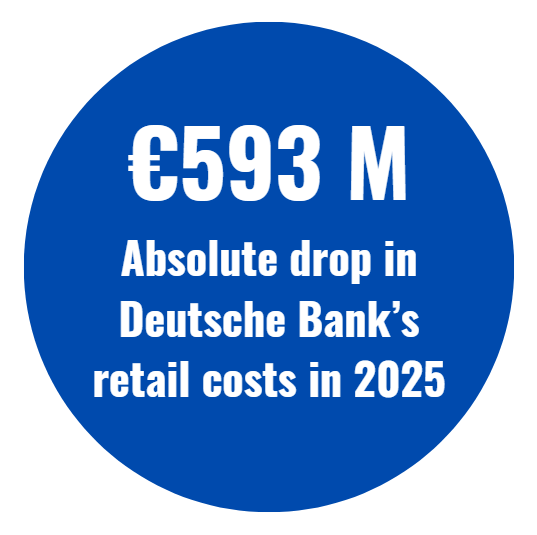
Despite relatively high cost-to-income ratios, SocGen and Deutsche Bank saw the biggest absolute falls in retail costs in the ranking, both cutting costs by more than €500 million in 2025 alone, as they executed on multi-year cost-cutting programmes.
With a similar profile, Commerzbank saw an increase in its CTS in 2025 to €215, even if this remains much lower than Deutsche (€337), whose retail business includes the large Postbank network. Commerzbank’s cost-to-income ratio improved, albeit less than Deutsche’s. Commerzbank is, in fact, much closer to efficiency leadership than Deutsche or any of the big French banks, thanks to a radical transformation programme starting earlier this decade, which has seen it roughly halve its branch network in Germany.
We reduced a large number of branches during our previous strategic plan, while simultaneously building alternative sales channels, including a remote advisory centre with 1,000 advisers. This allows us to deliver the same quality of service through video and telephone as clients would receive in a branch
Thomas Schaufler, head of private and small-business customers, Commerzbank
Small public sector and cooperative banks dominate German retail banking, while big mutual banks dominate French retail banking – features that are often blamed for the high costs and low efficiency prevailing in these markets.
However, big banks in the UK, Italy and the Netherlands also suffer from both a high CTS and high cost-to-income ratio. Among these, Barclays made gradual progress to improve its efficiency but remains firmly in the high-cost, low-profitability group. Lloyds Banking Group’s retail banking revenue base – the UK’s biggest – should make it closer to the high-cost, high-profitability group, but motor finance remediation charges pulled Lloyds further into the high-cost, low-profitability pack in 2025.
Italy’s third biggest bank, Banca Monte dei Paschi di Siena occupied a similar high-cost, high-profitability position to its biggest Italian peers in 2024. However, the Sienese bank saw a sharp deterioration in its cost-to-income ratio in 2025 when it completed its acquisition of Mediobanca, leading to the largest absolute increase in costs in the ranking.
In 2024, ABN AMRO had the highest retail CTS of any major European bank, €461. Alongside a moderate rise in customers, it saw a 15.6% drop in retail costs in 2025, reflecting increased automation, business simplification and a reduction in external staff costs. But ABN Amro’s CTS and cost-to-income ratio remained relatively high in 2025 at €374 and 65.5%, respectively. This reflects a traditional focus on relatively wealthy retail customers, who are few in number and require high-touch servicing. However, the bank’s focus is evolving, including via the launch of new digital brands.
The UK’s most efficient banks
UK banks have carried out stringent branch-cutting programmes throughout the past decade, leaving them with far fewer branches relative to the population than France, for example. It also has one of the region’s most developed neobanking sectors.
Despite this, only two UK banks are among Euromoney’s efficiency leaders in Europe – Revolut and Zopa. Revolut’s CTS in the UK is high by neobank standards, at £110 compared with €25 (£21) across its primarily European group operations. However, its UK cost-to-income ratio is much more in line with its group cost-to-income ratio – and exceptionally low by neobank standards, at 43.1% in the UK. That speaks to a well-developed income stream across payments, interest income subscriptions, wealth management and foreign exchange, especially in the UK.
Zopa’s CTS is lower than Revolut, at £81. Its cost-to-income ratio is the UK sample’s lowest, 36.3%, reflecting income from personal loans. However, it is the smallest of the group, earning £377 million in 2025, around a 10th of our UK median.
Another outlier is NatWest. Like other large UK banks, it has a relatively high CTS, £193. However, it has the UK ranking’s second lowest cost-to-income ratio at 41.6%. Lloyds Banking Group would be closer to NatWest’s position were it not for its 2025 motor finance remediation charges, although conduct charges have been a persistent feature for Lloyds ever since its creation after the 2008 crisis.
These banks aside, the challenge for UK banks is generally more on the income than cost side. The median UK cost-to-income ratio is slightly above the European median, but the median CTS is lower than the European median.
This partly reflects the prevalence of neobanks, which have not yet moved into a monetization phase – as well as the influence of building societies, which tend to tolerate low margins more than high costs and low growth. Starling Bank and Monzo have the UK sector’s lowest costs to serve, £49 and £60, respectively, but their cost-to-income ratios are both slightly above the European median. The building societies Nationwide and Coventry have lower costs to serve than other big UK banks, £174 and £165, respectively, but high cost-to-income ratios of 59.8% and 61.1%, respectively.
These UK challenges may also reflect a lack of the cross-selling models adopted by many large continental European retail banks – due to the broker-led nature of the UK mortgage market, and the extent to which post-2008 conduct charges have discouraged cross-selling. Barclays is perhaps the best example. It has the UK’s highest CTS, £253. Continental European peers such as Intesa Sanpaolo have even higher costs to serve, but often much lower cost-to-income ratios than Barclays’ 56.1%.
Another case in point is Santander UK. It was largely built on acquisitions of former building societies. After recent restructuring measures, Santander UK has an exceptionally low CTS for an established bank, £79 – but a more middling cost-to-income ratio, 52.3%.
How the tables could turn
Europe’s efficiency leaders combine both a low CTS with a robust revenue model. This is not easy to achieve, nor to retain. Banks that prioritise growth over profitability by sacrificing margins can fall into the low-profit camp, even if they retain a relatively low CTS. Even neobanks may struggle to maintain such low costs as their product penetration and regulatory obligations increase.
Moving from a high-cost, low-profitability profile to a low-cost, high-profitability profile will be a bigger struggle still. Societe Generale’s BoursoBank may help SocGen achieve this if Bourso is able to do more to replicate French bank’s traditional cross-selling model, without the costs. However, SocGen’s legacy branch-based business will remain.
The relatively high cost-to-income ratios of most Dutch and UK banks further show that branch reductions alone are not the answer.
Tackling the problem via cost synergies derived from M&A will not be a universal cure either. Many banks in the high-cost, low-profitability camp are already large. Neither are there many signs so far that AI is dramatically helping, yet. The extent to which more banks can leverage AI for efficiency gains in the future will partly depend on the social and political acceptability of attendant savings which impact local employment. Yet neobanks may also cut costs thanks to AI, including in their IT development, and perhaps with less internal push back.
I believe AI will radically shift the way we do retail banking. Problems can be identified faster, resolved faster and customer service can become dramatically more efficient. We are already moving beyond chatbots towards conversational AI that can take actions for customers
Pinar Abay, group executive board member for retail banking, ING
Can digital banks keep costs low but boost their revenues? If so, can those with the opposite problem cut costs while retaining high revenue capabilities?
Neobanks’ cost advantage today is sufficiently large that it is likely to remain a moat for the foreseeable future. However, with some exceptions, these banks are still struggling to develop more effective credit or wealth management models. Meanwhile, some European banks have shown that, with the right culture and revenue model, traditional banks can retain the primacy of the local network while remaining highly efficient on a cost-to-income basis. Whether they can continue to do so remains to be seen.
Our platform strategy is to centralise software development where possible and only localise for regulatory requirements. That gives us stronger negotiating power with technology providers and lowers operational risk across the group
Peter Bosek, chief executive, Erste Group
An increasingly common efficiency-boosting strategy is to launch digital-only flanker brands to appeal to younger customers and offer them a lower-cost alternative. Examples include UniCredit’s Buddy Bank, Intesa Sanpaolo’s isybank, BNP Paribas’s Hello bank! and most recently ABN AMRO’s BUUT.
Other banks, such as Erste Group, ING and Santander, are focusing on gaining better cross-border synergies in retail thanks to technology, and especially in areas such as investments. They are simplifying products, and ensuring end-to-end digital processes are available for those who want them. Banks are also focusing on technological transformation in the back and middle office, so they can redeploy capital and staff for the front line, in branches and in new remote advisory centres.
Approaches such as this are helping banks cut costs while maintaining and developing their relationships. But given the changes in the competitive landscape, it may not be enough. Transformation never ends.