
Europe pessimists often say that the US innovates, while Europe regulates. But in retail digital banking, the opposite has sometimes been closer to the truth.
The analysts


EU regulation – often so maligned – has at times been an encouragement to financial sector disruption, even if national rules have proven otherwise. The continent has been a leader in open banking, and passporting rules have spurred neobanks of regional and even global relevance. Even if Brexit brought some complications, the UK’s post-2008 licensing regime has resulted in a radically different retail-banking landscape, which has brought genuine concern for the incumbents. In the US, by contrast, getting a licence as a new bank has remained almost as difficult as ever.
The sector’s slow post-crisis recovery and negative interest rates made it harder for some European incumbents to invest heavily in digital banking in the prior decade, aiding the neobanks. But over the past three years, that dynamic has also changed, with some banks previously written off as hopeless dinosaurs bouncing back in terms of digital banking leadership and innovation.
US banks’ frequent obsession with branch-based growth strategies is met with bafflement among European bankers more used to viewing bank branches as a costly inconvenience.
In this report, Euromoney unveils which banks are really leading in digital banking in Europe today. In doing so, we look at the sector through four lenses, reflecting our digital banking benchmarking criteria.
- Paths to success
How are the digital banking frontrunners changing, and why? What are neobanks doing to foster more primary customers? How are in-house challenger banks and new digital banking brands helping incumbent players to fight back?
- Ecosystems and open banking
What are banks doing to widen their presence in the consumer economy via digital platforms? How are neobanks building on early popularity as travel money providers to become lifestyle apps focused on travel? How are banks using open banking to boost service and revenues?
- Customer experience in the mobile and AI age
What are the best digital onboarding strategies, how important is speed, and what impact is it having? What is the next stage of using generative and agentic AI for customer support? How can banks make security a competitive advantage?
- Financial health and inclusion
Where is digital banking improving access to finance? What is the strategic importance of financial health? How are banks deploying new digital tools to help us build better spending habits and set aside money?
The fight between incumbents and neobanks today remains as intense as the contest within those categories. Yet, this research also suggests a growing degree of convergence in terms of sophistication and customer experience.
Particularly in southern Europe, incumbents are still seeking to make the best of branch networks and customer service staff, as a differentiator to neobanks. Nevertheless, the most effective players increasingly understand that the app – not the branch – has primacy, while systems that allow the two to work together are essential. This is why Banco Santander executive chair Ana Botín, for example, summarises her bank’s strategy as creating a “digital bank with branches”.
This report shows which incumbents can live up to Botín’s description, and which neobanks are leading the way – and why.
More reports

The MarketMap methodology
This report is based on Euromoney’s assessment of over 300 retail banks globally as part of its annual research cycle. It combines qualitative insights from interviews with senior executives – CEOs and other C-suite executives, heads of retail banking and digital banking, heads of strategy and transformation, among others – with quantitative data. The research covers the capabilities of digital-focused incumbent banks and their digital-only subsidiaries, as well as standalone digital-only challenger banks.
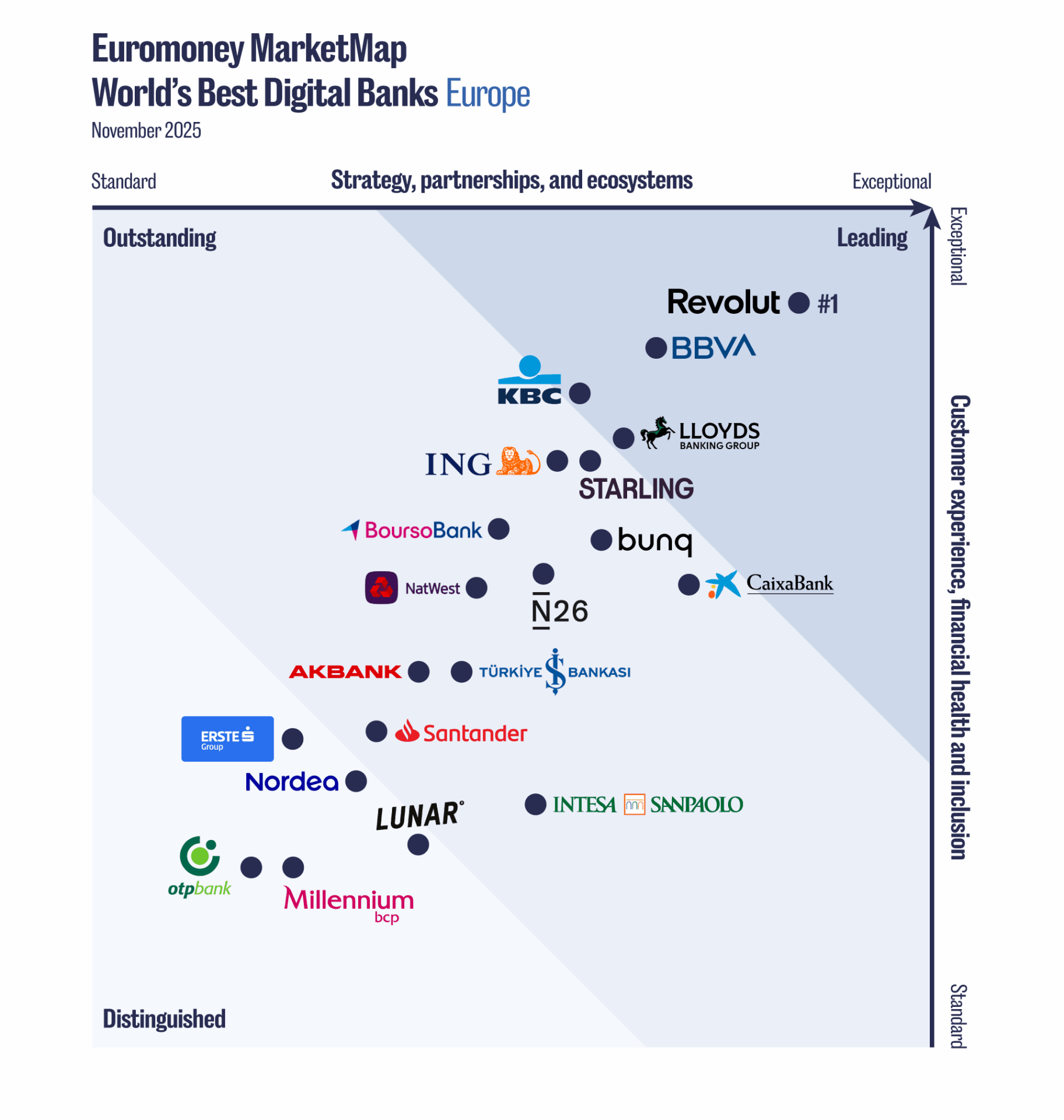
The quantitative analysis is grounded in a proprietary scoring framework that evaluates each bank against six criteria driving excellence in the fiercely competitive and fast-changing world of digital banking for consumers. The Euromoney MarketMap 2025: Europe’s Best Digital Banks highlights 20 top-performing retail banks, across two central pillars:
1. Strategy, partnerships and ecosystems
This pillar examines the most effective and successful digital banking strategies, financial and technology partnerships, and infrastructure enhancements that support the digital transformation and growth of the banking industry:
» Strategic execution of digital banking strategies, including growth and financial success.
» Ecosystem development including digital partnerships, and open banking integration.
» Innovative consumer benefits and rewards programmes promoting customer loyalty.
2. Customer experience, financial health and inclusion
This pillar examines improvements to customer experience including onboarding and digital customer support tools, anti-fraud and banking security tools and initiatives, as well as products and services promoting financial empowerment and well-being, including savings, budgeting and financial planning features:
» Customer onboarding processes, digital support services, and initiatives promoting digital product use.
» Banking security measures including cyber-resilience and anti-fraud measures, promoting trust.
» Tools and programmes to foster wider financial-sector access and better financial habits.
Due to its general-purpose nature, the adoption of AI – including generative and agentic AI – was considered within each section.
Each bank is evaluated using a consistent 0-100 scoring framework across all six dimensions. Banks are benchmarked using evidence from documentation reviews, structured expert interviews, platform demos and usage data.
Based on their performance across the pillars, the top-performing institutions feature in one of three tiers:
» Leaders, who are ahead both axes.
» Outstanding, who demonstrate excellence in one of these two axes.
» Distinguished, who offer strong capabilities across multiple digital fronts.

Euromoney MarketMap: Europe’s best digital banks
Revolut
Revolut had a series of breakthroughs in 2024, as it reached 50 million customers and acquired a phased banking licence in the UK – adding confidence and knowhow to its wider international growth, licensing and localisation strategies. Revolut impresses not only for its global ambition – after already becoming Europe’s dominant neobank – but also for its product design, and capability to roll out new tools and features rapidly, including those integrating carefully chosen third-party products and capabilities. Others have sometimes adopted similar features: imitation is the sincerest form of flattery.
BBVA
Digital transformation has been a long-standing focus at BBVA. The bank reports relevant metrics relatively transparently, although execution sometimes remains fragmented between countries. In Spain, the bank’s Energy Advisor feature, for example, proves its continued capacity to innovate and adopt new technology. That capacity was further evident in new tools – notably using AI – in customer service, fraud prevention, and financial health.
Lloyds Banking Group
Alongside a product simplification drive, Lloyds showed demonstrable boosts to sales from improved onboarding design. It launched innovative financial health tools and has moved forward in how it uses open banking to improve product marketing. As it runs one of the UK’s biggest customer databases, rock-solid cyber-security is an imperative. Nevertheless, it lags some neobank peers in integrating with third-party services.
KBC
KBC has focused on using AI via its digital assistant, Kate, while Kate Coins shows the potential for blockchain, notably in rewards programmes. Its ecosystems strategy ranges from property searches to integration with public transport systems and much more. It boasts strong levels of digital onboarding even for complex products. Its use of machine learning to counter fraud is also of note. KBC has rolled out common digital features internationally, although traditional M&A has driven much of its growth outside Belgium.
Starling Bank
Starling was an early mover on financial health, including budgeting and savings tools. While others have since rolled out similar features, the bank has used gen AI in a new Spending Intelligence tool. It reached profitability before other neobanks, but growth has lagged some of them, and it faced issues with the UK’s Covid-era Bounce Back Loans scheme. The recent acquisition of accounting and tax platform Ember, coupled with new investment in its Engine software business, suggest Starling is one to watch.
ING
ING stood out in development of digital customers service, including personal financial management tools, and exploring how gen AI can be deployed in customer-facing uses. It recorded high levels of digitisation, even in its mortgage business, and has ambitious group-wide straight-through-processing targets. Although it has a long heritage as an international internet bank, it operates on a relatively federated approach in some markets, with some attendant limitations to rolling out group-wide capabilities.
Bunq
Bunq has become continental Europe’s largest neobank, reaching 17 million customers in early 2025 while 2024 marked its second consecutive year of profitability. It has pursued a strong push towards internationally mobile customers, including ecosystem-style features ranging from embedded travel insurance to restaurant and other user recommendations. Customer experience tools include a gen AI-upgrade to its digital assistant Finn, although its focus on financial health was less evident than at some international peers, and its international growth is less developed than Revolut.
BoursoBank
BoursoBank’s outstanding customer experience features range from industry-leading onboarding times to innovative loan-application and open-banking integration, although its wider partnership ecosystem is less notable. New products in investments have helped a loyalty push, while financial health was less of a focus. BoursoBank shows high deposit balances by digital-only bank standards, but its ability to sustain growth in customer numbers while achieving its profit targets is more of a question mark, partly due to the role of generous new-customer bonuses.
N26
N26’s appeal in Germany and elsewhere has largely been its smooth and quick, digital-focused onboarding process. Digital customer service tools and language availability has further appealed to internationally mobile consumers. Its speed-to-market and edgy style marks it out from many incumbents, as does its readiness to integrate best-in-class third-party products. Subscriptions and new investments products have boosted its profitability. Strategic execution has been a challenge, however, notably the aftermath of regulatory restrictions on its growth until mid-2024.
NatWest
Digital banking, including retail, has been part of NatWest’s bounce back in recent years. Straight-through-processing rates, and mortgage approval times, have benefited. Other elements of a £1.1 billion technology investment programme in 2024 included a gen AI upgrade to its digital assistant, Cora. Spending categorisation, budget planning, rounding-up features, and a new financial coaching tool added to innovations around financial health and literacy. Nevertheless, some peers appear more clearly advanced on topics such as open banking and, outside UK incumbents, in lifestyle and beyond-banking features.
CaixaBank
As CaixaBank steps up technology investment, its digital-only brand imagin has helped bolster its digital presence. CaixaBank has recently been at the forefront of banks’ efforts around housing and mobility ecosystems. Its financial inclusion effort includes programmes to help older people access digital banking. Despite some early AI moves, as Spain’s biggest retail bank, it is progressing cautiously in putting generative and agentic AI in front of customers. Greater use of AI in fraud prevention is another of the bank’s next steps.
Isbank
The scale of Isbank’s digital banking uptake, together with daily app engagement and open-banking adoption, is impressive, albeit in a Turkish context. The İşCep app extends to services around the home, cars, travel and shopping. The bank’s AI-driven personal assistant, Maxi, is adding to its efforts around personal financial management, and Isbank is also rolling out gen AI capabilities in its mass affluent wealth management services. The Nays app is also helping it retain engagement among younger customers, including via gamification, demonstrating impressive growth.
Intesa Sanpaolo
Core banking and front-end digital transformation has been a central focus for Intesa Sanpaolo over the past three years. Despite some regulatory hiccups, the investment is helping to ensure the bank’s customers enjoy a properly integrated omnichannel platform. Its housing and consumer ecosystem capabilities should not be overlooked. Its rollout of innovative customer experience tools and features, however, continues to trail some European competitors.
Akbank
Like Isbank, Akbank enjoys impressive growth in digital customers, and it is playing a similar role in widening open banking in Turkey, along with developing beyond banking capabilities and integrating customer-facing gen AI capabilities. A new digital loyalty programme, with innovative gamification features, was an important step in 2024. The bank also demonstrated important digital initiatives around financial health and inclusion. Although Akbank has a developing banking-as-a-service strategy, its digital initiatives often appear slightly less scaled than those of Isbank.
Banco Santander
Santander has been going through an ambitious front- and back-end digital transformation, aiming to create a globally scaled, digital-first retail banking platform. Its digital-only bank, Openbank, has already expanded across Europe and demonstrated high customer satisfaction. Product simplification has already boosted digitalisation, onboarding times and sales. The transformation – coupled with a Polish exit – will lead to less fragmented digital capabilities globally than before. Although elements were still in execution in 2024 and early 2025, the positive impact should become increasingly clear in the coming years.
Nordea
Nordea’s move to a single mobile front-end for consumers across its Nordic markets has boosted digital adoption and engagement. Its Nova chatbot showed widespread use and it has advanced open-banking capabilities. The bank notes strong cybersecurity and anti-fraud defences including new digital tools and educational material for consumers. It also launched a new financial health check. All this has helped secure its place as a Nordic leader, even if there was less evidence of globally important digital banking innovation, including in areas such as gen AI and consumer ecosystems.
Lunar Bank
Lunar Bank has gained pan-Nordic scale, helped by a partnership with the SAS rewards programme. It has a forward-thinking approach to gen and agentic AI, evident in some of its existing capabilities. While financial health and inclusion appear less central to its proposition than at other banks, it offers some similar tools. Its product suite and profitability is still a work in progress, however, and its Nordic focus could limit growth, even if a new banking-as-a-service business could boost its potential.
Erste Group
Investing in digital platform George was one of the best moves in Erste’s 200-year history. New financial health capabilities include helping customers analyse their finances, advice, helping them budget, and flagging fraud risks. The bank is also exploring early uses for gen AI in George. Erste sometimes lacks the agility of more centralised players, however, impacting how rapidly new features can be executed across the group. It has also been less active than some peers in the region in building out ecosystems beyond banking.
OTP Bank
OTP’s digital capabilities have made big advances in recent years. Many of its digital customer service tools and anti-fraud features are on par with other top-performing digital banks. Its digital front-end has integrated retail ecosystems in transport, loyalty cards, housing and medical bookings in Hungary. Fuller back-end integration between countries has begun but is still in progress. Initiatives launched in Hungary can take time to be adopted across the group. Onboarding speeds and the proportion of end-to-end digital sales lag nimbler players.
Millennium bcp
Millennium bcp’s digital prowess is testament to a wider turnaround of the bank’s performance in recent years. An example is its use of the EU’s PSD2 account aggregation framework to facilitate embedded credit products, for example for private health patients. The bank marked wider progress around sales and onboarding digitalisation, and in the rollout of digital tools and initiatives for fraud management, financial health and digital inclusion, although the impact and differentiation of these were not always as clear as at other European banks.

Paths to success
Europe has been a two- or three-speed market for digital banking for much of the past 15 years. The continent has produced some of the world’s leading neobanks, at the cutting edge of innovation and digital user experience. Some incumbents, at the same time, have faced heavy distractions around regulation, profitability and the technical resilience of their legacy businesses.
But the digital frontrunners are now changing – even within the neobank landscape. Revolut has pulled ahead in terms of customer numbers (surpassing 65 million by September 2025), while gaining important experience in tailoring its businesses and regulatory setup to the local environment, notably after securing a conditional licence in the UK. Bunq has become continental Europe’s largest neobank, surpassing 20 million customers by September 2025. Lunar Bank has built a pan-Scandinavian business with a million customers by March 2025, barely five years after gaining a standalone banking licence.
Meanwhile, the best incumbents have closed the gap with neobanks on digital customer experience and product agility – often benefitting from a relative emphasis on digital banking by their leaders in the previous decade, and thanks to renewed digital investment and focus since then.
The rewards of digital investment
For the best banks, digital investments are paying off. BBVA’s proportion of customers acquired through digital channels rose from 21% to 66% over the five years to the end of 2025, contributing to its growth in new customers to 11.4 million in 2024 versus 7.1 million in 2019. It has used its Spanish digital banking platform to enter Italy, reaching 600,000 customers by end-2024, two years earlier than targeted, and launching a digital mortgage and credit card while preparing for a similar launch in Germany in 2025.
While ING has heritage in Europe as a cross-border online-only retail bank in markets such as Germany and Spain, it has recently implemented straight-through-processing targets common to all its markets – including its incumbent Benelux markets – aiming at between 85% and 90% within two years, compared to around 75% in 2024. In 2024, 89% of ING’s 16.2 million primary bank customers used mobile as their primary touchpoint.
KBC has grown within central and eastern Europe largely by M&A. But it has invested heavily in digital capabilities, notably digital assistant Kate: often transferring capabilities originating in Belgium and Czech Republic to its banks in Bulgaria, Hungary and Slovakia. Its M&A strategy has recently turned more to digital banking with the purchase of Slovakia’s 365.bank.
In the UK, Lloyds Banking Group regards itself as the country’s biggest digital bank. It has 20 million app users and registered 7 billion app logins last year. Its number of app users has risen by 40% since 2021 in its consumer banking app. It has approached digitalisation as a route to growth – by putting more content onto a regenerated app, helping to distribute products like investment and insurance. That strategy has contributed to fees growth of around 10% over the past two years.
At the heart of our digital strategy is the commitment to enhance, not replace, the personal banking relationship
Malthe Falck, head of retail digital, Nordea
Turkish private banks are following a similar path of impressive digital growth in their country. Isbank’s IsCep app counted 15 million users last year, with around 7 billion visits. Akbank’s digital customers reached 12.5 million, and 4 billion logins.
Other banks struggled more in the previous decade with the legacy of past M&A deals or recovering from losses associated with the 2008 and Eurozone crises. But recently they have been better able to focus and invest in digital, including AI. NatWest, for example, had 10.5 million active mobile app users last year, logging in 4 billion times to use its spending categorisation, budget planning and rounding-up features, as well as a new financial coaching tool. NatWest also played a leading role in deploying customer-facing generative AI in its Cora+ app.
Meanwhile, as Nordea transitioned to a single mobile front-end called One Digital for consumers across all four of its Nordic markets, it saw digital customers rise to 5.2 million with logins rising to 1.5 billion. Portugal’s Millennium bcp has seen digitally active customers double since 2018, and the number of app users tripling with digital channels now serving 83% of its total sales. OTP has also upped its digital game in recent years, with spending categorisation and open-banking tools, and integration of a proprietary housing search and medical bookings.
Neobanks widen their attack
Despite widespread branch closures and IT upgrades at incumbent banks, neobanks retain an edge in terms of cost to serve and acquire customers. They are also boasting better profitability as they build out their product ranges. The trouble for incumbents is that neobanks have used lower costs of acquisition and first-mover advantages in customer experience to gain scale. Now, they are adding new revenue streams and gaining more primary accounts, making them even harder to dismiss.
At Starling Bank, its average revenue per active customer was £219.70 last year. But it cost the bank only £42.40 to serve that average customer, down from £48.10 the year before. Its focus on relatively mature customers, and its early move in business banking, helped it reach profitably before other neobanks. It is now growing revenue by establishing a core-banking software business in continental Europe, and most recently the US, under its Engine brand.
What makes N26 special is the high usage of the product. People are not necessarily coming to us for one specific product, like a debit card for traveling, or to invest money. They’re usually looking more for the full picture, for primary account usage
Arnd Schwierholz, chief financial officer, N26
Retail brokerage offers a further capital-light revenue stream to many neobanks, sometimes tying in to the subscription offerings that neobanks like Bunq, N26, Lunar Bank and Revolut have rolled out to foster loyal customers. Higher tiers are naturally targeted to customers with a higher income, including those with greater interest in growing wealth via innovative investment products. Revolut and Bunq’s higher tiers, for example, offer lower fees for trading and investments.
N26 launched exchange-traded funds (ETFs) and fractional stocks investing in early 2024 as part of a wider shift to deepening relationships with existing customers, including via its subscription products. That helped the bank notch up its first quarters of underlying profitability later in the year. BoursoBank also launched a new offer, called BoursoFirst, in 2024, targeting individuals with more sophisticated investment needs.
The in-house digital banks and brands making waves
In-house challenger banks, typically aimed at younger people, have increasingly been at the core of some incumbent banks’ strategies to fight back against neobanks, despite some similar projects reaching well-publicised dead ends in the previous decade.
Societe Generale, for example, has continued to invest in BoursoBank, which has become France’s biggest digital bank with 7.2 million clients by end-2024. BoursoBank operates largely independently from SocGen, its 100% owner. CaixaBank’s imagin is more closely integrated into the group’s systems, sometimes serving as a sandbox for front-end innovations. Fee-free travel money and peer-to-peer payments are part of the draw. Alongside social media-focused marketing, it also offers access to music, events, and discounts: drawing users in, and gradually introducing products such as basic savings accounts and small loans. By 2025, imagin had 3.5 million customers, more than any standalone neobank in Spain. Around half of imagin’s adult customers pay in their salary.
Nays, launched by Isbank in 2022, performs a similar function: targeting young people, and offering payments and peer-to-peer transfers, micro-credits, foreign exchange, and a gamified cash-benefit programme. It had 4.5 million users by end-2024, including 2.3 million non-Isbank customers. Erste Group, by contrast, has built out George as its digital platform for all retail customers. It had onboarded 11 million customers to George across seven countries by end-2024, helping digital channels reach 60% of sales.
Operating at scale across multiple important geographies allows us to have a global digital capability. No fintech company can replicate the combination of that scaled local presence, plus branches. This is a combination unique to us, and a competitive differentiator
Daniel Barriuso, global head of retail and commercial banking, Banco Santander
Other banks have invested in digital brands which can both help their group’s front and back-end digital transformation and offer an efficient avenue for international retail expansion.
Banco Santander relaunched Openbank as a full-service cloud-native digital bank in Spain in 2017. It is now central to Santander’s efforts to realise new global economies of scale in retail banking as part of executive chair Ana Botin’s aim to be what she calls a “digital bank with branches”. That includes front-end technology which Santander is rolling out globally, starting last year in the UK, after initially developing it in Openbank. After launches in Germany, the Netherlands and Portugal, Openbank is today one of Europe’s biggest digital banks by deposits, with a balance sheet of €18 billion at the end of 2024.
Italy’s biggest retail bank, Intesa Sanpaolo, has also concentrated a large proportion of its management’s attention over the past three years on deploying technology first developed in its digital-only brand Isybank, to overhaul the group’s core banking systems. At the same time, Isybank offers a fresh new brand and simplified experience, capable of globally leading onboarding times, reaching over a million mostly new-to-bank consumers. Greece’s biggest retail bank, Piraeus, has lately launched a similar digital-only bank called Snappi in partnership with Natech, a Greek core-banking software provider.

Ecosystems and open banking
Compared with Asia, European neobanks tend not to be predicated on relationships with a specific retail, telecoms or e-commerce partner. Nevertheless, big banks in Europe are increasingly developing digital ecosystems of their own, especially around housing and mobility. Forward-looking banks recognise that it is vital to maintain and grow direct connections with customers at a time when big tech players and AI threaten to demote less user-friendly institutions to back-end deposit storehouses and balance-sheet providers.
Mortgages and leasing become housing and mobility
In addition to current accounts, mortgages have traditionally been a lynchpin of bank customer relationships in some continental Europe markets, because of long fixed-rate periods and the size of the bancassurance market. Some banks have consequently seen an opportunity and need to work within the housing market’s growing reliance on internet listings. ING, for example, has plugged a mortgage calculator into the biggest property search engine in the Netherlands, Funda, which links back to a wealth of mortgage advice and services on its digital channels. And in Belgium, KBC owns 50% of Immoscoop, one of the country’s biggest property search engines, which it has integrated into its app and credit systems.
As business models continue to evolve – influenced by the growing dominance of big tech and increasingly stringent EU data regulations – we face a significant risk of disintermediation. … Our objective is to engage with customers much earlier in their decision-making journey
Sigrid de Wever, general manager for corporate strategy and innovation, KBC
KBC’s Immoscoop partnership stands out by allowing users to simulate financing, maintenance costs and cost-of-living scenarios. The service further gives advice on energy efficiency and offers instant quotes for items such as solar panels, insulation and new windows – working alongside a network of contractors via its Impact Us Today partner. It also helps with housing certificates for energy performance and electrical safety, and property valuations.
Other non-banking services KBC offers on its app include transport tickets, parking apps and ride sharing. It has recently added new tools to allow Belgians to get a driving licence, buy concert tickets and store documents.
CaixaBank is taking similar action to protect and grow its dominant Spanish and Portuguese banking business. In late 2024, its Portuguese subsidiary BPI launched Quatru, a new housing platform for property listings and mortgage services. In Spain, CaixaBank in June launched Facilitea Casa: a new property portal with 40,000 homes for sale or rent via more than 1,000 real estate companies, offering financing and insurance via the platform. That followed an earlier launch in December 2024 of Facilitea Coches, a new used car financing portal listing more than 5,000 used cars and plugged into more than 150 car dealerships across Spain.
When we look at the business, we see opportunities in areas adjacent to our business. We have a competitive advantage there, because we have the clients, we know the suppliers, and we understand the market dynamics – and because we have the credibility, the name. That’s why we can do better than our rivals not just in pure banking business but also in the ecosystem around it
Gonzalo Gortazar, CEO, CaixaBank
In Italy, Intesa Sanpaolo has a longer-standing approach of developing its locally dominant retail banking business alongside residential brokerage services. In 2023, however, it merged its in-house real estate agency into a local property technology company while opening the service to other Italian banks, boosting its digital component.
From fee-free foreign exchange to travel super-app
Europe’s biggest and best neobanks have long moved away from simply being travel money providers, just offering lower currency fees than the incumbents. Nevertheless, Europe’s wealthy but fragmented markets, as well as the lack of currency union between the UK and the rest of the continent, means services related to international travel continue to be a key driver of growth for European neobanks, especially among younger users.
Revolut’s app has both shopping and travel features, including a Stays section which allows users to find and book accommodation on the app thanks to connections to partners including Expedia and VRBO – also tying in to a new points programme launched in 2024. Dutch neobank Bunq offers a range of services, from foreign exchange to insurance, advice, and recommendations on the best places to visit from fellow users, whether it’s an art gallery or a restaurant. A partnership forged last year between SAS and Copenhagen-based Lunar Bank means the latter’s users can now sign up to a co-branded debit card earning them points in the airline’s rewards programme when they fly or spend on anything from groceries to dining out.
In addition to housing, Intesa Sanpaolo’s digital consumer ecosystem approach includes an array of retail partnerships, allowing the bank – via its app – to sell and fund the purchases of everything from iPhones to scooters to Ray-Ban Meta glasses, on a business-to-business-to consumer basis. Intesa is consequently one of Italy’s biggest iPhone distributors.
Other new ways in which banks are seeking to develop stickier digital relationships include in-app accounting, expenses and invoice-management software for small business owners. An example is Portuguese bank Millennium bcp’s iziBizi service, developed in partnership with a local professional services software company Cegid Cloudware. The UK’s Starling Bank acquired local accounting and tax platform Ember in August with plans for an exclusive integration into its app, while France’s BoursoBank has developed an in-house service called Wicount.
The benefits of open banking
Open banking began in Europe and has continued to notch up adoption. The UK, previously as part of the EU, has been an early leader. Total open banking users in the UK grew to a record 15.2 million by mid-2025, up by 34% on the year before, according to Open Banking Limited, the country’s official open banking implementation entity. Lloyds Banking Group is leading the way in terms of using consented information from external accounts to better hone its products, marketing and credit models.
Elsewhere, open banking frameworks are helping banks keep customers on their own channels even if they have accounts with other banks – particularly useful for digital-focused challenger banks, where the holy grail is translating high customer numbers into higher proportions of active and primary account customers. Open banking means a firm like BoursoBank in France, for example, can now allow customers to initiate payment from other banks without leaving the BoursoBank channel.
Other open banking leaders stretch from Nordea in Scandinavia to Millennium bcp in Portugal. Millennium bcp, for example, has leveraged the PSD2 account aggregation framework to allow customers of partner companies to share their financial data, enabling digital credit approvals that are embedded in the partner’s platform. Patients of the healthcare group Luz Saude’s My Luz platform can subsequently finance medical expenses at checkout – regardless of whether they are direct customers of the bank – through embedded personal loans from Millennium bcp, via a product called pagaFlex.
Turkey implemented PSD2-style regulations earlier this decade. Akbank and Isbank are now leading the adoption of open banking services in the country, whether it is external payment initiations or allowing the banks to offer customers better insights on their finances and gain more targeted offers. At Isbank, more than a million people have consolidated external accounts into Isbank channels after a rapid increase in use of the capability in 2024.

Customer experience in the mobile and AI era
Speed as an early differentiator
European banks are rapidly transforming how they onboard customers and encourage early product use. In response to rising expectations and competition from fintechs, institutions are adopting digital-first onboarding strategies that prioritise speed, convenience and future product engagement. They are developing real-time services that build trust and encourage customers to make the new accounts their primary banking relationship, while gamification strategies are fostering deeper relationships and increase product adoption from the outset.
Increasingly, AI is enhancing and streamlining sales and onboarding in the region. In Spain, for example, BBVA applies AI to pre-fill forms and verify documents, reducing friction and improving accuracy.
In much of the European retail banking market, mobile onboarding has already become the norm – with neobanks often setting the standard. Seamless digital onboarding helped Revolut become the most downloaded financial app in the UK and Europe. N26’s mobile onboarding offers a less manual, paper-based experience than many incumbent banks in Germany.
Traditional banks are adapting. Lloyds Banking Group redesigned its mobile onboarding experience to match neobank standards, integrating feedback from users along the way. Digital channel improvements also saw Lloyds double protection product uptake during its mortgage onboarding process.
Ambitious transformations of front-end systems and core-banking infrastructures at Banco Santander and Intesa Sanpaolo are helping to ensure a true omnichannel platform at those firms. The aim has partly been to ensure customers enjoy a seamless onboarding experience between the banks’ digital and physical channels: allowing them to switch between platforms easily, and potentially helping the bank to avoid losing the sale if customers might go home to consider whether they want to go ahead.
In most cases, banks talk about omnichannel activity, but customers can interact with the bank in a single channel, without any contact between the channels. In our case, customers will be able to start the experience on the app, and then seamlessly resume the activity in the branch or remotely with a human agent. That is key, because it increases the probability of executing the sale
Stefano Barrese, head of Banca dei Territori, Intesa Sanpaolo
Banks are also digitising sales of more complex products, such as mortgages. In the Netherlands, ING has digitalised 95% of its mortgage journey. BoursoBank offers online loan applications with real-time status tracking.
Onboarding processes that are more digital, and designed around the customer, are especially useful for internationally mobile customers. Santander offers digital onboarding for non-residents while Millennium bcp in Portugal uses video-based onboarding for foreign nationals.
Speed, perhaps above all, is a strategic differentiator. Santander provides instant virtual card issuance. KBC and Revolut enable immediate account access post-approval. N26 also offers instant account use. Account opening in a matter of minutes – as little as three minutes at firms like BoursoBank – exemplifies the push for speed. More banks, such as Erste Group, are offering instant lending decisions via mobile apps, too, making credit more responsive.
Gamification is further enhancing the onboarding process and early product use. BBVA uses gamified flows and progressive profiling to improve completion rates, for example, and in late 2024, Akbank introduced a new digital loyalty programme. It attracted millions of users in its early stages, becoming one of the biggest of its kind in Turkey, and helping to take its mobile traffic to record levels. As part of the gamification of the programme, customers must complete specific tasks to move to a different tier within the programme’s different levels, each with its own benefits.
From self-service to AI service
For a new era of digital support, Europe’s best digital banks are not just aiming to boost efficiency, but also to improve service quality and better absorb demand spikes. This is part of a wider shift among incumbents from product‑centric distribution to data‑driven, customer‑centric engagement – including personalised guidance and integrated journeys within a single, trusted interface.
Chatbots and virtual agents now handle routine questions, triage and route complex cases, and increasingly provide personalised recommendations. Next steps being piloted include voice‑enabled assistants and more context‑aware digital employees capable of managing more complex dialogues as well as simple workflows in an agentic AI framework.
In the UK, rather than just directing the customer to a relevant part of the website, NatWest upgraded its Cora chatbot to ask the customer’s permission to retrieve information itself and present it to the customer in its own words. For customers who elected to use the upgrade, it halved handovers to human agents, with the bank recording a 150% lift in customer satisfaction. Nordea’s Nova agent conducted more than 5 million sessions in 2024 – exceeding human‑handled calls – operating across in‑app messaging, live chat and video.
Meanwhile, also in Scandinavia, Lunar Bank has resolved 80% of its customer issues via AI. Now it is pursuing what it calls invisible banking. As part of this, AI assistance is already evolving from giving information to action, such as executing tasks like blocking cards. The next step is for it to do so automatically, and then contact the customer, after detecting suspicious behaviour.
I’ve seen incumbent banks monitoring their success on app logins. They see that as a positive trajectory going upwards. Our ambition for 2026 and beyond is for that to come down. You don’t need to go into a banking app. We should be able to pay the bills for you. We should be able to help you find the right utility vendors or even switch mortgage providers. That should be able to run in the background, especially for the small tasks
Ken Villum Klausen, founder and CEO, Lunar Bank
Part of the digitalisation of service includes embedding personal financial management tools into mobile apps to help customers understand their spending and build savings, adding a financial wellbeing ethos and making apps that are almost like personal advisers.
Banks are adding lifestyle services and third‑party integrations into their apps – with Revolut and Bunq adding eSIMs and accommodation booking, while the apps of banks such as KBC, Akbank and Isbank are becoming like daily utilities for everything from bike rentals to comparing energy suppliers. Investing is also moving into the everyday banking service interface, as banks add trading and wealth-planning features into retail apps. Banco Santander, via Openbank, is integrating robo-advisory and recently also crypto, for example.
Digital does not replace human service; it reframes it. Some European banks are combining remote advisers, accessible design and branch‑based inclusion measures to ensure customer service is always available: preserving trust, at the same time as boosting digital adoption.
Spain’s CaixaBank serves over 3 million customers through InTouch, which provides remote personal managers via chat, phone, video and WhatsApp, while branches offer video sign‑language interpretation for hearing‑impaired customers. Italy’s Intesa Sanpaolo operates around 3,000 “digital branches”, assisting customers by phone or other remote channels as if it were a branch, sometimes offering customers the chance to speak to the same person who they previously spoke to in the physical branch. This blending of technological innovation with human support could capture a greater share of wallet and loyalty.
Five steps to build trust through security
For any successful digital bank, cybersecurity and fraud prevention should be strategic imperatives. In an era when digital channels are the main point of interaction with banks, the focus should not be just on regulatory alignment, but also on enhancing resilience and trust.
Five key ingredients make up European banks’ defences: customer-controlled security, fortress-style authentication, AI-driven detection systems, multi layered cyber-resilience, and a security-first culture. How are banks shoring up their safeguarding strategies?
- Put security in the hands of your customers
As banks globally empower customers to act as the first line of defence, clients feel safer knowing they can take immediate action without waiting for assistance. Revolut, for example, offers a lost device lock feature and biometric overrides, allowing users to instantly restrict access. Hungary’s OTP Bank also introduced a panic button to block all digital channels at once. Allowing customers to make sure they are speaking to legitimate bank representatives is another area of innovation. Revolut now conducts customer support calls exclusively in-app, ensuring users are speaking to verified representatives. Starling Bank launched a Call Status Indicator feature to verify incoming calls, reducing impersonation scams.
- Take authentication and identity verification to the next stage
PSD2’s Strong Customer Authentication requirements have ensured multi-factor authentication is common across Europe. Banks are replacing SMS codes with app-based tokens and device-binding methods. Biometric verification is also widespread among the best digital banks. Among notable examples, Nordea integrates national ID systems like MitID and BankID for secure logins, adding a government-vetted layer of identity verification. Banco Santander uses facial recognition for ATM withdrawals. Revolut applies biometric checks for new device logins and transaction overrides.
- Use data and AI to prevent criminals from winning
The best digital banks give numerous examples of how AI is transforming fraud detection. BBVA uses behavioural biometrics and anomaly detection to flag suspicious activity. KBC applies pattern recognition to monitor transactions. Lloyds Banking Group deploys gen AI to support fraud response teams. Using AI is a risk in itself, however, demanding proper governance and controls. ING, for example, has consequently established an AI Risk Centre of Excellence to vet models for bias and hallucinations. CaixaBank is exploring explainable AI to ensure transparency in fraud detection.
- Build multiple walls to ensure cyber-resilience
Across Europe, the best banks are adopting Defence in Depth strategies to secure cyber-resilience. Multi-layered defence ensures that if one measure fails, others are in place to prevent breaches. Lloyds Banking Group targets 99.99% uptime, for example. Piraeus Bank conducts frequent penetration tests and uses AI-powered threat monitoring. OTP Bank combines device fingerprinting and VPN detection to block fraud attempts.
- Breed a security-conscious culture
While technology changes, culture can remain constant. The best banks are consequently fostering a security-first culture among their customers through education, often embedding security warnings in their digital channels. Public awareness campaigns, meanwhile, included Banco Santander’s Polish business’s “Don’t Believe in Fairy Tales” scheme. In addition to staff training and phishing attack simulations, partnerships are also important. Nordea works with telecom providers to block spoofing SMS messages, for example, while Erste Group has launched a regional Cyber Defence Centre with EU support.

Digital banking’s boost to financial health
Much of the narrative around the digitalisation of banking in Europe focuses on closure of branches, the attendant boost merely to banks’ bottom lines, and the negative effect on people who continue to rely on cash and in-person customer service. Yet the best digital banks, whether they also have branches or not, are finding ways for digitalisation to boost people’s financial health through new digital tools and features, while making it easier for all customers to use their digital channels.
Although Europe enjoys high levels of banking penetration, financial inclusion is an important concern here, too. Digital banks can help bring in people excluded from the sector and target underbanked populations.
How digital banking improves financial access
Digital-focused banks are often adept at designing user-friendly apps, and thanks to lower running costs they are often much cheaper. In France, for example, BoursoBank started out as an online broker naturally orientated to more urban areas. In a country where standing current account fees are the norm, the bank estimates most traditional peers charge their customers 20 times more (more than €200 a year versus less than €10 at BoursoBank).
Neobanks like Revolut, N26 and Bunq can appeal to migrant populations thanks to simple digital processes and the option for a front end in different languages, as well as lower currency and remittance fees. They have rolled out local IBANs to help customers receive salaries and pay bills when moving within Europe. Revolut now offers local IBANs in all of the most populous EU countries and the UK. Bunq does the same in most of Western Europe: allowing customers to apply on its app for a local IBAN when moving to Spain, for example, before they have even left their home country.
Less reliance on traditional credit scores is also a feature of some digital banks. Bunq and Revolut both offer credit cards secured against money held on deposit, helping customers build credit history.
The rise of the financial health app
At Starling Bank, financial health has been a core part of its proposition ever since Anne Boden founded the bank in 2014. Relatively early, it introduced features such as spending categorisation, upcoming debit warnings, as well as savings spaces and rounding-ups (putting aside digital spare change). Recently, it took a first step towards customer-facing uses for gen AI with a new feature called Spending Intelligence, allowing customers to ask questions about their money, using Google Gemini.
Ultimately, what’s really important is improving the product, so our customers bank smarter with us. We know we can be agile, and by being agile we want to help our customers be good with money
Adnan Ahmed, head of strategy, Starling Bank
Other banks are now following a similar route. In Spain, BBVA recently redesigned its app with AI and financial health firmly in mind. As part of this, it launched a new AI coach to analyse customer’s monthly savings capacity, emergency savings sufficiency, and personal debt sustainability. The coach suggests actions such as cutting down on coffee or other small items, closing little-used subscriptions, paying lower charges for slower shipping, in addition to rounding-up features. It will also alert for bills which might exceed your balance, and push you into your overdraft, up to several weeks in advance.
Separately, BBVA introduced a digital Energy Advisor feature to estimate electricity and gas consumption and potential changes such as solar panels – using numerous data points from location to energy certificates to ultimately help customers visualise potential cost savings and financing options. KBC has a similar tool for energy spending, using AI digital assistant Kate.
Harking back to its savings bank heritage, Erste Bank has put financial health at the very centre of its strategy over the past few years. Peter Bosek has continued this focus after becoming CEO in mid-2024, including efforts to tie in to asset management ambitions with consideration of the the need to supplement state pension schemes in its markets.
In its George Fit section, Erste’s digital platform helps customers analyse their finances to answer questions like how much they are spending, how much they could and should save or invest, and how to do it. George Tips offers further savings advice and might flag a regular payment that is unusually high, for example, or when a merchant has double charged. Now it is rolling out George Spotlights, allowing personalised budgets and spending categorisations. In some markets it has launched a Financial Coach and Hey George – a new personalised banking assistant in the app allowing customers to chat and analyse their money, using large language models (LLMs).
Retail banking is about helping clients manage liquidity over their lifetime. Digitalisation gives us the opportunity to give digital advice to all our clients, such as helping them to set appropriate savings goals, alongside their day-to-day banking needs. AI is a huge opportunity in that regard
Peter Bosek, CEO, Erste Group
Isbank has built out a personal financial management section of its app with around 1 million users a month. With monthly spending charts, Maxi – the bank’s AI-driven personal assistant – can further make spending recommendations and help customers to budget and manage their money. Nordea launched a new financial health check based on account data and a questionnaire and then offering suggestions such as ensuring a two-to-three-month expense buffer, paying off expensive debt, buying life insurance, or making sure customers are saving enough for their pension. Portugal’s Millennium bcp combined subscription management, expense forecasting, budget alerts and a savings centre into a financial wellbeing hub.
Gamification also supports education and community engagement. NatWest’s MoneySense uses games, videos and activities to help teach financial literacy to children and young adults.
Staying on top of debt, making money management accessible
At ING, its Financially Fit programme encourages savings via an Everyday Round Up feature available in most major markets, in addition to tools helping customers control and plan expenses. In Western Europe, it has rolled out digital financial coaches to help customers budget, save and invest.
Financial health is not just about making sure a customer is in a good position for their mortgage in the first place, which is strictly guided by regulations. It’s also making sure that they stay financially healthy during the lifetime of the mortgage. Things change in people’s lives. They change jobs; their income may change, and this is less heavily regulated
Fleur de Groot, product lead for mortgages, sustainability, CX and mortgages, ING
ING’s new Mortgage Check feature has also offered a new way for borrowers in the Netherlands to see how their debt affordability could change over the longer term. Particularly relevant for interest-only mortgages, the tool sources information including from government sources, such as tax and pension information, as well as property valuation data, to give a holistic view – before offering relevant tips for how to manage the situation.
These tools can improve customers’ spending habits. They help consumers avoid unsustainable debt, which would cost the bank capital too. And they encourage people to put money aside before helping them invest that money in an accessible and affordable manner, which simultaneously brings a capital-light revenue stream for the bank.
Our users kept telling us ‘We’d love to start investing, but we simply don’t know how to.’ Instead of just looking at all the features we could launch, we asked what our users would need. We made it simple, and low-cost. We added fractional investing to make sure that you can start trying out by buying €10 in Apple. And we made sure you can buy and sell instantly
Bianca Zwart, chief strategy officer, bunq
Some of the continent’s biggest digital-only banks, such as BoursoBank, started off as low-cost brokerage platforms earlier this century. Now, newer digital banks are proving similarly adept at introducing retail customers to investing. Bunq users can have digital spare change and part of their salary automatically invested every month. Its Stocks feature means people with as little as €10 can invest in ETFs or fractional shares, with no monthly fees for the first three months and a 0.99% per-trade fee thereafter.

Looking ahead: From apps to bots
Incumbent banks in Europe have come a long way in catching up with neobanks over the past five years.
Incumbents are slimming down their product ranges to make them simpler, almost as fast as neobanks are adding to their product offerings. Trust is another key battleground. Incumbents might think they have an advantage because of their physical networks and history, but if their systems are more likely to go down and cause customer disruptions, their digital banking capabilities look less trustworthy.
The increasing maturity of neobanks, particularly around regulatory topics – coupled with a return of a healthier funding environment for the best fintech companies – means that the retail banking landscape will remain highly competitive in Europe. Incumbent banks can no longer tell themselves that neobanks are fly-by-night players who they will soon be able to buy on the cheap. That is why more incumbents have set up their own neobanking brands.
The next stage, however, is how to deploy generative and agentic AI. Banks are already well into the experimentation phase in terms of customer-facing uses for gen AI, testing how LLMs can be used to adapt how they present and explain their products and policies to the individual customer. As those functions move from informing to acting, they will reinforce the value to banks of having sufficiently capable – and trusted – digital assistants such as KBC’s Kate. Linking those assistants to banks’ own currencies, like KBC, is another avenue of exploration.
The agility of being able to evaluate and react to the AI technology that is coming along so thick and fast is a superpower. You have an overall vision of what you want to achieve for your customer – keeping them safe, acting ethically –and be quite open minded to how you get to that
Wendy Redshaw, chief digital information officer for retail, NatWest
Will AI, and perhaps digital assets such as stablecoins, play more into the hands of the neobanks or incumbents? The answer may be mixed, and largely dependent on the extent to which banks can sustain trust and relationships despite or because of these technologies. Ecosystem-style strategies could win out, but the question is how customers will access those ecosystems. The last decade has been about apps. Will the next be about bots?