
A year ago, this report described artificial intelligence as private banking’s ‘everyday companion’ and concluded that those treating digital transformation as a business strategy were pulling ahead of those still viewing it as an IT upgrade. Twelve months later, both observations need upgrading themselves.
The analysts

The companion has become an agent. The leading private banks no longer merely equip their staff with tools that answer questions; they deploy multi-agent systems that complete entire workflows – parsing documents, drafting compliance memos, screening names, nudging payments – with humans supervising rather than typing. At the same time, an asset class this report first mentioned last year has crossed into the mainstream: digital assets now sit in client portfolios, structured products, trusts and succession plans within the industry’s most advanced institutions.
And a third shift – quieter but perhaps the most consequential – runs beneath both: the economics of digital transformation have changed. Generative AI is the first banking technology whose costs are metered – rising with every workflow it automates and every adviser who embraces it.
This year’s research therefore seeks to answer a sharper central question: which private banks are converting digital innovation into measurable value – and which are still investing in a promise?
It explores seven areas shaping digital private banking:
- How are banks moving from AI copilots to agentic systems that own workflows end-to-end – and how are they governing them?
- How is AI rebuilding the client journey, from prospect engagement through onboarding and perpetual KYC?
- How are recommendation engines and propensity models delivering personalisation at scale?
- Which mobile, conversational and omnichannel platforms are meeting clients in the channels they inhabit?
- How are digital assets, custody and tokenisation being woven into mainstream wealth and succession planning?
- What best practices are emerging in cybersecurity and financial-crime detection as AI arms defender and attacker?
- And how are the leading institutions measuring and controlling their return on investment, as the token economics of AI reshape technology budgets?
The answers reveal a new divide. Last year’s MarketMap separated strategy from IT. This year’s separates conviction and measurement of return from enthusiasm with no clear ROI. In other words, private banks that fund multi-year bets with measurable financial benefits, disciplined model portfolios and honest unit economics, versus those deploying the same technology with neither the budget nor the discipline of the leaders.
The MarketMap methodology
This report is based on Euromoney’s assessment of more than 300 private banks globally as part of its annual research cycle. It combines qualitative insights from interviews with senior executives – CEOs, CTOs, and heads of strategy and digital – with written submissions from leading institutions.
The quantitative analysis is grounded in a proprietary scoring framework that evaluates each bank against six key criteria across digital transformation and technology.
The Euromoney MarketMap: World’s Best Private Banks for Digital highlights the top performing institutions globally, across two strategic capability pillars that reflect the priorities of today’s private banking clients and institutions:
1. Digital transformation and client experience
» Mobile and internet banking
Quality and depth of mobile and online platforms, including trading tools, dashboards and app usability across segments.
» Client communication and collaboration
Secure messaging, video conferencing, co-browsing, content sharing and real-time adviser interaction features.
» Onboarding and customer acquisition data
Digital KYC, identity verification, cross-border onboarding ease and data-driven prospecting capabilities.
2. Technology and security
» Wealth and portfolio management tools
Scenario modelling, performance analytics, proposal generation and holistic portfolio visibility.
» Cybersecurity
Authentication protocols, threat detection, client education and defence-in-depth architecture across the bank.
» AI adoption and tools
Use of AI and LLMs to support advisers, automate workflows, personalise experiences and generate insights.
Each bank is evaluated using a consistent 0–100 scoring framework across all six dimensions. Banks are benchmarked using evidence from documentation reviews, structured expert interviews, platform demos and usage data.
Based on their digital maturity across the key pillars, the top performing institutions feature in one of three tiers:
- Leaders, who are ahead both on client experience and technology;
- Outstanding, who demonstrate excellence in one of these two axes;
- Distinguished, who offer strong capabilities across multiple digital fronts.
Euromoney MarketMap: The world’s best private banks for digital
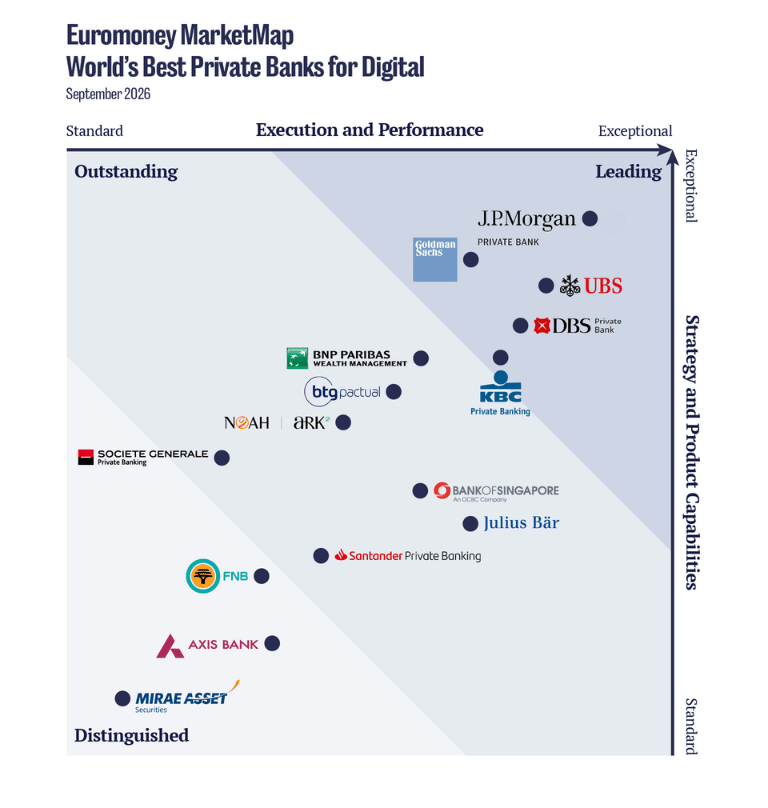
JPMorgan Private Bank
JPMorgan sets the benchmark for this ranking. This truly end-to-end, mobile-first experience – anchored by the redesigned JPOI app – drove a significant jump in active mobile users and pushed the majority of eligible trades online. Its LLM Suite and Connect Coach co-pilot give it a clear AI edge, while $600 million of annual cybersecurity investment, mandatory 2FA and FIDO adoption make security exemplary. Exemplary feature, direct-to-client nudges run more effectively than industry norms. Cross-border onboarding remains marginally slower, but otherwise the bank leads on all fronts.
UBS Global Wealth Management
UBS pairs one of the most immersive client experiences in the study with deep AI maturity. Circle One – the self-styled ‘Netflix of wealth’ – and the My Way mobile mandate builder doubled average monthly users and more than tripled structured-product digital revenues during the review period, with three quarters of equity trades now online. Its Red AI assistant and agentic, multi-agent architecture deliver near complete front-office adoption. WhatsApp and WeChat servicing make collaboration frictionless, and the UBS Access app powers over tens of millions of secure logins monthly. Self-onboarding is strong, though full KYC automation still trails its client-experience scores.
Goldman Sachs
Goldman’s unified wealth platform – spanning mobile, web and adviser-led conversations – saw mobile users continue to grow significantly throughout the review period, with integrated trading, Addepar aggregation and rich alternatives transparency. Its GS AI assistant and Translate AI continue to evolve, and co-browse plus a secure message centre make collaboration seamless. Multi-layered security with behavioural analytics is robust. The guided onboarding journey – capture, e-sign and fund in a single session – is strong and improving.
DBS Private Bank
DBS continues to punch above its weight as a recognised global digital leader. The digibank app’s consolidated view of traditional and digital assets drove a significant rise in UHNW/HNW usage, while DDEx trading volumes are up eightfold since 2022. AI is industrialised rather than experimental: more than 1,000-plus models across hundreds of use cases delivered measurable economic impact, and DBS-GPT streamlines account opening. Institutional-grade custody with 100% air-gapped cold storage and operational losses four times below benchmark make risk management best-in-class. AI-driven KYC screening has halved onboarding time to 14 days.
KBC Private Banking
KBC leads Western Europe on the strength of a world-class app. Its Kate digital assistant resolves 90% of queries correctly and is 70% fully autonomously, freeing bankers for advisory. AI-driven insights now support more than 100,000 personalised portfolios, and layered fraud monitoring, MFA and the novel ‘check who’s there’ caller-verification feature keep security strong. Fully digital post-meeting onboarding brings in thousands of new private clients a year, with caller-authentication and recording features slightly ahead of its communications maturity.
BNP Paribas Wealth Management
BNP’s myWealth V3 delivers a polished 24/7 experience, with online trading tripled and the vast majority of low-value equity transactions executed digitally. Its AI-powered RM Workbench, Genix LLM platform and Speech AI compliance tools are promising and maturing versus its US peers. WhatsApp Business and Symphony integration surged chat-based transactions during the review period. The internally hosted Genix platform underpins secure AI, and smart KYC tooling delivers major screening efficiency gain – leaving communications and AI as the areas with most headroom.
BTG Pactual
BTG anchors Latin America with the overwhelming majority of private clients active on digital channels via an app-and-portal hub whose Investment Aggregator consolidates custody and Open Finance data for full transparency. Its Client Summary AI tool and Personalization Flow engine help bankers prepare efficiently, while a WhatsApp virtual assistant merges conversational convenience with secure transactions. Multi-layer protection and a dedicated cyber team simulating breaches keep the platform resilient.
ARK Wealth Management (Noah)
ARK’s iARK app shows some of the highest engagement in the review period – with account opening compressed from days to as little as two hours. Its AI framework brings automated diagnostics, 3D customer portraits and the Nora AI relationship manager. Digital engagement climbed and a security-by-design architecture with end-to-end encryption and retrieval-augmented generation (RAG) pipelines underpins operations. Onboarding is fast and KYC is intelligently layered (KYP/KYA models), leaving communications and cyber maturity as the next frontier.
Bank of Singapore
Bank of Singapore fields a strong platform with high relative digital adoption and a complementary IX platform for family offices that has boosted logins and moved the vast majority of their trades online. Its AI hub co-pilots are impressive – the Source of Wealth Assistant cuts report generation from 10 days to one hour – and the Bedrock engine achieves accuracy with a cut in false positives. The One Platform workbench and next-generation core engine onboarding are strong, with collaboration and onboarding the areas still scaling.
Julius Baer
Julius Baer’s Wealth Navigator unifies planning, advisory and discretionary offerings in one workspace, achieving near complete adoption across its advisory locations and booking centres. Its Instrument Recommender, Insights Content Hub and embedded JAI assistant give it a solid AI and compliance record during the review period, with suitability checks baked into every recommendation. Onboarding is largely digitised, though KYC technologies are developing. Two-way client-RM engagement via e-banking is also advancing.
Societe Generale Private Banking
SGPB’s digital transformation, anchored by Espace Investissements and the Synoé engine, validates automated recommendations online in minutes, plus Coach Financier for self-directed clients. Secure e-signature features in the majority of subscriptions, and a security-by-design approach with GDPR compliance and group-level cyber collaboration underpins trust. Onboarding – blending e-signature, video-conferencing and Mifid refreshes – is a genuine strength. AI remains algorithmic rather than generative, however, and video-conference-led communications keep its collaboration and cyber scores developing.
Santander Private Banking
Santander’s Digital Wealth app gives affluent Latin American clients a cloud-native offshore platform with paperless onboarding, digital identity verification and e-signature that cuts time-to-invest and lifted funded accounts post-launch. The Brazilian Toro app adds structured-equity recommendations with real-time, push-based execution. AI-powered market insights halved report preparation times, and the OpenShift-based architecture is secure and scalable.
FNB Private
FNB leads the African field with a personalisation-first approach: its Solution Recommendation Engine spans app, online, USSD, FNB.mobi, serving 950 million solutions monthly, while the nav» Earth platform extends banking into lifestyle and energy advisory. AI powers three of four engine components using more than 100 unique data sources, and generative AI cuts campaign build time from three months to three days. Cybersecurity is governed by an ISO 27000-aligned, five-layer defence with board-level reporting. Digital onboarding aligns to FirstRand’s compliance programme, though digital-trade penetration and onboarding remain its softer metrics.
Axis Bank Limited
Axis brings a distinctly omnichannel, collections-oriented digital model – multilingual journeys, WhatsApp, IVR, voice bots and a DIY Virtual Debt Manager – backed by predictive, generative and agentic AI for hyper-personalised, vernacular engagement. Secure campaigns span multiple platforms with model-driven fraud reduction.
Mirae Asset Securities
Mirae Asset’s Digital PB Advisory Solution supports self-directed wealth management at scale and a proprietary robo-adviser. Generative-AI advisory tools reach clients at scale, and a standout security record – zero data breaches or IT incidents from 2022 to 2025 – anchors trust. AI-powered translation and a vast video-education library round out the offering.
From copilots to agents: AI takes on the workflow
A year ago, this report described AI as private banking’s ‘everyday companion’ – a helpful presence at the adviser’s elbow: summarising research, drafting emails and answering questions.
The banks leading the 2026 MarketMap are no longer simply giving their staff chatbots. They are deploying multi-agent systems that own entire workflows from end-to-end: parsing client documents, drafting compliance memos (and proof-reading and formatting them), with the human repositioned from AI operator to reviewer. The previous copilot era asked: What can AI answer? The coming agentic era asks: What AI can finish?
The numbers tell the story of a technology crossing from pilot to production. Speaking with Euromoney, one global US bank said its LLM platform had processed tens of millions of prompts since its mid-2024 launch, with more than 500 AI use cases being explored across the firm. Another pure-play private bank’s proprietary assistant handled more than 1.4 million prompts in its first year alone – making it the most rapidly embraced platform in the bank’s history. Goldman Sachs, which rolled out a firmwide AI assistant in mid-2025, called 2026 its “year of scale”.
The strategic divide identified in last year’s report – between banks that treat digital transformation as business strategy and those that view it as IT – has become more profound. The leaders are industrialising; the rest are still experimenting.
The adviser copilot grows up
The copilots profiled in the 2025 MarketMap have not disappeared. They have matured, and their impact is now measurable in time and dollars rather than enthusiasm.
More striking than the volume is the sophistication. These copilots no longer just retrieve approved private bank investment views; they prepare client meetings, build the starting framework for presentations, and surface curated, timely investment ideas. As a leading private bank’s digital executives tells Euromoney: “The system can now tell an adviser, in effect – you spoke to this client two months ago, she was interested in yield opportunities in this range, she received an inflow of $500,000 yesterday, and this new investment opportunity is exactly what she was looking for. Call her this morning.”
Another good example came from a leading private bank, whose copilot indexes its research across 4,000 securities and lets relationship managers “talk to” the entire library. More than 50% of RMs now use it daily. “So far, our co-pilots have been focused mainly on productivity and time savings,” the bank’s platform lead tells Euromoney. “It’s mainly been augmentation – augmenting what they do, rather than any independent decision-making or going straight out to the clients.” That restraint is deliberate – and increasingly the exception.
Smaller institutions are proving the model also scales down. A European private bank told Euromoney it has connected LLMs to its internal APIs, so advisers can query a client’s portfolio performance and history in seconds without any data leaving the bank. That lets advisers manage larger books while preserving the personal service level private banking clients expect. Another bank detailed how its LLM knowledge assistant gives relationship managers instant answers on products, processes and regulation, while a client-facing assistant executes hundreds of transactions everyday through natural language, around the clock.
Finally, Goldman Sachs has focused its copilot investment where a global UHNW franchise feels friction most acutely: language and paper. An AI translation tool renders complex financial content into a client’s preferred language in seconds rather than hours – a capability few general translating solutions can match at private banking standards of precision – while a companion document tool is expanding automated scanning of tax, trust and private banking documents.
The agentic leap
The defining innovation of this year’s research was the arrival of genuinely agentic AI: systems composed of multiple specialised agents that hand work to one another and complete complex processes with humans checking in, rather than typing instructions.
A good example is Bank of Singapore’s Source of Wealth Assistant, launched in late 2025. The system chains seven agents – an income document expert, a financial document expert, a human-in-the-loop checkpoint, an income benchmarking agent, a memo writer, a proof-reader and a formatter. This is supported by a toolset that includes a PDF parser, a vision processor for layouts and tables, an internal data-lake reader and a wealth calculator. It ingests pay slips, financial reports, property and tax documents in any format, validates the data against bank records and past approved cases, and produces a standardised, compliance-ready source-of-wealth report. Because the assistant is built into the client onboarding journey rather than offered as an optional tool, the bank expects adoption among RMs to approach 100%.
Another private bank’s credit collection function has become a live laboratory for autonomous AI. “There are three parts to it,” a senior executive explains to Euromoney. “One is the predictive, the generative and the agentic. Agentic is the more autonomous.” Predictive models assess repayment probability; generative models decide the optimal timing, language and content of each customer communication; and agentic AI acts on its own – identifying, for example, accounts where a salary lands on the third of the month but an instalment falls due on the second, and sending the right nudge at the right moment. Customers can settle loans in minutes instead of days. The bank’s ambition is for 40% of credit collection activities to move fully into agentic AI, and it is building what it calls “super agents” to get there.
A large US universal bank spoke to Euromoney about its process of constructing agentic frameworks designed to handle complex client intents – including voice-to-text interfaces backed by intent engines – but is candid that the harder problem is not capability but containment. Client-facing agents operate inside strict guardrails: the system must never respond to requests it should decline, must keep a human in the room before anything resembling advice is given automatically, and must answer in the bank’s own voice rather than that of the underlying model. The bank’s framing is a useful motto for the whole industry’s agentic moment: digitally enabled, not digital-only.
AI moves into the control room
If 2025’s copilots lived in the front office, 2026’s agents are just as likely to be found in compliance – a shift with implications for the economics of private banking, where regulatory process has long been the largest hidden cost of growth.
Julius Baer has embedded AI directly into name and media screening, increasing both the accuracy and speed of its KYC and due-diligence processes. Its proprietary assistant automates meeting summarisation, secure document retrieval, multilingual communication and standardised client-file reviews; automated transcription alone saves more hundreds of hours annually. Likewise, Bank of Singapore applies AI to name screening as well, using entity recognition to identify proper nouns across client documents and track changes over time, lifting a burden from RMs while improving consistency.
BNP Paribas Wealth Management’s Speech AI platform shows how a single system can serve risk and revenue simultaneously. Trained on the bank’s own data, it transcribes and analyses client calls, across landline, mobile and Microsoft Teams, with high accuracy in English, Cantonese and Mandarin. Natural language processing extracts critical events and discussion topics, accelerating compliance checks and simplifying investigations, while the same analysis gives commercial teams insight into call types, coverage models and campaign effectiveness. Human oversight remains integral: AI-generated alerts and scorecards are reviewed by people, and access is tightly controlled and audited.
Governance becomes the differentiator
With scale has come discipline. Every leader in this year’s study paired its AI expansion with a formal governance architecture – and the sophistication of that architecture is becoming as much a competitive marker as the technology itself.
One large European private bank detailed to Euromoney how its applications are overseen by a responsible-AI council enforcing standards of fairness, transparency and human oversight; its ‘human-in-the-loop’ model aims to ensure technology enhances professional judgement rather than replacing it. “True innovation delivers value responsibly,” the bank tells Euromoney. “Ours is client-led, operationally embedded and scaled with discipline.”
Behind the governance sits an arms race for talent. JPMorgan bank now fields the largest AI workforce among the world’s top 50 banks: more than 2,000 AI and machine-learning specialists, 900-plus data scientists, 600 ML engineers and a research team of more than 200 – a commitment recently profiled in a Harvard Business School case study on leadership in the age of generative AI.
What comes next?
While the private banks profiled in this MarketMap leave little doubt about the future direction of AI investment, the most consistent message from the industry’s leaders is one of restraint at the client boundary. The banks furthest ahead are those most careful about which decisions they hand to machines: augmentation inside the bank, agents in the back office, and (for now) a human voice wherever advice meets the client. The question the next 12 months will answer is not whether agentic AI works in private banking. It demonstrably does. The question is which banks can afford to run it at scale – a question of economics as much as engineering, and the subject of the ‘Proving the Return’ chapter below.
Hyper-personalisation at scale
Last year, UBS described the bank’s ambition to treat its clients as “a segment of one”. Hyper personalisation is now the goal for the entire industry.
What changed is the machinery. The leaders in this year’s MarketMap are no longer treating personalisation as a marketing overlay but as core infrastructure: recommendation engines fed by hundreds of data features; propensity models that decide who hears about what and when; and AI that adapts not just the advice but the tone of voice it arrives in. Crucially, they can now prove it works through conversion rates, net inflows and assets migrated from self-service into advised portfolios.
The recommendation engine becomes a revenue engine
One example comes from South African bank FNB Private’s Solution Recommendation Engine. It appears to private banking clients as a personalised ‘just for you’ screen, drawing on more than 130 feature sets and over 1,400 individual features from the bank’s data reservoir: spend patterns, life stages, source-of-funds signals and behaviour within the app itself. The engine drove an increase in user interaction engagement on the personalised screen, with total interactions nearly doubling and sales conversion on the platform rising.
Personalisation as an upgrade path
If FNB shows personalisation driving volume, Societe Generale Private Banking demonstrates its value by moving clients up the advice ladder.
Its integrated digital ecosystem is built around a digital advisory solution. The algorithm analyses a client’s profile, market backdrop and the house investment strategy – drawing on the bank’s economists, portfolio managers and product engineers – to generate automated recommendations, updated daily and executable in minutes, from the app. Adoption has accelerated, with structured-product mandates nearly tripling in under a year, which the bank attributes to the smooth integration of multiple strategies within a single contract.
The true innovation is the free, proactive digital coach for self-directed clients that monitors portfolios, detects those needing adjustment and serves personalised recommendations within an internal investment universe. It supports thousands of clients and is moving to towards €1 billion in assets under advice. Close to half of those clients have already upgraded to a premium solution.
From calendar to signal
Personalisation is also transforming when the bank reaches out to clients, not just what it says. Belgium’s KBC has replaced the traditional calendar-driven meeting schedule with an event-driven model powered by intelligent leads. Dozens of lead types have been rolled out to private bankers, with the majority of them relating to investments: a large client deposit sitting in cash; a portfolio drifting from the house strategy; an unsigned proposal; a company announcing a capital reduction; even signals of a client’s willingness to sell real estate.
This proactive approach generated near half a million leads in the 12 months after its rollout. Its quality control has dedicated lead managers to monitor effectiveness and a system that generates what the bank calls “serve leads”: a prompt to call a client even when no product signal has surfaced in a while.
KBC is not the only private bank applying this signal-driven logic. Another leading private bank is delivering personalised, suitability- and cross-border-checked investment ideas to clients and advisers within seconds. On average, 25% of the bank’s clients receive targeted content in near-real time, matched to preferences, risk tolerance and eligibility, while after-sales notifications – fund updates, risk mismatches, downgrades, corporate actions – have reached 92% client adoption. The annualised front-office saving has been $2.6 million, and the 2027 ambition is full digitisation of the product universe with straight-through execution of ideas by clients.
Knowing the whole client
The frontier of personalisation is completeness – seeing the client’s entire financial life, including those held at other private banks. BTG Pactual’s Investment Aggregator, expanded in 2025 into a comprehensive analytical report, consolidates internal custody data with external holdings via Open Finance, letting clients visualise total wealth by liquidity, allocation strategy and market exposure. This gives its wealth managers the full picture on how their advice impacts a client’s overall portfolio. On top of it sits the bank’s new Personalization Flow, a proprietary engine that converts portfolio positions, transaction behaviour, demographics and platform usage into automatically delivered, individualised recommendations through an app and portal. The Client Summary AI briefs bankers before every meeting on history, asset composition and preferences.
Goldman Sachs is pursuing its own form of client completeness. The US bank approaches client archetypes in a deeply customised way: dashboards and reporting are presented in a way that represents how the client actually thinks about their total wealth; from grandchildren’s trusts, to operating companies and other family members. The ambition is to get the default client experience “90% of the way there” in terms of reflecting a client’s overall financial situation, before the adviser adds the last mile.
Turkey’s İşbank is a good example of what can be achieved in more local markets. Its private banking arm builds propensity models for its top 1,000 clients and personalises campaigns in real time on behavioural, sector, merchant and location signals. Its KYC dashboard captures interests, hobbies and preferences so that personal knowledge survives RM turnover.
The personalisation stack
A common architecture emerges across the examples in this chapter: complete data, interpreted by models (propensity, eligibility, personality), delivered as signals (leads, nudges, content) through whichever channel the client inhabits. The banks that have assembled the full stack are moving idle cash and self-service into advised relationships.
The AI-native client journey: Prospecting, onboarding and KYC
Onboarding – with its questionnaires, wet signatures, source-of-wealth interrogations and weeks of compliance back-and-forth – has long been private banking’s great paradox: the richer and more complex the client, the worse their first experience of the bank.
Last year’s MarketMap concluded that the institutions able to ‘finally tame onboarding complexity’ would be positioned to dominate this market positioning report. Twelve months on, the most successful private banks have rebuilt the journey around AI and moved its starting line back to before the client is a client at all.
Winning them before they sign
The most striking innovation in this year’s research comes from a global universal bank, which is piloting a fully digital onboarding experience that begins at prospect level – a move the bank believes is without precedent.
The mechanics are borrowed from leading consumer technology. A prospect downloads the app, photographs their driving licence and watches their information populate automatically. From there the journey is deliberately curated: an introduction to their adviser, an explanation of relevant services, a transparent view of what the bank already knows and an invitation to share more. “It isn’t going to feel like a DocuSign experience,” the bank’s digital leadership tells Euromoney. “It’s really going to feel much more personalised, much easier – a curated, arms-around-you type of experience, [rather than] a clinical approach to onboarding.”
The strategic insight is in the timing. Prospects gain access to the bank’s online platform long before an account exists, receiving research digests and content matched to their interests, so that by the time they convert, they have already seamlessly entered the bank’s digital environment. For firms whose UHNW scrutiny requirements make onboarding uncommonly complex, the effect is to make a complicated journey feel simple at the point first impressions are formed.
Industrialising the onboarding factory
Away from the client side of the journey, another leading Asian private bank is re-engineering its machinery. Its new onboarding and relationship-enablement platform, piloted in 2025, digitalises workflows and case management, centralises documents, automates client risk scoring and embeds the gen-AI source-of-wealth assistant directly into the journey. This bank has ambitious plans, telling Euromoney it is targeting 50% shorter onboarding turnaround, a doubling of onboarding capacity, and a 1.5x uplift in net new money, on the logic that money committed arrives faster and leaks less.
The bank is equally candid about where the old process broke. “Previously, there were up to five back-and-fourths between the client and document checkers, because the clients weren’t being guided systematically on what documents are expected and what good looks like,” its platform lead explains to Euromoney. Guided workflows – document expectations made clear from the start, with the source-of-wealth assistant drafting to compliance standard – are designed to “get it right first time and cut the number of cycles from five to a maximum of two,” bringing onboarding turnaround below 15 days. In a private banking context, where complex cross-border cases can drag for months, that is a step change.
Government rails and perpetual compliance
In the Middle East, Mashreq Private Banking demonstrates what becomes possible when a bank plugs its onboarding directly into state digital infrastructure. Through integration with UAE regulatory authorities, documents are validated at source and identity confirmed by electronic facial recognition. For business clients, a trade licence can be authenticated directly against the licensing authority, so information is fetched rather than typed. Its propriety KYC engine is integrated into the platform itself, steering clients back through refreshed checks and suitability assessments when needed.
The compliance model is shifting from episodic to continuous. The bank has replaced case-by-case checks with perpetual name screening: every client, new or existing, is screened continuously, with rule-based logic discounting false matches automatically. Julius Baer reports the same direction of travel: AI embedded in name and media screening has significantly increased both the accuracy and the speed of its KYC and due-diligence processes – strengthening controls and accelerating turnaround.
First impressions, made digital
Europe’s top private banks show that a fully digital first day is now expected at the top of the market – and that it can feel like luxury.
KBC guides thousands of new private banking clients a year through fully digital onboarding. In a few clicks, a new client opens and signs everything from the global service agreement to an advisory portfolio and investor account; the investor profile is created and signed digitally; every document lands in a secure digital vault, with KYC rules in full force throughout.
The payoff, in numbers
What distinguishes this year’s onboarding successes from previous cycles of “digital KYC” enthusiasm is that the returns are now being counted in revenue. The Asian private bank’s 1.5x net-new-money target attaches a growth number to speedier onboarding. Another bank’s 20-point STP improvement converts directly into capacity. The example shared earlier of the bank’s prospect-level journey is, at heart, a client-acquisition mechanism within an onboarding tool. And every bank interviewed made a version of the same observation: data captured in a truly digital onboarding – structured, validated, machine-readable from day one – becomes the foundation on which personalisation is built.
Meeting clients where they are: Mobile, conversational and omnichannel
In 2026, the question is no longer whether a private bank’s app is first-rate but whether the firm is present wherever its clients are: on WhatsApp between meetings; on Teams from a yacht; in a super-app that books restaurants. The leaders have stopped asking clients to come to the bank’s channel and started taking the bank to clients.
Mobile becomes the main branch
The direction of gravity is beyond dispute. The most recent Euromoney Private Banking Awards showed that demand for mobile has surpassed web-based services. For example, one leading bank demonstrated how its client research distils what wealthy users want from the channel into four priorities: convenience and speed; real-time portfolio analytics amid volatile markets; efficient execution on the go; and uncompromising security. Its international platform for UHNW clients in Asia and EMEA answers them directly, down to details such as confirming wire transfers in-app rather than by phone call, and full accessibility compliance so that mobile innovation excludes no clients.
Another global universal bank told Euromoney that between 2021 and the first half of 2025, total active users of its client wealth platform grew by a quarter – but app users more than doubled versus 16% for web. Clients move fluidly between mobile, web and adviser-led conversations, self-serving when convenient and collaborating when decisions carry weight.
Self-service trading grows up
The self-directed trading tools that were new in last year’s MarketMap have become mature franchises with deliberate strategies behind them. A leading private bank’s client platform now shows 89% digital adoption, with 70% of trades in applicable products executed online – up from 50% just two years ago. Logins to its platform for external asset managers are up 400% year-to-date, with 95% of that channel trading online. The 2026 roadmap adds FX cash and exchange-traded options to online trading, plus self-service account maintenance.
What distinguishes the bank’s approach is its discipline on scope. “We don’t want to venture into products that are predominantly offline,” its platform lead tells Euromoney, citing complex FX derivatives such as target redemption forwards. “It’s too complex; it’s unlikely to move online.” The goal is not digitising everything, but achieving 70% online execution in every product the platform does offer – a selective philosophy with cost implications this report returns to in the ‘Proving the Return’ chapter below.
Mashreq has addressed the same tension – sophisticated versus occasional traders – through design rather than scope, offering dual journeys on one platform: a simplified flow for clients who want quick execution, and an advanced interface with technical analysis tools for high-frequency traders, each shaped by persona research and user testing.
The conversation moves to the client’s channels
The boldest development of the year is conversational banking in the messaging apps clients already live in. BTG Pactual launched a virtual assistant on WhatsApp through which clients perform banking operations by talking: executing instant transfers, even photographing an invoice and letting the AI recognise the intent and process the transaction automatically. The bank calls it a milestone in making private banking “more accessible, immediate, and human” – and it is the clearest expression yet of a principle every leader in this chapter shares: meet the client in the channel they use most.
Bank of Singapore, meanwhile, is solving the compliance problem that has kept most private banks out of consumer messaging. Its architecture registers bank-issued numbers with mobile providers and pipes SMS conversations into a corporate collaboration platform – where surveillance, recording and compliant order-taking all operate. WhatsApp and WeChat functionality will follow shortly.
The super-app
The omnichannel philosophy exemplified by Santander in last year’s MarketMap is now producing new franchises outright. Its wealth app, launched from a US offshore hub in late 2024, is a fully digital offshore proposition for affluent Latin American clients. It offers paperless onboarding with digital identity verification, risk profiling and e-signature, cutting time-to-invest by up to 90% versus traditional methods, with self-onboarding added in mid-2025. In Brazil, its investment platform pushes structured-product opportunities to clients as instant notifications with real-time execution. In its home market of Spain, a real-time tax module on web and app gives clients a live view of the tax status of all their holdings. In another European market – where digital adoption has climbed – a service tracker lets clients follow requests in real time inside the app while keeping their banker in the loop.
One backend, every surface
Underneath the proliferation of channels, the winning architecture is singular. A private bank demonstrated to Euromoney how it runs its three platforms – one for clients, one for external asset managers, one for staff – as “a continuum of feature sets” on one backend, one team, common microservices. “If an RM sees something different from what the client sees, that’s the genesis of so many complaints,” its platform lead notes. “It’s a common backend, common microservices, but a differentiated experience based on whose eyeballs we’re trying to reach.” Santander’s synchronised web-tablet-mobile continuity, Goldman Sachs’ fluid mobile-web-adviser experience and Mashreq’s consolidation of four or five legacy systems into a single core all express the same strategy: clients experience many channels; the bank must run one.
Security
Every innovation described in the preceding chapters – agents that draft compliance memos, onboarding that begins with a photographed licence, banking that lives inside WhatsApp – expands the surface a private bank must defend. And the adversary has been upgrading, too. The same generative AI that powers adviser copilots now powers convincing impersonation at industrial scale: cloned voices, fabricated documents, phishing that reads like it came from a genuine family office. U/HNW clients, with their public profiles, dispersed households and staff, remain the most tempting targets in finance.
A decisive shift on both sides of the wall is visible in this year’s MarketMap. Defensively, the industry is dismantling the legacy trust signals – passwords, SMS codes and phone calls – that AI-enabled fraud is targeting. Offensively, banks are deploying AI to read transactions, documents and networks at scale.
The end of the password
JPMorgan’s JPOI platform demonstrates where authentication is heading: biometrics, in-app identity authentication and mandatory two-factor authentication. JPOI is the first platform within JPMorgan Chase to adopt FIDO, the cryptographic authentication standard that resists phishing by design. High-risk activity triggers real-time alerts; self-serve fraud tools let clients review suspicious transactions and instantly lock their own accounts; concurrent login limits close another door.
Most telling is what has replaced the callback – for decades the industry’s default verification and now one of its most exploitable. In the US, a digital payment-verification feature lets clients approve payments initiated through their service team in two clicks inside a fully authenticated app, eliminating traditional callbacks altogether. And when a client speaks with their service team, a registered trusted device verifies their identity in seconds – the authentication moving from what a voice sounds like to what a cryptographic key can prove.
Proving who’s who
The defining threat of the AI era is impersonation – of both the bank and the client.
KBC has given clients a button for the question everyone now asks. “How can you be sure you’re talking to us and not a scammer?” – the answer being a feature on its mobile app’s home screen that instantly confirms whether the person calling or messaging is genuinely from the bank. It sits within a full client-protection kit: a 24/7 security line, an option to hide balances by shaking the phone, real-time AI monitoring of payment orders, and awareness content addressing threats as specific as money-mule recruitment.
Other leaders are solving the same problem by controlling the channel itself. İşbank routes sensitive client instructions through Dialogue, its secure in-app messaging service, where every instruction is verified and backed by two-factor authentication. Axis Bank Limited in India goes further: every customer communication the bank sends passes through a single controlled gateway, ensuring a message that claims to be from the bank is from the bank. Continuous education across email, SMS and WhatsApp teaches customers how to verify the rest.
Different architectures, one conclusion: in a world where anything can be faked, authenticity must be engineered and not assumed.
AI takes over financial-crime detection
On the offensive side, the deployment of AI and ML for detection had more than 80% accuracy in fraud detection and a 70% reduction in false positives for one bank Euromoney spoke with. This method combines analysis of client profiles and transactions into contextual monitoring that surfaces high-quality alerts; complex-network detection that maps relationships no analyst could hold in their head; and fraudulent-document detection that reads what humans miss. The benefit is a holistic, single-layer investigation process, and less effort wasted on false alarms.
The same pattern – machines reading everything, humans judging what matters – recurs across those banks featured in this MarketMap. BNP Paribas’s Speech AI transcribes and analyses client calls for surveillance points and compliance events, which are then reviewed by humans. Julius Baer’s AI-driven name and media screening sharpens KYC accuracy while accelerating it. ING pairs real-time fraud detection and anomaly analysis – suspicious activity identified and blocked immediately – with ISO 27001 alignment and regular penetration testing. BTG Pactual layers device-level authentication with behavioural analysis; its dedicated cybersecurity team running constant monitoring and breach simulations.
The fortress and its governance
Behind the visible innovations sits the machinery that regulators – and increasingly clients – now inspect. FNB Private’s cybersecurity framework is one of the most comprehensive examples in this report. Using FirstRand’s ISO 27000-aligned information security management system, the bank manages security across identification, protection, detection, response and recovery. Governance is reinforced through annual policy reviews, biennial technical standard updates, quarterly board-level reporting, regulatory reviews by the South African Reserve Bank, independent penetration testing and red-team exercises, and mandatory encryption or tokenisation of data both at rest and in transit.
Societe Generale Private Banking calls its equivalent philosophy “security by design” – protection integrated from conception, with vulnerability testing, audits and cyberattack simulations run continuously, and every digital validation executed in a protected environment. Bank of Singapore organises its posture into four verbs – review, transform, react, develop – a cycle of governance, next-generation tooling, resilience drills and workforce training.
The human layer
Every chief information security officer interviewed for this report agrees on where the perimeter sits: with people. KBC runs a compulsory security-awareness programme for its entire staff, alongside a client-facing curriculum featuring dedicated web resources, push notifications and an in-app academy covering topics from “why might the bank call you?” to money-mule schemes. Another private bank sends clients updated cybersecurity articles every two months and works on the problem in real time. “We have tools today that tell us if there’s a fake site out there impersonating us,” a senior executive tells Euromoney. “We get notified in real time – and then it gets taken down.”
Conversely, DNB Carnegie invests less in broad client education, reasoning that in a true private banking relationship the adviser is the safeguard – a trusted human who knows the client well enough to smell a fraud, with enhanced measures such as four-eyes authorisation reserved for clients who want them.
Overall, security has become inseparable from experience. The banks leading this MarketMap are not choosing between frictionless and safe; they are engineering authentication that is both. Trust, always private banking’s core product, now has a technical specification.
Digital assets go mainstream
Digital assets were not spotlighted in last year’s MarketMap. But today, their place in the industry has shifted significantly.
The catalysts are well known: a crypto-friendly policy turn in the US, including the GENIUS Act’s recognition of stablecoins within the Treasury market; the approval of spot Bitcoin ETFs in January 2024; and the April 2025 ‘Liberation Day’ repercussions. But there is a structural force that matters far more to private banks – the generational transfer of wealth to clients for whom digital assets are not a curiosity but part of the portfolio conversation. As DBS put it, clients today expect to see digital assets on the private bank’s platform alongside more traditional investments such as equities.
What separates the leaders from the laggards is no longer whether they offer crypto. It is whether they have built the surrounding architecture – custody, research, credit, structured products, tax awareness and succession planning.
The full-stack pioneer
DBS has pushed digital-asset adoption among private bank clients more than most. Its digital exchange launched in 2020 and that prescience is now paying off. In the first half of 2025, the bank’s UHNW and HNW clients traded more than $1.4 billion in cryptocurrencies and over $1 billion in crypto-linked instruments. Trading volumes in 2025 grew four times year-on-year and are up eight-fold since July 2022, while volumes between January and October 2025 were almost seven times higher than for the entirety of 2023. The number of unique clients trading crypto nearly doubled year-on-year, and penetration across the private bank’s accounts has reached the teens in percentage terms – a level with few, if any, peers globally.
The differentiation lies in its ecosystem. The bank does not just offer a 24/7 trading platform and associated research and forecasts. DBS has also built a leading product set that few crypto-native exchanges can match. Clients can trade options strategies on cryptocurrencies to earn yield and manage exposure, as well as access crypto ETF-linked notes. There are even tax-arbitrage use cases: because many jurisdictions treat capital gains on digital coins themselves differently from gains on crypto ETFs, sophisticated clients actively trade between the two – a manoeuvre only possible on a platform that offers both sides. Lending against digital assets is next, with loan-to-value financing on coins scheduled for the coming year.
Custody: the missing link, found
For years, the barrier between HNW money and digital assets was not access but trust. Exchanges collapsed, keys were lost and hacks proliferated. The banks now leading this category understand that institutional-grade custody, not trading, was the real product.
DBS holds client digital assets in 100% air-gapped cold storage – a deliberate contrast with crypto-native exchanges, which typically run part-hot, part-cold wallets for operational efficiency. Cryptographic key generation, management and storage are governed by controls of the standard one would expect from an institution consistently ranked among the safest in Asia. Client assets legally and beneficially belong to them, segregated both from the bank’s proprietary assets and from those of other clients. Clients’ verdict on this approach has been emphatic: digital assets under DBS custody grew 20% in 2024 and now exceed the bank’s custody of physical gold.
From portfolio to posterity
Perhaps the clearest sign that digital assets have entered the private banking mainstream is that they are now part of the succession conversation. DBS was among the first in its market to integrate digital assets into legacy and succession planning, and its trustee arm was among the first bank-backed trust businesses anywhere able to hold digital assets. The demand is real: according to the bank, one client established a trust in which digital assets make up most of its total value.
Europe’s measured entry
If Asia’s story is one of first-mover scale, Europe’s is one of careful, regulated construction.
BBVA was among the first tier-1 banks in Europe to offer fully integrated crypto trading and custody in 2021 through its Swiss private bank. Its digital investment platform has since evolved into a unified account in which equities, funds and ETFs sit alongside Bitcoin, Ethereum and USDC in a single portfolio view. That eliminates the fragmentation that once pushed clients toward external fintech channels. Adoption has reportedly outrun the bank’s own expectations, supported by a fully digital onboarding that takes under 15 minutes. Going forward, Solana, Cardano and Avalanche are being added to the platform.
KBC, meanwhile, illustrates how a bancassurance model can approach the asset class on its own terms. Together with eight other European banks, it has joined a consortium to launch a MiCAR-compliant, euro-denominated stablecoin, in a bid to create a trusted European payment standard offering near-instant, low-cost, programmable, 24/7 cross-border settlement. Cryptocurrency trading will be available on the bank’s execution-only platform, with a characteristically prudent twist: holdings will be non-transferable, eliminating money-laundering risk at the design stage. A new application – the first built on the group’s flexible blockchain platform – lets private banking clients securely catalogue art, jewellery and other valuables with their documentation, an exclusive service that hints at where tokenisation of real-world assets may take the client experience next.
The next wave: tokenisation and yield
Every leader in this category is already positioning for what follows spot trading. DBS launched Asia’s first retail tokenised fund, in partnership Franklin Templeton, with access from just $20 – a demonstration of how tokenisation collapses ticket sizes and democratises access. Tokenised gold, listed on the blockchain, was launched in June 2026, with tokenised structured products under exploration. The bank expects growing client interest in yield-generating instruments such as Ethereum staking – income streams beyond spot exposure – and in accessing private markets through the tokenisation of real-world assets, bringing liquidity, fractional ownership and efficiency to historically illiquid opportunities.
Proving the return: The economics of digital transformation
For the first time, leading private banks are publishing hard revenue and cost figures against individual digital initiatives. The timing is no accident. The final section of this report explores how generative and agentic AI carries an economic profile unlike anything the industry has deployed before: a variable, usage-driven cost that grows with every workflow it automates.
Part one: From adoption metrics to P&L
The fullest disclosure in the study
No bank opens its books further than one leading Asian private bank, whose digital programme reads like an investor presentation. Its client platform targets a $50 million year-on-year revenue uplift by 2027 – with $20 million already achieved in year one. Its order management system delivered a $15 million revenue uplift in 2025 through new product onboarding and OMS augmentation, on a path to $60 million of incremental revenue plus $2.4 million of cost avoidance by 2027. Whole-portfolio advisory has added $1.7 billion in AUM. Its content engine saves $2.6 million a year in front-office costs; its AI hub another $1.1 million. Its onboarding platform carries a 1.5x net-new-money target. Even employee satisfaction has a number attached: a 15% targeted uplift.
What makes these figures more than marketing is the governance behind them. “All adoption and benefit metrics are reviewed and agreed with the finance team,” the bank tells Euromoney. It is a quiet institutional shift with large implications: when finance signs the benefits, finance also starts deciding the pipeline.
Revenue you can point at
Across this MarketMap, digital initiatives come with attributable money. A European private bank’s digital advisory solution gathered €495 million of net inflows in the first 10 months of 2025, while its free digital coach converts 43% of users into paying premium relationships. FNB Private’s recommendation engine lifted platform sales conversion significantly in just six months post launch, producing hundreds of thousands of validated digital sales; more than half of all unsecured loans now flow through it. DBS’s digitised credit-linked-note launch boosted the bank’s orders and revenue within months of its introduction. The productivity tools of the ‘Copilots to Agents’ chapter above translate directly into capacity: JPMorgan’s adviser copilot has saved an average of 10 minutes on hundreds of thousands of adviser enquiries.
The scale benchmark – and the scale question
At the top of the market, the raw numbers are formidable. JPMorgan invests $18 billion a year in technology, $600 million of it in cybersecurity, and fields more than 63,000 technologists including 2,000 AI and ML specialists – a human-capital moat no mid-sized private bank can replicate. The platforms’ investment shows up in engagement economics: app users have more than doubled since 2021.
But scale cuts both ways, with one bank reflecting on its investment in technology: “The first few years were very painful.” The lesson the industry’s leaders draw is not that big bets are reckless – it is that they must be made with a multi-year horizon, explicit conviction and the discipline to measure honestly along the way. Which brings this report to the question hanging over every AI roadmap in it.
Part two: The rising cost of intelligence – token economics and the case against going all in
Every previous wave of banking technology arrived with familiar economics: a licence, an implementation and then a depreciation schedule. Generative AI does not work that way – it is metered. Every prompt an adviser types, every document an agent parses, every compliance memo a copilot drafts consumes tokens – the unit in which model providers charge – and the bill scales with usage. The better the tool, the more it gets used. The more it gets used, the more it costs.
The agentic multiplier
The shift chronicled in the ‘Copilots to Agents’ chapter above is precisely the shift that transforms this from a rounding error into a board-level line item. A chatbot answers a question with one response according to its model. An agent plans, retrieves, executes and checks its own work and iterates. Industry analysis by Gartner puts agentic workloads at five to 30 times the token consumption of a standard chatbot query, per task. Consider the architecture behind one private bank’s celebrated source-of-wealth assistant: seven specialised agents, each making multiple model calls, plus parsers and vision processors, for every single onboarding case. Or the always-on class of systems – the financial-crime monitors and content engines described in earlier chapters – that consume continuously against every transaction and market event, whether or not any human asked a question.
The paradox confusing many technology budgets is that all of this is happening while the unit price of intelligence falls. Per-token prices have been falling steeply and, per Gartner’s forecasts, inference on frontier-scale models will cost providers more than 90% less by 2030 than it did in 2025. Yet the same analysts expect total enterprise inference costs to rise, because consumption is growing faster than prices are falling. Cheap commodity tokens, in other words, do not equal cheap agents.
Why ‘all in’ is now a balance-sheet question
For private banks, three features of this cost structure argue against undisciplined maximalism.
First, the cost is variable and correlated to success. Budgeting frameworks built for per-seat software licences systematically underestimate this, which is why cost-management discipline for AI consumption – FinOps for agents – has become a fast-growing function in enterprise technology.
Second, the input price is volatile and concentrated. A handful of frontier-model providers, themselves dependent on a constrained GPU supply chain, set the tariff on which every agentic workflow runs. Model generations churn; pricing tiers change; capacity is rationed in hot demand periods. A bank that has transferred its onboarding, compliance and advisory processes to metered external intelligence has acquired a new category of supplier concentration risk – one that deserves the same treatment as any critical outsourcing.
Third, the economics punish indiscriminate deployment and reward routing. The emerging best practice is a portfolio of models: routine, high-frequency tasks routed to small, cheap, domain-tuned models; expensive frontier reasoning gated and reserved for the complex, high-margin work that justifies it. Several banks in this MarketMap were quietly practising this before it had a name – one private bank told Euromoney it was pairing modest models with internal APIs so no data – and no premium tariff – leaves the bank. Another large bank reported sorting every use case through a steering group before it commits to that case.
Discipline as the differentiator
Seen through this lens, the governance structures described in the ‘From Copilots to Agents’ chapter above are revealed as cost architecture, not just risk architecture. Julius Baer’s formulation – innovation that is “client-led, operationally embedded and scaled with discipline”, under a responsible-AI council – is a spending philosophy as much as an ethics one. One bank reported a refusal to digitise products unlikely to move online (“We don’t want to venture into products that are predominantly offline,” says its platform lead, of complex FX derivatives) is selective deployment as cost control, and its finance-validated benefit metrics close the loop: every agent must pay rent.
Unit economics, done honestly, frequently do clear the bar. A private bank’s thousand recovered hours, another bank’s four million saved adviser-minutes, or another’s $1.1 million of front-office savings were all examples shared with Euromoney that favour deployment. The discipline lies in the deployment to the right use cases: measuring cost per workflow against value per workflow, and having the data to switch off agents that lose the comparison.
The digital-exchange counterexample belongs in the ledger, too. Some transformative bets – a digital exchange built through a crypto winter – only pay off for those willing to fund conviction through the painful years. The distinction that leaders draw is not between bold and cautious, but between conviction with measurement and enthusiasm without it. That bank that built a crypto exchange knew what it was spending and why; it simply refused to let year-two economics veto a decade-long thesis.
Digital excellence, this report has argued for two editions, is business strategy rather than IT upgrading. In 2026, it acquires a corollary: AI excellence is cost strategy. The banks that master the token economics of intelligence will compound their lead; those that mistake falling token prices will discover that the most expensive AI is the kind deployed without counting.
Looking ahead
If this year’s research chronicled AI’s move from the adviser’s elbow into the bank’s workflows, next year’s will likely chronicle its arrival at the client boundary. The case studies in this MarketMap point unmistakably in that direction. One leading private bank’s copilot programme culminates in 2027 with portfolio-analysis and next-best-action copilots – AI stepping visibly closer to the investment decision itself. Another plans to give its investment assistant transactional powers before merging it into a single conversational interface for a client’s entire financial life. A global universal bank is building the agentic frameworks and guardrails for client-facing intent handling, even as it insists on remaining digitally enabled, not digital-only. The banks that solve the governance problem – advice-grade AI with a human accountable in the loop – will define the next edition of this ranking.
The channel frontier will be messaging. Bank of Singapore’s compliant WhatsApp and WeChat adapters complete testing this year. As banking dissolves into the client’s own channels, expect the impersonation defences profiled in the ‘Digital Assets Go Mainstream’ chapter above – verified channels, trusted devices, authenticity by engineering.
The industry closes 2026 with its direction settled and its discipline still being tested: the agents work; the assets are bankable; the clients have moved. What separates the next edition’s Leaders from the rest will be the oldest skill in banking, applied to the newest technology: knowing precisely what a thing costs, what it returns – and having the conviction to fund the difference.