A surge in asset growth, the rising dominance of integrated One Bank models and the accelerating presence of US‑bank franchises defined Asia’s private‑banking landscape in 2025. Euromoney’s ranking of the region’s 30 largest private banks by assets under management maps a buoyant sector where aggregate AUM expanded 20.6% in the 12 months to mid‑2025, adding $0.6 trillion in new client assets, significantly outpacing the region’s already robust GDP growth. Asian wealth remains a key source of global industry dynamism, a region where incumbents drive technology‑led integration and rising powers compete for client assets across the full spectrum of private‑client activities.
The analysts
Private banks and wealth managers in Asia have enjoyed a surge in assets under management (AUM) on the back of lower interest rates and strong asset price inflation. As shown in Euromoney’s inaugural ranking of Asia’s 30 largest private banks by AUM, aggregate AUM growth hit 20.6% in the 12 months to 2Q25, representing $0.6 trillion in new client assets. That AUM growth rate significantly outpaced GDP expansion in Asia – the region that continues to drive global economic growth.
Incumbents and rising powers on the podium
UBS Global Wealth Management maintained its significant lead as the region’s largest private bank with $746 billion in Asian AUM. It also leads Asia on net new assets (NNA), adding $24.7 billion in the 12 months to 2Q25, supported by a regional footprint across 13 markets and the growing momentum of its One UBS model. UBS’s technology leadership continues to set it apart, using Asia as a test bed for digital innovation, including enhancements to its Circle One mobile platform. With the migration of Credit Suisse client accounts in Asia long since finalised, UBS has entered a new phase in Asia, with reinforced scale and accelerating client engagement.
HSBC Private Bank comes in second in our table with $486 billion in Asian AUM, leveraging its wealth continuum proposition and strength in succession planning to help clients grow, preserve and transition wealth across generations. Its advantageous position in Hong Kong – one of the world’s biggest wealth hubs – underpinned a double‑digit expansion in client AUM and a substantial uplift in net new invested assets in its home market. It also continued to build out its onshore positions, including in mainland China and India, ensuring HSBC is one of the first in line for new‑to‑wealth and liquidity‑event clients across the region.
DBS Private Bank, a rising power in Asian wealth management and the winner of Euromoney’s world’s best private bank 2026 award, registered $249 billion in Asian AUM, up 22% year-on-year. Its momentum reflects disciplined execution and sustained inflows from across Asia, underpinned by balance-sheet strength and industry‑leading operational resilience. DBS’s integrated One Bank model, high‑conviction CIO guidance and institutional‑grade digital‑asset capabilities reinforced client trust in 2025, positioning the franchise as one of the safest high‑performance platforms for generational wealth in the region.
American muscle
Despite a strong showing, the top-two ranked banks nonetheless saw their market share moderate modestly in the year to 2Q25, with AUM growing at ~19%, or 1% below the top-30 aggregate rate. This was largely due to the exceptional performance of Morgan Stanley and JPMorgan, two ultra‑high‑net‑worth (UHNW) and family-office‑focused franchises whose Asian businesses enjoyed above-trend growth.
Morgan Stanley Private Wealth Management Asia grew client AUM by 44% year-on-year. That was underpinned by its integrated private bank model, which gives Asian clients direct access to the firm’s institutional securities platform, research, capital markets expertise and an increasingly sophisticated suite of advisory, discretionary and alternative investment solutions. Its strong US franchise, paired with what it calls a “US pivot” proposition, resonated strongly with Asian entrepreneurs seeking high‑quality US exposure during the year’s market rotations.
JPMorgan Private Bank delivered similarly striking growth of 43% year-on-year, supported by a multi‑year buildout of senior talent in Asia, significant investment into cross‑border advisory capabilities, and the strength of its global platform spanning family office services, institutional‑grade alternatives and digital innovation. Both banks benefitted from capturing the region’s fastest‑growing UHNW families and from clients continuing to overweight US assets.
Outside of 360 ONE in India, whose AUM grow 34% year-on-year, no other pure‑play wealth proposition in Euromoney’s top 30 saw significantly above-trend AUM growth. Pure plays as a whole saw AUM grow at 14.4% versus IB‑integrated/universal bank AUM growing at 21.9%. 14.4% appears strong compared with the European market’s 14.1% AUM growth, but in Asia this marks a relative decline and, given the seven‑percentage-point delta, a fairly significant one.
Across Asia, conversations with bankers and client case-studies consistently highlighted the advantages of integrated models for wealth creation, growth and long‑term stewardship, a view reinforced by clear evidence of rising collaboration revenues across integrated franchises.
Taken together, these dynamics make it clear that in 2025 the integrated model was the dominant competitive architecture in Asian wealth management, accelerating a shift in market share that pure‑play participants may struggle to counter.
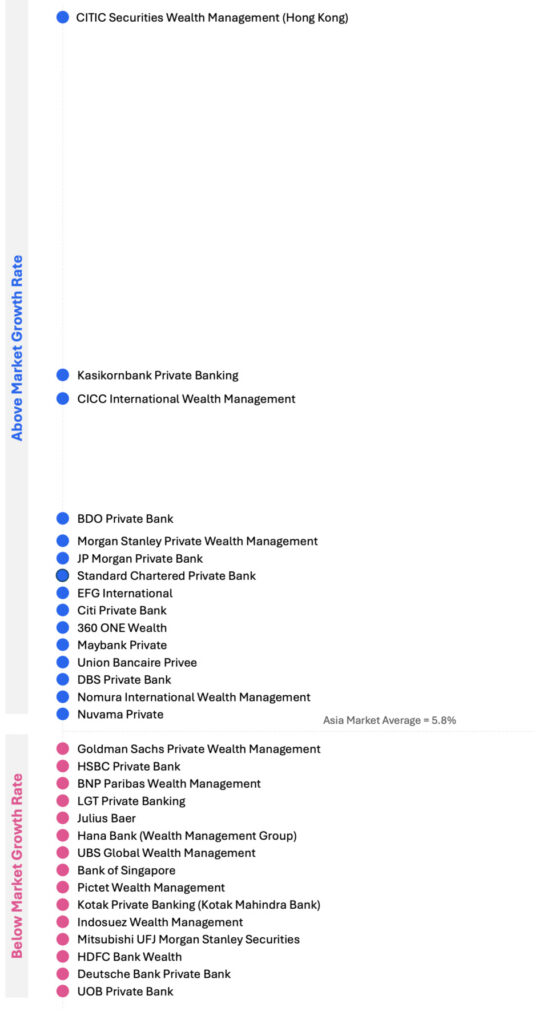
Asia’s fastest growing private banks by NNA/AUM (1H25)
Learn more about the AUM rankings methodology. For more on our private banking benchmarking and insights, contact Euromoney’s head of private banking Daniel Shane.
More reports