
Treasury is undergoing its fastest transformation in a decade. The shift from operational to strategic decision-making is unmistakable and the tools that support treasurers must evolve just as quickly.
The analysts


The Euromoney Cash Management Survey 2025, drawing on more than 30,000 corporate responses, highlights a vendor landscape crowded with options. Choice has never been greater for treasury management systems (TMS).
For corporates, this creates a clear paradox: a market rich in innovation but harder than ever to navigate. Every provider promises speed, scalability and intelligence, yet treasurers must find the right fit for their own operating reality and level of maturity. Budgets are tight, IT resources stretched and systems must be easy to implement, integrate cleanly and remain cost-efficient – ideally without requiring another upgrade 12 months later.
What corporates need is clear: real-time visibility, cleaner data, automation that removes friction and platforms that adapt as quickly as their risks evolve.
This report sets out what treasurers expect from their TMS providers and maps the competitive landscape, highlighting which platforms are most used, most preferred and best positioned to meet the demands of modern treasury.
Explore the global top 10 TMS rankings to understand how these providers are shaping the market.
Treasury transforms and technology keeps pace
Volatile markets, tighter liquidity conditions and shifting supply chains have pushed corporate treasury into a far more strategic position than it held even a few years ago. Treasury is now judged on its ability to support growth, protect margins and preserve optionality, not only on its control of cash and exposures. That has raised the bar for technology: systems must deliver real-time visibility, credible forward views and the automation needed to free treasurers to spend more time in the boardroom than in the spreadsheet.
In addition to assessing their banking providers, Euromoney’s survey respondents shared insights into their use of third-party tools: from TMS to enterprise resource planning (ERP) platforms and accounts-receivable and accounts-payable solutions.
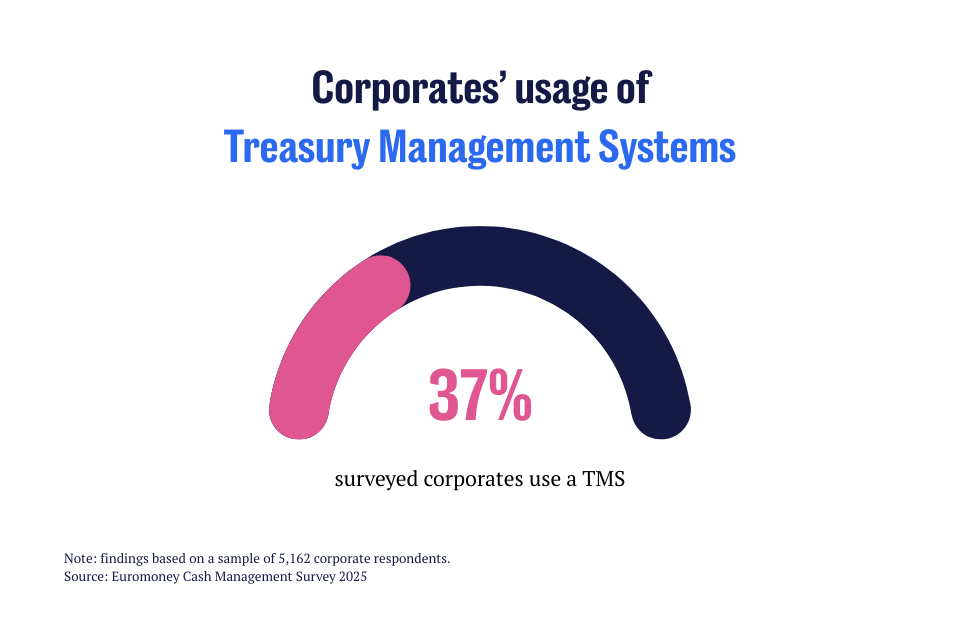
Thirty-seven per cent of corporates use a TMS, with penetration highest among larger companies: 61% of firms with revenue of $500 million use a TMS.
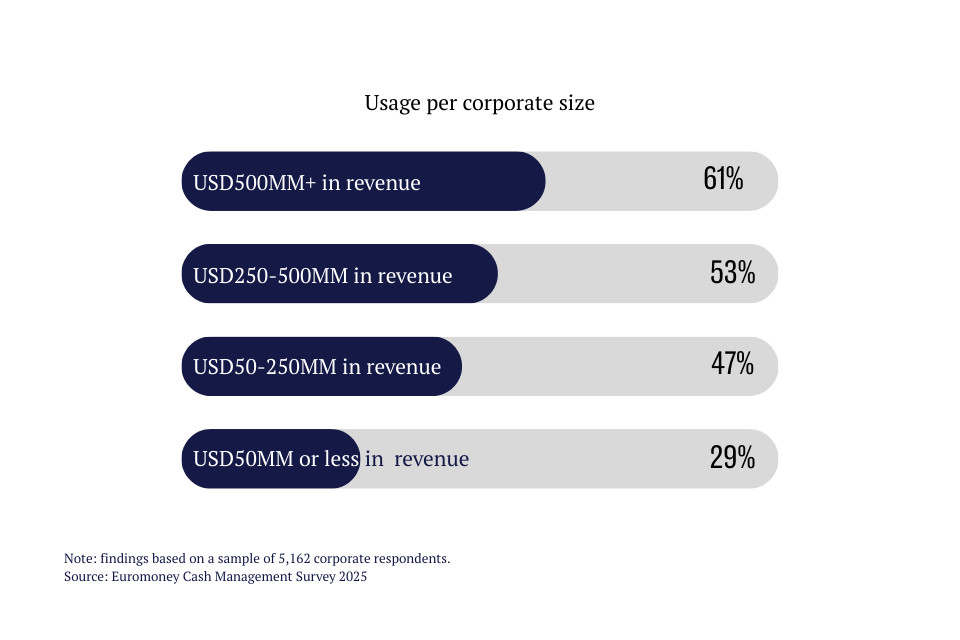
Only 29% of companies with $50 million or less in revenue use a TMS, reflecting the reality that their treasury needs are simpler and their resources more constrained. Instead, these firms typically manage cash and payments through spreadsheets, online banking portals and basic accounting or ERP tools, with some relying on dashboards developed by fintechs or lightweight API connections for visibility. These alternatives give smaller corporates a workable starting point, though they can lack the visibility, control and automation that a dedicated treasury system provides.
The fundamental shift in how treasurers operate – and what is expected of the function – is reshaping the way they use and engage with technology providers. Visibility, speed and accuracy now matter as much as process control, and teams want tools that can translate raw bank and enterprise data into usable insight. Automation is expected to handle reconciliation, monitoring and routine workflows, enabling treasurers to engage earlier in funding, investment and risk decisions. Providers are pushing towards deeper integration and data-led intelligence to meet these demands.
According to Bob Stark, Kyriba’s head of market strategy, the evolution of treasury is inseparable from how firms use technology: “If a treasurer is empowered with the right technology, they are in a good place to make more influential decisions to support the business.”
Treasury teams are also reassessing their own mandate. The core responsibilities of safeguarding cash and keeping operations moving have not changed, but the remit around them has widened. Treasurers are being asked to look further ahead, understand how liquidity may evolve over the coming weeks and months, and bring that insight into the strategic decisions the business is making. The emphasis is increasingly on forward visibility and support for enterprise-level choices.
When the world speeds up, the architecture has to cope or it will start to break
Brett Turner, Trovata
“If accounting is telling the story of what happened, then treasury is all about accurately predicting where the business is going,” explains Simon Bell, Sage’s head of product marketing, specialised solutions group. “This is a critical role for treasurers, and for their technology providers, as those decisions must be based on as much information as we can provide.”
That forward tilt now shapes how providers design and evolve their platforms. Treasurers want clearer signals from their data and faster ways to interpret risks so they can support decisions with confidence. That requires systems designed for immediacy rather than end-of-day reporting, particularly in an environment shaped by rate uncertainty, tariff shifts and operational pressures. As Thomas Jerolitsch, vice-president, product management, enterprise treasury solutions at FIS, puts it: “Treasury teams need a clear read on what is happening across the organisation and the agility to pivot, while still understanding the financial risks behind every decision.”
On the technology side, change is coming through in shorter, sharper cycles. Cloud adoption, application programming interface (API) connectivity and data-rich payment rails have created new possibilities for efficiency and automation. Providers see a clear inflexion point as treasurers embrace shorter upgrade cycles and assess systems not only by functional breadth but by the strength of their underlying data and infrastructure.
Top ranked TMS providers

The MarketMap presents the top 14 providers on two axes:
• Client footprint, indicating the scale of the solution based on the number of corporates that reference it.
• Client satisfaction, calculated as a simple average of respondents’ ratings. The measure is unweighted and includes the full sample, regardless of respondents’ roles or company size.
The results reflect corporate usage and client satisfaction, with no adjustments from Euromoney.
The battle for treasurers’ attention now plays out in how providers build, connect and scale their platforms. This field now spans end-to-end suites, connected ecosystems and specialist architectures, each designed for different levels of scale, complexity and sophistication. 2024 and 2025 found many TMS providers investing in their cloud infrastructure, open API connectivity options and artificial intelligence (AI)-driven tools.
In 2025, more than 30,000 corporates took part in the Euromoney Cash Management Survey, assessing not only their banking providers but also the third-party solutions they use, such as TMS. Almost 14,000 respondents reported using at least one external tool, including a TMS, an ERP platform, accounts-receivable or accounts-payable solutions.
Euromoney’s Treasury Management System Providers MarketMap sets out the leading TMS providers globally, grouping them into three categories: Leading, Outstanding and Distinguished.
For many large corporates, treasury starts with the systems embedded in their wider ERP landscape. That is why SAP and Oracle are ranked a Leading provider in the Euromoney MarketMap, reflecting the depth of their installed base and the influence of their broader finance platforms on how treasurers run cash, liquidity and risk.
SAP has been pushing that boundary further as clients shift to S/4HANA Cloud, using the migration to modernise workflows, embed AI and connect new forms of liquidity, from digital assets to deposit tokens. Oracle, meanwhile, has sharpened its offer inside the Fusion Cloud ERP, unifying post-trade activity and giving treasurers real-time control across currencies, products and organisations as reconciliation becomes faster and more automated.
It is clear that providers with extensive multi-product suites, which aim to support the entire finance value chain rather than a narrow set of treasury workflows, are better positioned in the market. FIS, an Outstanding TMS provider, is a case in point, linking cash, liquidity, payments, receivables and risk into a single ecosystem that can serve both complex global groups and mid-market organisations.
The ‘one solution fits all’ approach does not quite work in practice. We provide a choice through our portfolio of seven different TMS
Sourabh Verma, ION Treasury
That approach is underpinned by scale, predictable investment and ongoing infrastructure modernisation. Long-standing platforms have been migrated to software-as-a-service (SaaS) and public cloud to process data at speed while maintaining resilience and control.
“We do not define ourselves solely as a TMS,” states FIS’ Jerolitsch. “We define ourselves as a partner for the office of the CFO, from ‘money in’ to ‘money out’.”
ION Treasury, another outstanding TMS provider, follows a different path, but pursues similar breadth, offering a family of platforms designed for varying levels of scale, complexity and maturity. The premise is that every treasury deserves a system built for its own operating reality, not a simplified version of someone else’s design. Sourabh Verma, vice-president, treasury strategy and market insights, explains: “The ‘one solution fits all’ approach does not quite work in practice. We provide a choice through our portfolio of seven different TMS.”
This portfolio approach allows ION Treasury to meet organisations at different stages of maturity, from highly automated, trading-intensive environments to firms taking their first steps off spreadsheets.
Sage brings another dimension through its reach across accounting, enterprise systems and payroll. Treasury is treated as part of a wider finance architecture that can leverage group-wide investments, from cloud infrastructure to AI tooling.
A third group of providers is reshaping treasury by focusing on data architecture and cloud design. Trovata was built from the outset as a cloud-native, serverless platform. Its focus is on ingesting bank data at scale, normalising diverse formats and providing treasurers with a real-time, highly consumable view of cash. The speed and resilience treasurers require in today’s market environment depend on infrastructure as much as functionality.
“When the world speeds up, the architecture has to cope or it will start to break,” explains Trovata’s CEO Brett Turner.
AI only works when the underlying data is clean, connected and complete. Without that foundation, all you get are interesting features rather than real value
Bob Stark, Kyriba
As markets accelerate, providers are also looking to AI to help treasurers keep pace. Faster signals, clearer exceptions and earlier intervention all depend on data that is unified and ready for automation. This has been a focus for GTreasury, for example, where its GSmart AI initiative brings signals, insights and agent-driven workflows into a single data layer designed to detect issues, recommend actions and, where appropriate, take the next step on the user’s behalf.
“GSmart AI surfaces the signal, generates the insight, and then proposes the next step with the user deciding whether to act,” reflects Mark Johnson, chief product officer, GTreasury.
Other providers are also investing in how data is organised, stressing the need for unified models so AI can work across the whole platform, not just in isolated features. Across the market, there is a growing sense that data readiness will differentiate genuine value creation from surface-level features.
“AI only works when the underlying data and processes are clean, connected and complete,” outlines Kyriba’s Stark. “Without that foundation, all you get are interesting features rather than real value.”
Another segment centres on specialist, standalone providers. For example, Trinity, a distinguished TMS provider, is one of the few remaining organisations in this industry with more than 30 years of continuous ownership. It serves both compact treasuries that require fast, standardised deployments and large corporates with complex integration needs, supporting all treasury processes.
CEO Henning von Tresckow argues that continuity and focus resonate with clients, adding: “We are not finance-investor orientated. We have a consistent focus on treasury.” The company pitches itself as a partner that can deliver robust functionality with minimal training while providing a close relationship with treasury teams that value familiarity.
How client expectations are evolving
Across the market, treasurers are looking for tools that free them from low-value tasks and sharpen their focus on decisions that matter. GTreasury’s Johnson sees a clear shift in what clients expect from their core systems: “A TMS can’t just be a system of record,” he says. “Treasurers expect proactive insight on where they should actually spend their time.”
The first expectation treasurers have of their systems is speed. Treasury teams want early value and far less manual work. Implementation support, intelligent onboarding and ready-made connectivity have become decisive factors. For many treasuries, the goal is a system that automates tasks so their time is spent on scenarios, analysis and advice rather than reconciliation and data wrangling.
Our role is to give treasurers the ammunition, the insights and the tools that will enable them to make those decisions quicker
Simon Bell, Sage
A second priority is deeper strategic capability. Treasurers are now central to decisions on funding, expansion and resilience, which creates demand for tools that support scenario planning, real-time dashboards and analytics that draw in a broader mix of internal and external data.
“Our role is to give treasurers the ammunition, the insights and the tools that will enable them to make those decisions quicker,” explains Sage’s Bell.
Connectivity is climbing the priority list, too. Treasurers increasingly want platforms that link to banks, enterprise systems, trading venues and data providers, without the operational drag of maintaining multiple interfaces. Regulatory change, cybersecurity and resilience concerns have only strengthened the appeal of more consolidated, better-governed platforms.
Then there is AI. Treasurers are proving to be selective, moving beyond broad claims of efficiency towards evidence of real value. Providers expect the coming year to distinguish meaningful AI applications from superficial ones.
ION’s Verma highlights what matters most: “Clients will choose providers who combine technology with the reliability, compliance and strategic insight that are needed in an increasingly complex treasury landscape.”
For most treasurers, AI only earns its place if it can take on routine work, sharpen forecasts, flag what needs attention and support day-to-day decisions. Anything less risks being treated as noise rather than progress.
The direction of travel
Treasury technology is moving into a defining phase. Providers are refining their architectures, expanding their portfolios and rethinking their implementation models to support a more strategic, data-driven treasury function. Treasurers, for their part, are seeking systems that deliver fast value, trusted data, stronger connectivity and credible AI.
The pace of change is forcing technology firms to rethink how they build and evolve their platforms. As Trinity’s Tresckow reflects: “We have existed for 30 years, but now we are in a startup mode, with continuous development combined with the new wave of requirements.”
We are not finance-investor orientated. We have a consistent focus on treasury
Henning von Tresckow, Trinity
One requirement rising quickly up the agenda is understanding stablecoins and the role programmable money may play in future liquidity and settlement models. “Stablecoins are moving faster than AI,” highlights Trovata’s Turner. “They are reshaping the financial system, and banks know they cannot sleep on this.”
The strategic consequences are already visible. Ripple’s recent acquisition of GTreasury signals how quickly the boundaries of treasury are moving as digital-asset infrastructure converges with traditional corporate finance. The deal reflects a broader shift towards real-time liquidity, instant settlement and new models of value transfer that will reshape treasurers’ expectations in the years ahead.
The providers that pair solid plumbing with thoughtful innovation are the ones most likely to set the pace from here. Treasury sits close to the centre of strategic corporate decision-making, and technology will be judged on how well it helps teams adapt to a financial system being reshaped by data and digital assets.