
574 non-bank financial institutions (NBFIs) participated in the Euromoney Financial Institutions Survey 2026, sharing their assessment of cash management providers across product offering, technology capabilities and client service. The report pinpoints what NBFIs seek in their ideal partners.
The analysts

HSBC emerges as the global leader, ranked by respondents as the number-one cash management provider for NBFIs. The bank benefits from an extensive international network, strong institutional coverage and consistently positive client feedback. Deutsche Bank, Bank of America and JPMorgan also occupy prominent positions globally, while Citi, Standard Chartered, BNP Paribas and Santander continue to demonstrate significant strengths across specific markets and client segments.
Regional dynamics remain important. Asia is characterised by rapid growth, increasing digitalisation and a competitive mix of global and regional providers. Europe continues to prioritise cross-border liquidity management and regulatory compliance. North America remains focused on liquidity precision, technology and operational efficiency, while the Middle East is emerging as an increasingly important centre for institutional investment and cross-border capital flows.
Taken together, the findings paint a picture of the ideal NBFI banking partner: one that combines strong relationships, modern technology, global reach, domestic market expertise and a broad product set. For providers, the challenge is not excelling in a single area but delivering consistently across all of them.
Six themes emerge as the defining trends shaping the market:
- NBFIs require banks to get fundamentals right. They continue to judge providers primarily on their ability to deliver core payments, liquidity and treasury services, with expectations rising faster than satisfaction across many of the products that matter most;
- NBFIs focus on the core infrastructure. Despite growing industry attention on innovation, NBFIs remain focused on core payments and liquidity products;
- NBFIs place trust at the centre of the relationship with their cash management providers. While technology and global capabilities are increasingly important, trusted relationships is the most influential factor in provider selection;
- NBFIs are preparing for real-time treasury – an always-on, multi-rail and multi-asset future in which liquidity, payments, FX and investment decisions are increasingly managed in real time through interconnected and programmable treasury infrastructures;
- Tokenised deposits and blockchain-based settlement networks are beginning to transform treasury operations by enabling 24/7 liquidity mobility, real-time settlement and greater automation across institutional payment flows;
- Institutional flows are reimagined under AI. As real-time infrastructure and tokenised assets converge, AI is evolving from a productivity tool into an orchestration layer capable of continuously optimising liquidity, funding and risk across complex treasury ecosystems.
Top ranked cash management providers for NBFIs
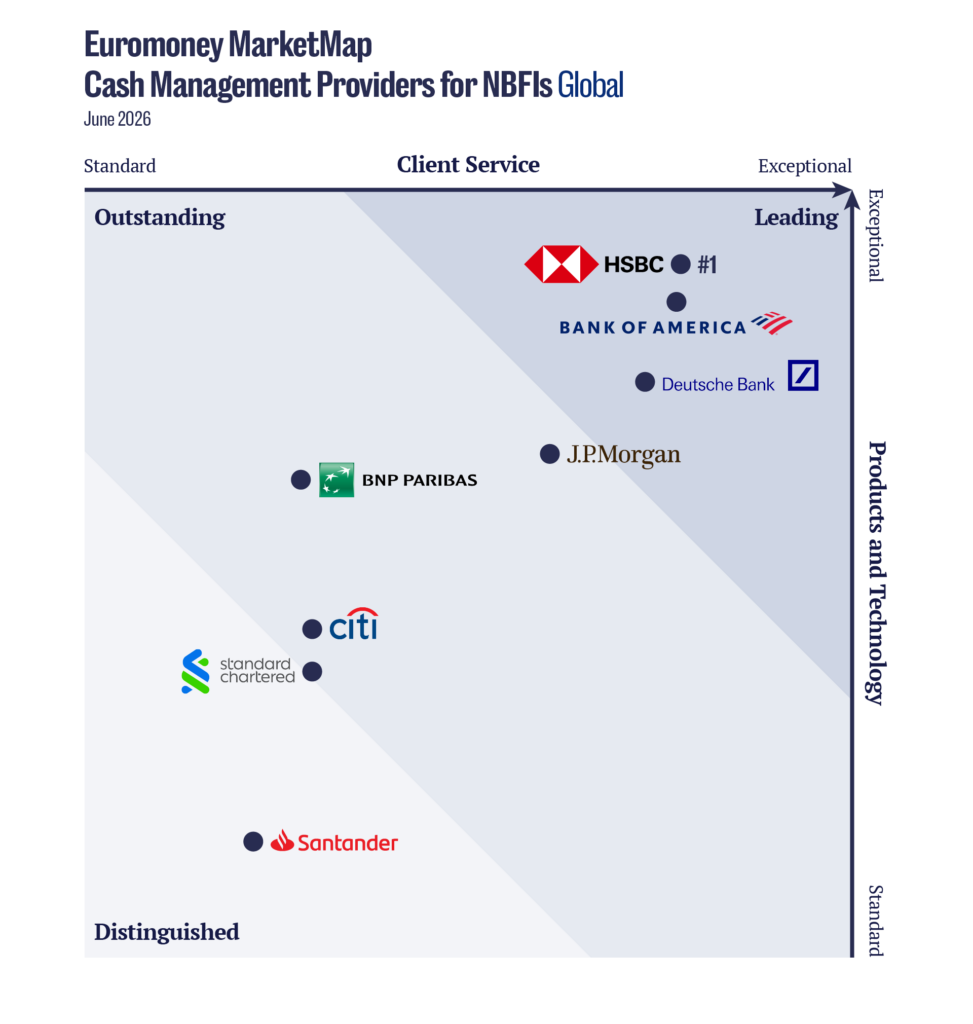
Ranked #1 cash management provider globally by NBFIs, HSBC distinguishes itself through a highly integrated coverage model that brings together relationship managers and product experts to deliver a seamless client experience.
Individual team members are recognised by name in client feedback, reflecting a culture of accountability and client commitment that resonates strongly across the institutional market. Globally, the bank’s combination of responsiveness and international connectivity emerges as its defining strength. Clients consistently highlight HSBC’s ability to anticipate needs, resolve issues quickly and support increasingly complex cross-border treasury structures through one of the most extensive international networks in transaction banking.
Bank of America shows some of the strongest client advocacy in the survey. Respondents highlight an accessible and highly supportive service culture, describing teams as “always there to help us” and praising “fantastic customer service”. The bank also stands out for its proactive approach to client education, regularly sharing insights on market developments and emerging treasury trends. Its CashPro platform continues to be a key differentiator, with ongoing innovation delivering enhanced visibility, automation and operational efficiency for treasury teams.
Another leading provider globally is Deutsche Bank, whose strength lies in combining deep transaction banking expertise with a highly relationship-driven approach. Across the survey, clients frequently describe the bank as a trusted adviser rather than simply a service provider, highlighting its thought leadership, best-practices sharing and strong understanding of client needs, particularly in Europe. In North America, respondents praise the accessibility of relationship teams, competitive pricing and responsiveness. Its leadership position is further reinforced by its strength in cross-border cash management, European market depth and ability to support complex multi-currency liquidity and payment structures across global markets.
JPMorgan is recognised for its digital innovation and technology leadership. More broadly, JPMorgan’s proposition is built on the convergence of cash management, payments, custody, liquidity and capital markets services, which is an increasingly important consideration for asset managers, broker-dealers and other market-facing institutions. The bank continues to invest heavily in next-generation infrastructure, including its Kinexys blockchain platform, which has processed trillions of dollars in transaction value and is helping to shape the future of programmable payments and tokenised deposits.
BNP Paribas is positioned among the leading global providers for NBFIs, underpinned by its strength in European transaction banking, securities services and institutional client coverage. Respondents highlight the quality of relationship management and back-office support as the bank continues to demonstrate strong execution at scale.
Citi’s clients consistently highlight its cross-border capabilities, payments capabilities, digital innovation and relationship quality. European respondents are particularly enthusiastic about virtual accounts and payment tracking, while North American clients point to the bank’s platform design. A key strategic development has been the evolution of Citi Services, which brings treasury and trade solutions together with securities services under a single organisational structure. For NBFIs, this creates a more integrated experience, enabling the management of cash, liquidity, custody and securities servicing through a unified client relationship.
As the boundaries between treasury and investment operations continue to blur, this convergence is becoming increasingly relevant for NBFIs. Combined with the expansion of Citi Token Services, growing adoption of application programming interface (API)-enabled treasury solutions and one of the world’s largest transaction banking networks, Citi continues to distinguish itself through relationship strength and infrastructure innovation.
Standard Chartered remains one of the top global providers for NBFIs, earning recognition for the quality of its relationships and deep network across Asia, the Middle East and emerging markets. Clients consistently highlight responsiveness, execution quality and competitive pricing, particularly in regions where the bank’s international footprint provides access to important trade, investment and payment corridors.
Santander completes the distinguished group of global providers, being recognised for its regional expertise. Santander’s strength lies in providing deep local knowledge, strong client relationships and connectivity across key markets, particularly in Latin America and Europe.
The survey results suggest that the competitive battleground is becoming more complex. Relationship quality still matters more than anything else, but it is now inseparable from digital capability. Clients want specialist relationship teams that understand institutional operating models, but they also want platforms that can deliver real-time information, API connectivity, cash concentration, liquidity forecasting and faster execution.
Regional strongholds
The geographic distribution of provider usage reveals that the NBFI cash management market remains highly regionalised. Most providers continue to derive their strength from specific corridors and regions.
The clearest trend is the dominance of US-headquartered banks in their home market. Bank of America records the highest regional concentration in the survey, with 75% of its NBFI clients using the bank in North America, followed by JPMorgan at 64% and Citi at 43%. While all three have established meaningful positions in Western Europe, their penetration declines across other markets.
By contrast, HSBC and Standard Chartered stand out as the most geographically diversified providers. HSBC’s usage is particularly strong across Asean, South Asia and the Middle East, while maintaining a significant presence in North America. Standard Chartered exhibits a similar profile, leading in Asean and performing strongly across the Middle East and North Asia.
Asean emerges as the most competitive region in the survey. HSBC, Standard Chartered, Bank of America and Deutsche Bank all command significant usage levels, suggesting that NBFIs operating in Asia-Pacific are more likely to adopt multi-bank models, selecting providers for different currencies, products and operating entities rather than relying on a single global partner.
The data also reveals distinct regional specialisations. BNP Paribas performs strongly across the Middle East and Western Europe, while Santander displays the most concentrated footprint of all distinguished providers, with usage focused primarily on Western Europe and Latin America closely mirroring the geography of its franchise.
Where NBFIs use their providers
Explore the interactive map below, which can be filtered by individual cash management provider to view regional usage concentrations and competitive positioning.
Interactive world map: cash management provider usage by region for NBFIs
Cash management provider usage by region
% of NBFI respondents using the cash management providers by region. Hover over details
Table view

Asia remains one of the most dynamic markets for NBFIs and one of the most competitive regions for cash management providers.
The region combines mature financial centres such as Singapore, Hong Kong and Japan with rapidly expanding capital markets across Southeast Asia, India and the Gulf-linked Asian corridors. For asset managers, insurers, broker dealers and other institutional clients, cash management requirements are becoming increasingly sophisticated as investment flows, regulatory complexity and cross-border activity continue to increase.
Unlike some other regions, where institutional cash management is dominated by a relatively small number of established providers, Asia presents a more diverse competitive landscape. Global banks remain important because many institutional clients operate across multiple jurisdictions and currencies, but regional champions continue to play a critical role where local market access, domestic clearing expertise and regulatory knowledge are essential.
HSBC receives the strongest and most consistent client endorsement in Asia, with NBFI respondents highlighting strengths in relationship management, service quality, cross-border capabilities and digital innovation. Clients frequently praise the bank’s integrated coverage model, noting “exceptional synergy between relationship managers (RMs), cash management, and product specialists”, alongside “the availability of RMs at any point to resolve any issues swiftly”. HSBC’s global network is viewed as a key differentiator, with one respondent citing its “strong global network and cross-border capabilities”. Digitally, clients report that enterprise resource planning (ERP) integration enhancements “have streamlined payment workflows, reduced manual intervention and strengthened internal controls”. Respondents also value the bank’s proactive sharing of regulatory and industry insights.
An outstanding provider, DBS Bank is recognised by institutional clients for its digital capabilities and API infrastructure. Respondents highlight the bank’s “strong API capabilities” and dedicated service model, with several noting that the “continuous enhancement to its API capability is critical to improve efficiency”. Client service is another key strength, with feedback praising “perfect customer service and quick response times”. DBS also stands out for its expertise in cross-border payments and compliance, with one client citing its “strong grasp of management services organisation (MSO) operations in Hong Kong” and responsive RMs. Areas for improvement are limited but include client onboarding processes and aspects of the bank’s risk-appetite framework.
Client feedback highlights Deutsche Bank’s combination of service excellence, technology leadership and responsiveness. The bank’s ability to deliver “full straight-through processing (STP) automation” is particularly valued, demonstrating its success in helping clients streamline processes, enhance operational efficiency and reduce manual intervention across payment and cash management activities.
Citi occupies another prominent position in the Asian MarketMap. Its extensive international network and longstanding institutional franchise continue to resonate with NBFI clients operating across Asian markets. The bank’s ability to provide consistent service across multiple jurisdictions remains a significant advantage, particularly for clients seeking standardised operating models across diverse geographic markets.
Standard Chartered receives consistently positive feedback from clients in Asia, particularly for the strength of its relationships, payment execution and competitive pricing. Respondents highlight “customer relationship” as key differentiator, while others point to the bank’s “close relationship – competitive price” proposition. Ease of use across online banking channels and “quick turnaround time of processes” are also cited as notable strengths. The bank’s deep roots across emerging Asian markets and its focus on cross-border connectivity continue to provide a compelling proposition for many institutional clients. Its strength is particularly evident among organisations with activity across Southeast Asia, South Asia and broader emerging-market corridors.

Europe remains one of the most sophisticated and demanding environments for NBFI cash management. The region combines deep capital markets, extensive cross-border investment activity and a complex regulatory landscape that continues to evolve. For asset managers, insurers, broker dealers and other institutional clients, cash management has become increasingly important as organisations seek to optimise liquidity, improve operational efficiency and prepare for structural market changes such as the transition to T+1 settlement.
Institutional clients increasingly view cash management through a strategic lens, survey results show. Liquidity visibility, operational resilience and technology have become central priorities, particularly as treasury teams are expected to support increasingly complex investment and settlement activity with leaner operating models. The leading providers in Europe are those capable of combining network strength, digital innovation and specialist institutional expertise.
Ranked #1 cash management provider by European NBFIs, Bank of America is valued for its combination of deep US market access with strong digital capabilities and a highly focused client coverage model. For many respondents, the bank serves as a gateway to activities across the Americas while also supporting selected Asia-Pacific requirements through its network. Client feedback consistently highlights the quality of relationship management and the banking portal.
European clients highlight the depth and longevity of their relationships with HSBC as a defining strength. Respondents are “keen advocates” of the bank, praising its willingness to engage and collaborate, particularly in areas such as virtual accounts. Dedicated service is another recurring theme, with one client noting that their relationship manager is “very prompt, helpful and seems to be working around the clock”. HSBC’s client-centric approach also stands out, with respondents highlighting its “problem-solving orientation” and focus on meeting client needs. The bank’s API capabilities and thought leadership receive positive recognition.
Deutsche Bank’s European clients view the bank as more than a transaction provider, highlighting its role as a trusted advisory partner. Respondents particularly value its thought leadership and best-practices sharing, with one noting that such support provides “invaluable insights into transformation and product innovation”. This advisory strength is complemented by consistently strong execution, with clients citing “support and prompt service delivery” and the bank’s deep “understanding of client needs”.
The quality of Deutsche’s digital offering is also recognised, with respondents pointing to a “smooth online banking experience” as an important contributor to overall client satisfaction. For many NBFIs, Deutsche’s appeal lies in its ability to manage complexity. European treasury structures often involve multiple legal entities, currencies and banking relationships. Efficient liquidity management requires sophisticated concentration structures, high-quality reporting and effective execution across markets, which is appreciated by bank’s clients.
JPMorgan is an outstanding provider in Europe and continues to strengthen its position among institutional clients. The bank’s broader institutional franchise provides a natural advantage in a market where cash management increasingly intersects with securities services, custody, financing and capital markets activity. This convergence is becoming more important across Europe. Asset managers, insurers and broker dealers are increasingly seeking providers capable of supporting multiple elements of their operating model through a single relationship.
JPMorgan’s strength lies in its ability to connect cash management capabilities with a broader suite of institutional services. Technology investment is another important differentiator. European clients continue to prioritise automation, STP and enhanced data visibility. Banks that can provide modern digital platforms, robust APIs and integrated reporting tools are increasingly favoured by institutions seeking to reduce operational complexity.
Citi’s European clients consistently highlight the bank’s strengths in international payments, cash management and liquidity solutions. Respondents point to its “international capabilities” and offerings such as virtual accounts as key differentiators, reflecting the bank’s ability to support complex treasury structures. Citi’s payments proposition receives particularly strong praise, with one client describing it as “great payment lifecycle and cash management”, while also commending the bank’s change management capabilities and calling it “fantastic for payment tracking”. Liquidity management enhancements are also viewed as delivering tangible operational value, complemented by strong relationship management and client support across the region.
Barclays remains a core player within the European institutional landscape. For many NBFIs, particularly those with substantial UK and European operations, Barclays offers a combination of local market knowledge and sophisticated transaction banking capabilities. Barclays is valued for its specialist capabilities in serving NBFI needs, particularly around GBP-denominated infrastructure. Respondents also highlight “customer service and responsive messaging to queries” as key strengths, while improvements in STP demonstrate the bank’s investment in payment automation and operational efficiency.
The European market is also being shaped by significant structural developments. Preparations for T+1 settlement are accelerating as institutions assess the operational implications of shorter settlement cycles. The transition is expected to place greater emphasis on real-time cash visibility, intraday liquidity management and automated exception handling.

The Middle East has become one of the fastest growing and most strategically important markets for NBFI cash management. During the past decade, the region has evolved from a primarily domestic banking market into a major centre for international capital flows, institutional investment and financial market development.
Governments across the Gulf have invested heavily in financial market infrastructure, encouraging foreign investment and supporting the development of regional financial centres. At the same time, sovereign wealth funds have expanded their global investment activities, while private capital and asset management firms have increased their presence across the region. The result is a more sophisticated institutional ecosystem with increasingly complex liquidity requirements, that presents new opportunities and challenges for cash management providers.
HSBC is appreciated by NBFI respondents in the Middle East for its proactive engagement, international network and digital capabilities. Respondents praise HSBC for being “proactive in understanding the needs of our business and quick to act on it”, reflecting the bank’s client-centric approach. Its extensive regional and international footprint is particularly valued by organisations operating across multiple markets, while digital solutions such as API connectivity and automated liquidity structures deliver tangible operational benefits through “inbuilt software integration with HSBC APIs” and end-of-day sweeps. Overall, clients describe HSBC as “reliable, customer service, international, innovative”, underlining broad satisfaction with its proposition.
Clients value JPMorgan not only for its strength in the US market but also for its ability to connect operations seamlessly across North America, Europe and Asia-Pacific. For many NBFIs, the bank serves as a gateway to key financial centres, combining deep dollar expertise with extensive international reach. Respondents highlight the benefits of working with a provider capable of supporting cross-border cash, payment and liquidity requirements through a consistent global platform.
Middle East respondents highlight Standard Chartered’s reliability in payments and transaction execution. The bank occupies a distinctive position as a gateway to Asia-Pacific and one of the few international banks with extensive coverage across emerging markets, particularly in Africa. This breadth of network is especially valuable for Middle Eastern NBFIs expanding their investment, trade and operational relationships beyond traditional markets. As capital flows between the Gulf, Asia and Africa continue to accelerate, Standard Chartered’s combination of local market expertise, cross-border capabilities and connectivity across growth economies provides a compelling proposition for institutions with increasingly international ambitions.
Emirates NBD is another distinguished provider and represents one of the region’s most significant domestic banking franchises. Its position reflects the continuing importance of local market expertise and strong regional relationships. Although global connectivity remains important, many institutional clients continue to require providers with deep knowledge of local regulatory frameworks, payment infrastructures and market practices. Emirates NBD’s performance demonstrates that domestic and regional capabilities remain highly relevant.
FAB continues to strengthen its position within the institutional banking market, benefitting from the growing prominence of Abu Dhabi as a global investment and financial centre. For NBFIs, the bank offers a compelling combination of deep local market expertise, strong regional relationships and expanding reach across the Gulf, positioning it well to support the region’s growing investment and treasury activity. One respondent summarised the bank’s value proposition simply as “strong backing, reputation”, highlighting the importance of stability and credibility when selecting banking partners in the region.
With a strong product proposition and extensive international reach, Citi ranks among the top cash management providers for NBFIs in the Middle East. Clients value the bank’s ability to deliver a consistent service model across major financial centres, supporting institutional activity spanning the Americas, Europe and Asia-Pacific. Citi’s global network is complemented by a robust digital infrastructure and a long-standing reputation for innovation, particularly in payments.

North America remains the largest and most influential market for NBFI cash management. Home to the world’s largest capital markets, deepest pools of institutional capital and most active securities trading ecosystem, the region places unique demands on liquidity management providers.
Ranked the leading provider by North American NBFIs, Bank of America stands out for its combination of service excellence, digital innovation and client engagement. Respondents consistently highlight the strength of the bank’s support model, describing customer service as “fantastic” and noting that teams are “always there to help us”. The bank’s digital capabilities also receive strong recognition, CashPro being recognised as a platform that is “continuously being developed and improved”.
Beyond execution, Bank of America distinguishes itself through proactive client education, with respondents praising its regular updates on market developments and emerging trends, reinforcing its role as a trusted strategic partner rather than solely a transaction provider.
Clients distinguish HSBC through its highly personalised service model and strong digital capabilities. Respondents value the ability to connect directly with bank employees rather than call centres, praising the bank’s “personalised and relational” approach, flexible support channels and responsive client service. HSBCnet also receives strong recognition, with one client describing it as “the most convenient banking system” and highlighting its ease of use and functionality. Beyond service and technology, clients acknowledge HSBC’s strengths in “innovation, market engagement, thought leadership [and] prioritisation of customer needs”.
Deutsche Bank’s North American clients value the bank’s relationship-driven approach, competitive pricing and expertise in supporting multi-currency requirements. Respondents frequently highlight the accessibility of the team, citing “easy access via phone and email” and “quick follow-up from requests” as key strengths. The bank’s ability to support international treasury needs is also recognised, with clients praising assistance on multiple currency requirements and the availability of EUR and GBP account capabilities in New York. Feedback also underscores the importance of relationship continuity, with individual bankers receiving direct recognition from clients.
NBFIs identify JPMorgan’s “portal design” as a notable differentiation, reinforcing the bank’s reputation as a technology leader in a market where treasury teams increasingly demand intuitive platforms, real-time information, API connectivity and advanced reporting capabilities.
Standard Chartered’s strength in North America lies in the quality and continuity of its relationships. One respondent highlighted the value of a “long-standing relation and dedicated team”, underscoring the importance of specialist support and institutional knowledge. This relationship-led approach aligns with the bank’s broader positioning as a trusted partner for clients operating across multiple regions. For North American NBFIs with activities in Asia, the Middle East and Africa, Standard Chartered offers a differentiated proposition through its deep presence in many of the world’s fastest-growing markets.
North America-based respondents highlight the Citi’s client-centric approach, noting that “Citi helps in many scenarios” and that its turnaround times are “very quick”. The bank’s digital banking platform receives particular praise for providing enhanced data visibility and a more effective user experience. Clients also value Citi’s broad product coverage, global reach and capabilities across payments, FX and treasury services. The continued evolution of Citi Services, which increasingly brings treasury, payments and custody capabilities together under a more integrated client offering, further strengthens its appeal to institutional investors and other NBFIs seeking greater visibility across cash and securities activities.
Survey feedback highlights the importance of reliability, execution quality and operational consistency. In North America, where transaction volumes are often extremely high and operational failures can have significant consequences, these attributes remain critical. Clients consistently emphasise the importance of providers that can deliver dependable service while continuing to invest in innovation.
What NBFIs need today
Getting fundamentals right
Euromoney Financial Institution Survey data shows where NBFI expectations are most aligned with current provider capabilities and where meaningful gaps remain. The largest disconnects are concentrated around core payments products. Domestic payments – automated clearing house (ACH), real-time gross settlement (RTGS) and equivalent schemes – receive the highest importance score in the survey at 9.3, yet satisfaction trails at 7.8.
Domestic real-time payments show a similar pattern, with importance of 9.1 and satisfaction of 7.8. Real-time cross-border payments, FX services and cross-border payment offerings also record some of the largest gaps between importance and satisfaction. Speed, transparency, user experience, exception management and integration capabilities increasingly shape client perceptions across these products.
The pattern extends into liquidity management. Deposits remain one of the most important products for NBFIs, yet satisfaction scores remain notably below importance levels. Taken together, the results indicate that expectations are rising faster than service quality across several core treasury products.
At the opposite end of the spectrum, products with lower usage and importance across the market, such as mobile payments, digital wallets, virtual cards, tokenised instruments and green deposits show a high average satisfaction relative to the importance NBFIs place on these.
Core infrastructure focus
From a product-demand perspective, NBFI payment activity remains firmly anchored in established infrastructure. Domestic payments, including ACH, RTGS and instant payment schemes, are used by 83% of respondents, making them the most widely adopted products in the survey. Cross-border payments (76%), FX services (73%) and real-time cross-border payments (71%) also rank highly, reflecting the increasingly international nature of NBFI operations.
Future demand, however, reveals where growth is likely to concentrate. Deposits stand out as the strongest area of expansion, with 49% of respondents looking to further increase usage. Domestic payments, cash-concentration structures and money market funds (MMF) also show significant growth potential.
Technology is increasingly important, but it does not replace the value of strong client engagement
By contrast, emerging products have yet to generate comparable momentum. Green deposits, digital wallets, tokenised settlement and mobile payments all record relatively low levels of additional interest despite meaningful existing adoption. This suggests that while innovation remains important, NBFIs continue to prioritise proven solutions that improve liquidity, payments efficiency and treasury visibility. For providers, the immediate commercial opportunity lies in deepening relationships around core payments, deposits and liquidity products, while continuing to educate clients on the longer-term potential of digital and tokenised infrastructure.
One of the clearest messages from the data is that success in the NBFI segment starts with execution of the fundamentals. Institutions continue to value access to domestic payment schemes and local clearing infrastructure, reflecting the need to manage liquidity efficiently within individual markets and regulatory environments.
At the same time, NBFIs increasingly expect these local capabilities to be delivered through globally consistent platforms and service models. The most successful providers are therefore those that combine domestic market access with extensive international connectivity, allowing clients to operate smoothly across jurisdictions.
Trust at the centre of partnership
When it comes to selecting a new cash management provider, NBFIs evaluate banking partners against a broad range of factors rather than prioritising a single capability. Institutions expect providers to deliver across relationship management, technology, product capabilities and financial strength simultaneously.
The highest ranked criterion is overall relationship, with a score of 9.2. Despite the industry’s focus on digital transformation and automation, respondents continue to place the greatest value on trusted relationships, responsiveness and the ability to access knowledgeable specialists when needed. This reinforces a recurring theme throughout the survey: technology is increasingly important, but it does not replace the value of strong client engagement.
Provider reputation, software and technology, international capabilities and domestic capabilities all score 8.9. In line with the product usage and importance statistics, NBFIs require access to local payment schemes and market infrastructure, but increasingly expect these capabilities to be delivered through globally connected platforms that support cross-border operations.
Price remains an important consideration, scoring 8.8, but ranking slightly lower, suggesting that NBFIs are willing to pay for quality, reliability and expertise rather than selecting providers on cost alone. Product breadth, risk appetite, advisory capabilities and access to finance and credit complete the ranking.
What NBFIs think about tomorrow
Real-time treasury
For institutional clients, the challenge is no longer simply ensuring that payments are executed accurately or balances are reported on time. Treasury teams are increasingly expected to manage liquidity dynamically across multiple markets, currencies, counterparties and operating environments. In this context, real-time information, API connectivity and automation are becoming standard expectations rather than differentiating features.
The direction of travel is clear. As payment ecosystems evolve and operating hours extend beyond traditional banking windows, NBFIs are increasingly preparing for a multi-rail, multi-asset and always-on environment. Many already process significant payment volumes across domestic payment schemes, emerging settlement infrastructures and cross-border. At the same time, they must manage deposits, money market investments, foreign exchange exposures and, increasingly, digital assets within a single liquidity framework. For organisations whose own clients increasingly expect immediate execution and 24/7 access to services, treasury operations must be capable of supporting continuous activity.
The next phase of development is likely to see greater adoption of programmable and event-driven liquidity management, where balances are automatically mobilised in response to predefined triggers, funding requirements, market events or payment activity.
This shift also has implications for FX management. In an environment characterised by heightened market volatility, geopolitical uncertainty and increasingly global operating models, NBFIs are placing greater emphasis on real-time visibility of currency exposures and more dynamic hedging strategies. As liquidity becomes increasingly mobile across markets and currencies, treasury teams will require tools that allow them to manage FX risk alongside cash positions rather than as a separate process.
Interconnectivity underpins the entire model. APIs remain a foundational technology, enabling the secure exchange of payment, balance and transaction data between banks, treasury systems and enterprise platforms.
However, the industry is already looking beyond simple system-to-system connectivity towards agent-to-agent interactions, where artificial intelligence (AI)-powered systems can analyse information, initiate actions and coordinate liquidity decisions across multiple providers and infrastructures. While still at an early stage, this evolution has the potential to transform treasury from a process-driven function into an increasingly autonomous and intelligent operating environment.
Tokenisation
While adoption remains at an early stage, tokenised deposits, programmable payments and blockchain-based settlement infrastructure are beginning to move from experimentation to practical deployment. For NBFIs, the implications are significant: 24/7 liquidity mobility, real-time settlement, greater automation and the ability to connect traditional treasury operations with emerging digital asset ecosystems. The leading transaction banks are bringing these capabilities into production.
HSBC has been one of the most active banks in this space. Its Tokenised Deposit Service, launched in Hong Kong in 2025 and expanded to the United States in 2026, allows clients to convert eligible deposits into digital tokens that can be transferred around the clock within HSBC’s blockchain environment. Supporting major currencies including USD, EUR, GBP, HKD and SGD, the platform is designed to improve liquidity efficiency and support increasingly sophisticated treasury use cases.
JPMorgan has taken a similar approach through its deposit token infrastructure and the broader Kinexys platform. Together, these initiatives enable clients to move tokenised deposits, execute programmable payments and access near real-time settlement through blockchain-based rails. With trillions of dollars already processed across the platform, Kinexys has become one of the clearest examples of how tokenisation is being applied to mainstream transaction banking and liquidity management.
Citi is pursuing the same objective through Citi Token Services, which uses tokenised deposits and distributed ledger technology (DLT) to support real-time treasury and trade finance activities. By enabling 24/7 liquidity movement across its network, Citi is seeking to reduce settlement friction while improving treasury visibility and automation for institutional clients.
The move towards tokenised banking infrastructure is becoming a collective industry effort rather than a series of isolated bank initiatives. Some of the largest US banks, including Bank of America, Citi, JPMorgan and Wells Fargo, are exploring a shared tokenised deposit network designed to facilitate faster settlement and more efficient movement of money between participating institutions, to be launched in 2027.
Institutional flows reimagined
AI is also an enabler of the 24/7 world. For NBFIs, the immediate value is less about replacing treasury decision-making and more about improving forecasting, anomaly detection, reconciliation and exception management.
Bank of America has been among the most active banks in applying AI to treasury management, with innovation centred on its CashPro platform. A notable example is CashPro Forecasting. The platform integrates account data, applies machine learning to forecast cash positions and delivers actionable insights within minutes rather than days. In 2025 alone, more than 3,000 companies used the solution, collectively saving over 250,000 hours of manual forecasting work.
Citi is advancing its AI strategy beyond productivity tools and into agentic AI, positioning intelligent digital agents as the next phase of banking transformation. In 2026, the bank outlined plans to deploy AI agents capable of carrying out complex tasks, coordinating workflows and supporting decision-making across multiple business functions.
Unlike traditional AI tools that focus on generating content or answering queries, these agents are designed to act autonomously within defined parameters, helping employees analyse information, identify opportunities and execute routine processes more efficiently.
The future of institutional treasury will not be defined by faster payments alone, but by intelligent orchestration. As real-time infrastructure, tokenised assets and programmable liquidity converge, AI agents could act as the connective layer between systems, providers and markets.
Treasury teams will remain responsible for strategy, governance and risk, but many operational decisions will be delegated to intelligent systems capable of monitoring, analysing and acting in real time. The end state is an always-on treasury environment where liquidity, funding and risk are continuously optimised across a global network of accounts, currencies and assets.