
Accounts receivable automation has moved from the operational margins of finance to the centre of the cash management agenda. Rising interest rates, tighter liquidity and changing customer behaviour have raised expectations around visibility, control and predictability, at a time when the vendor landscape has become broader and more complex.
The Euromoney Cash Management Survey 2025, drawing on insights from more than 30,000 corporates globally, highlights an accounts receivable automation (ARA) market crowded with options and defined by increasingly demanding buyers.
Against this backdrop, respondents in the survey identified the top 14 ARA providers globally. This analysis is based on responses from 2,171 corporates, spanning small and medium-sized enterprises (SMEs) to large multinationals, and representing 76 countries, offering a truly global view of how receivables technology is being adopted and evaluated in practice.
The resulting MarketMap reflects real-world corporate usage and sentiment. It highlights where providers are delivering measurable impact today, where differentiation is emerging and how expectations around intelligence, integration and ease of adoption are reshaping competition. As finance teams look for greater certainty in cash outcomes, understanding how the ARA market is evolving – and which providers are setting the pace – has become critical.
In search of certainty
Customer behaviour has shifted in ways that strain traditional AR models. Greater adoption of digital payment methods, rising demand for extended terms and instalment plans, and heightened expectations around customer experience have forced finance teams to rethink how AR is managed — and the role automation plays in maintaining control at scale.
The introduction of artificial intelligence (AI) into AR workflows has accelerated this shift, moving automation beyond rule-based task execution towards more adaptive capabilities. AI-enabled systems can interpret large volumes of transactional and behavioural data, surface risk earlier and guide teams towards more targeted interventions, while also supporting improved customer experiences across the invoice-to-cash journey.
These changes have reshaped buyer expectations. AR teams are increasingly expected to operate within a ‘no-surprises’ environment, particularly around forecasting and exposure. Misses are no longer viewed as acceptable variance, but as indicators of breakdowns in process or visibility. As a result, automation alone is no longer sufficient; organisations are looking for systems that are transparent, flag uncertainty early and route exceptions in ways that preserve accountability.
At the same time, end-to-end automation is gaining traction for its ability to streamline the order-to-cash cycle, reduce manual effort and simplify interaction between seller finance teams and buyer procurement functions. In a high interest rate, tighter liquidity environment, these operational gains are being linked to financial outcomes, with faster collections helping to reduce reliance on short-term financing and improve cash availability.
Top ranked ARA providers
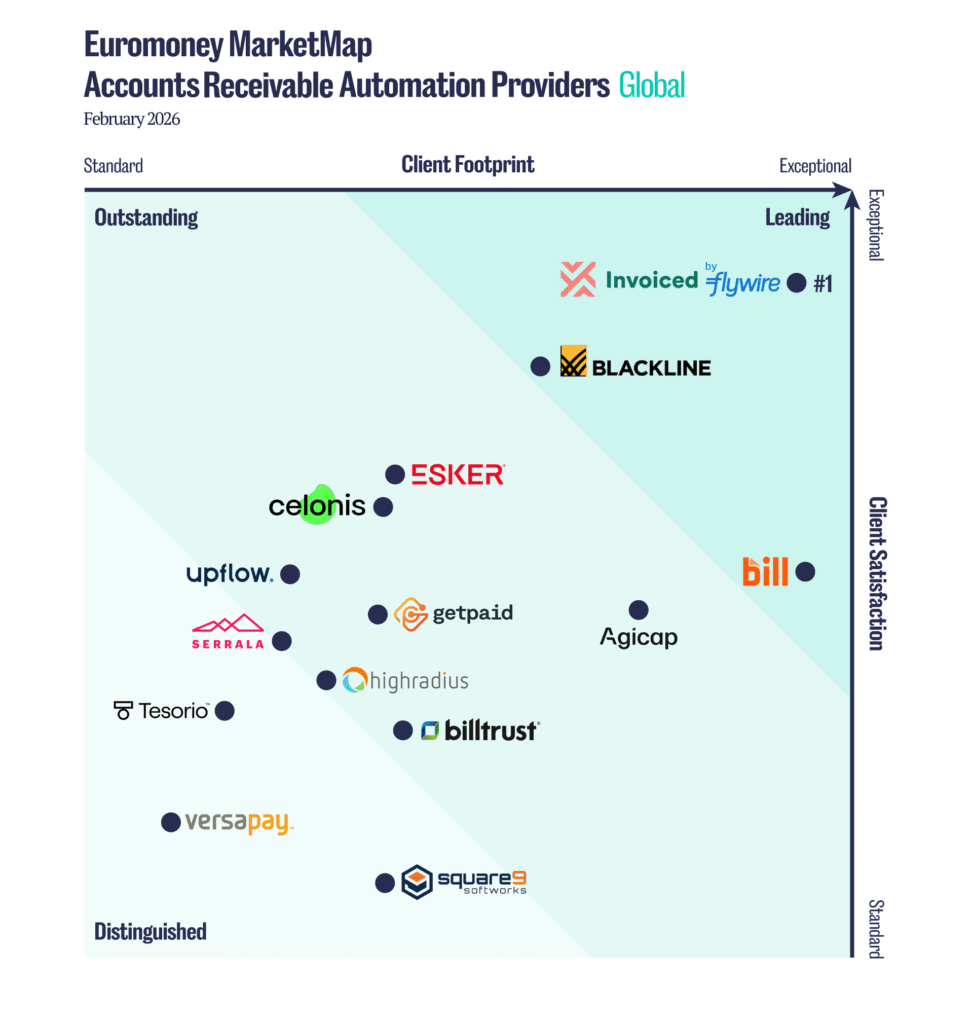
The MarketMap presents the top 14 providers on two axes:
• Client footprint, indicating the scale of the solution based on the number of corporates that reference it.
• Client satisfaction, calculated as a simple average of respondents’ ratings. The measure is unweighted and includes the full sample, regardless of respondents’ roles or company size.
The results reflect corporate usage and client satisfaction, with no adjustments from Euromoney.
The global ARA market spans a wide range of capabilities, from end-to-end, AI-led platforms to more modular solutions focused on deployment speed and ease of use. The providers at the top of the MarketMap distinguish themselves through their ability to combine scale, intelligence and ecosystem connectivity, while other providers in the top 14 globally compete through focused functionality, customer experience and rapid time-to-value.
BlackLine, a Leading provider, and Billtrust, an Outstanding provider, differentiate themselves through their ability to orchestrate the full order-to-cash lifecycle across complex, multinational environments. Billtrust points to the importance of true end-to-end intelligence, arguing that few solutions can deliver the accuracy, flexibility and deep connectivity required to manage receivables at scale without fragmenting workflows across systems.
AI mistakes are reversible in seconds, while human delays cost thousands per day
Chris Couch, Flywire
For BlackLine, embedding AR within a broader finance ecosystem is central to differentiation. Platforms that treat receivables as an integrated component of finance operations, rather than a standalone function, are better positioned to deliver end-to-end visibility and reduce operational risk, according to Andy Lilley, managing director of global invoice-to-cash. “AR automation’s greatest value lies in enabling better decision making,” Lilley explains. To maximise these benefits, corporations need to take a holistic approach, which means standardising AR processes across regions, aligning automation with billing and reconciliation, and actively using AR data to inform cash forecasting and collections strategies.
Flywire’s position among the leaders reflects its focus on AI-driven execution and speed at scale, particularly in high-volume, cross-border environments. According to Chris Couch, head of product, B2B, AI will enable companies to prioritise speed and total cost over accuracy. “AI mistakes are reversible in seconds, while human delays cost thousands per day,” he says. “An AI that processes 10,000 invoices at 94% accuracy, instantly fixing its 600 errors, outperforms a human team processing 100 invoices at 99.5% accuracy. The ‘autonomy tax’ – the real cost of fixing AI errors versus the value of speed – becomes the new ROI calculation.”
Couch believes that, within five years, the line between a contract and software will have disappeared. Documents won’t just contain terms; they will enforce them – and invoices won’t just request payment; they will negotiate their own terms based on cash flow and automatically escalate when ignored. Autonomous execution is therefore emerging as a defining theme at the top of the market.
The solution should continuously learn from payment behaviour, disputes and deductions, and recommend the next best action
Prashant Kumar, Serrala
BILL, another leading provider, aims to simplifying AR for mid-market and growing enterprises while supporting compliance, control and integration across accounting and tax requirements. By reducing manual processing, platforms such as BILL enable finance teams to move away from transactional work and focus on cash optimisation and customer relationships.
Celonis’ position as an outstanding provider reflects its emphasis on process intelligence and root-cause analysis. For Harit Nanavati, senior vice-president and general manager of AR, the deepest source of differentiation is understanding how the business truly operates – not just how invoices flow. This allows AR teams to move upstream, identify inefficiencies earlier and prevent issues before they impact cash.
Esker combines automation with analytics and reporting to support continuous improvement across AR operations. Samuel Townsend, head of marketing, says corporates can maximise value by: defining clear key performance indicators (KPIs) before deployment; standardising and optimising processes first; leveraging analytics and reporting to drive continuous improvement; investing in change management and training; and using automation as a platform for transformation, not just as an efficiency tool.
Serrala’s positioning is driven by ERP-agnostic design and integration flexibility. Prashant Kumar, vice-president of Alevate AR, highlights seamless connectivity with banks and adjacent systems as a core differentiator, alongside unified workflows, intuitive user experience and strong security. “The solution should continuously learn from payment behaviour, disputes and deductions, and recommend the next best action rather than simply executing predefined workflows and reminders,” he says.
Agicap sits in the Outstanding tier thanks to its focus on operational discipline and behavioural change in collections. To make the most of AR automation, corporates need to move from curative to preventive follow-ups and deploy systematic, consistent collection processes across all customers rather than acting only once invoices are overdue, suggests Benoit de Angelis, strategic projects manager, who adds that automation is most effective when it is applied everywhere all the time.
Adoption matters as much as capability, because the value only shows up when the business actually uses it
Pamela Ralli, FIS
HighRadius also competes strongly in this segment, particularly among large enterprises, by combining scale with high levels of straight-through processing. It recommends: prioritising systems that integrate easily with SAP, Oracle, Microsoft or NetSuite; capture remittance from cheques, ACH, emails and PDFs; auto-match 95-100% of payments; reduce manual exceptions; and provide instant visibility into days sales outstanding (DSO), ageing, disputes and cash-flow trends.
Versapay, a distinguished provider at global level, emphasises customer-first design as a key differentiator. According to the company, standing out in a crowded AR automation market depends on how effectively providers enable businesses to deliver ease, transparency and consistency across the invoice-to-cash journey.
Upflow focuses on collaboration and visibility rather than removing humans from the process. One of the most common misconceptions around AR automation, according to Alexandre Antoine, finance director, is that it means removing people from collections. For chief financial officers and finance directors, the goal is to automate what should be automated and elevate what should stay human.
Square 9 positions itself around invisible automation and ease of use. The company believes the most successful automation efforts work with existing processes, shifting the implementation mindset towards flexibility by operating in the background through routing, automated data entry and improved information visibility.
Tesorio highlights speed-to-value and modern buying expectations. It suggests that many enterprises still evaluate AR the same way they did a decade ago, rather than recognising that tools must deliver impact quickly and fit naturally into how teams work.
Delivering ARA at scale
While platform capability sets the ceiling, realised value depends on how organisations implement and operate ARA in practice. This is where execution, adoption and governance become critical.
Ease of adoption is a recurring theme. The most effective platforms fit naturally into how collectors, cash application and credit teams already work, quietly removing friction through prioritisation, automation and cleaner exception handling, agrees Pamela Ralli, head of product for automated finance at FIS. “Adoption matters as much as capability, because the value only shows up when the business actually uses it,” she explains.
As AR automation becomes more intelligent, the role of finance teams is evolving, reflecting growing expectations for treasury and finance functions to play a more strategic role within the organisation. AR teams are increasingly expected to operate within a ‘no-surprises’ culture, particularly around forecasting and exposure, where misses are no longer treated as variance but as failures of control.
This places a premium on visibility. Finance leaders need granular insight into where cash becomes trapped – whether through billing inaccuracies, dispute backlogs or delayed customer responses across markets. The most resilient operating models treat AR automation not as a standalone system but as part of a continuous finance process that connects historically siloed systems and country-specific workflows, enabling faster diagnosis and corrective action.
What began as an incremental efficiency upgrade has become a foundational requirement for restoring predictability, visibility and control over cash. Layered with AI, AR platforms are becoming more predictive and context-aware, allowing teams to focus less on execution and more on decisions that materially affect liquidity and customer outcomes. Modernising AR is no longer about making teams work faster; it is about strengthening relationships, improving cash performance and reinforcing business resilience.