
Through Euromoney’s exclusive survey, 30,000 corporate treasurers across 123 countries assess 486 cash management providers, sharing their outlook for the next 12–18 months and key strategic priorities.
The analysts

The results are in: HSBC is the global provider of choice; regional leaders are Citi in Africa, DBS in Asia-Pacific, ING in Europe, Mashreq in the Middle East and Deutsche Bank in North America.
Cash management in 2025 sits at the heart of corporate resilience – and it is a story of liquidity reinvention. The economy has achieved a soft landing, with global growth near 3.2% as inflation retreats. The era of ultra-low rates is over: benchmarks rates remain high after a brief dip in late 2024, squeezing net interest as cash yields fall and refinancing costs rise.
Treasurers have responded by putting cash to work, accelerating automation and tightening working capital. Euromoney’s survey shows 39% increased cash management activity in the past 12 months, driven by client demand, business expansion and international growth. Corporates are optimistic about the next 12-18 months, with liquidity solutions seeing the highest rise. They demand transparency and control over liquidity, while accelerating their transformation into a real-time strategic focused function.
Cash management leaders in 2025 excel by delivering global products and operational excellence alongside human expertise, ensuring treasurers have access to sophisticated technology and trusted advisers who understand their business.

Cash management in 2025
Treasurers’ key priorities and their underlying technology shifts.
Resilient growth amid tighter money supply
The global economy has achieved what many doubted was possible: a soft landing from aggressive monetary tightening. Global growth is expected to remain stable, holding at around 3.2% in 2024–2025 as inflation retreats. The era of ultra-low rates is definitively over. Policy benchmarks in the United States, the Euro area and the United Kingdom remain high, after a brief dip at the end of 2024, but largely unchanged in the September 2025 adjustments.
Higher yields initially created a windfall for corporate treasurers. Companies with fixed-rate debt but large variable-rate cash balances saw interest income surge, pushing net interest costs to historic lows. Cash-rich sectors such as technology and manufacturing reaped the biggest gains – a key reason why recession fears never materialised despite high borrowing costs. That dynamic is now reversing. As rates plateau and edge lower, interest income is shrinking just as firms face refinancing of cheaper legacy debt at today’s higher levels. The result is a squeeze on net interest outlays.

Treasurers did not sit idle and became more active in putting cash to work in interest-bearing instruments. Euromoney’s Cash Management Survey shows 39% of corporates worldwide increased their cash management activity, including investment and liquidity solutions. Three forces drove this: rising demand for products and services, expansion into new lines and markets, and international expansion, partially driven also by the ongoing diversification of global supply chains.

Getting the basics right
Corporates ranked their cash management priorities and assessed their providers across different products in 2024 and 2025 and the message is clear: banks must get the basics right.
Corporate accounts have sat firmly at the top of product priorities in the past two years, underlining that day-to-day account servicing remains the most important aspect for corporates. Domestic payments and liquidity management complete the top tier, signalling continued demand for reliable rails and tools to optimise working capital.
The next layer of priorities centres on automation. Payables and receivables automation rank high, reflecting corporates’ drive to strip out manual effort from accounts payables and receivables and improve reconciliation. Both categories recorded one of the sharpest increases in importance year on year, highlighting the push towards new technology and efficiency gains within treasury.
Virtual accounts also rose in importance, a trend explored further in the final chapter of this report, where growing cash management volumes over the next 12 to 18 months are expected to further increase this product’s demand.

Selection criteria remain largely consistent with 2024. Relationship quality continues to dominate, followed by pricing. The latter varies by market but is especially pronounced in emerging economies, where corporates see pricing as the most decisive factor. Local presence continues to rank above international reach, underscoring the need for providers to understand domestic regulations and walk clients through their complexities.
Software and technology solutions gained ground in the 2025 survey. Yet, this is also where satisfaction levels diverge most widely, pointing to clear opportunities for banks to differentiate.

The era of real time
Three technology shifts have accelerated sharply over the past year, reshaping how treasurers manage liquidity and risk.
Real-time infrastructure. This is the year of instant payments, with regulation coming into force across the European Union and new rails continuing to roll out globally. All euro-area banks must be able to receive and send instant SEPA transfers, processed within 10 seconds and priced no higher than standard transfers. Treasurers recognise the opportunities, but also the operational strain of moving to 24/7 money management, which demands upgrades to systems and processes. “By 2030, the global payments landscape is set to undergo a profound transformation. At the heart of this shift will be real-time processing, enhanced cross-border interoperability and a growth in blockchain-based innovations – all driving forward a smarter, faster and more connected global financial system,” highlights Manish Kohli, head of global payments solutions at HSBC.
respondents use API connectivity
Based on 25,381 respondents
API-driven connectivity. Banks and fintechs are scaling host-to-host connections and APIs that allow treasurers to stream real-time balances, transactional data and payments flows directly into ERPs and dashboards. The benefits are immediate: fewer blind spots in cash visibility, lower reconciliation costs and reduced latency across treasury operations.
Cash and liquidity forecasting. Where adoption of AI and machine learning has started to shift from experimental to operational. Treasurers are now using predictive analytics not only to forecast shortfalls and surpluses, but also to model interest rate and FX risks, and optimise investable cash and stress-test liquidity under volatile macro conditions.
Finally, no discussion of cash management in 2025 can overlook the rising importance of risk control amid increasingly sophisticated fraud and cyber threats. Treasurers are investing in stronger safeguards, from payee verification and dual approvals to AI-based fraud detection. Their remit has expanded to the front line of enterprise risk management, spanning both operational resilience and counterparty risk.
Similarly, banks are investing into their technology stack, to ensure resilience. For example, Itaú Unibanco has 65% of their applications deployed in the cloud, which resulted in substantial gains in scalability, cost reduction and a 99% decrease in high-impact incidents.

Sector perspectives
Euromoney’s survey analyses four major sectors. Understand the trends impacting each of them and key criteria for decision makers.

The consumer segment includes consumer staples, consumer discretionary, retail and wholesale trade, food, beverage, tobacco, healthcare and hospitality.
Behaviour of corporates in this segment is tied closely to consumer spending, inventory cycles and evolving payment technologies. With thin margins and high volumes, working capital efficiency is critical. In 2025, retailers benefit from expansion in real-time payments infrastructure, better reconciliation tools and enhanced cash concentration capabilities across their subsidiaries.
RFID (radio frequency identification) tagging, AI-driven demand forecasting and just-in-time restocking free up significant liquidity. The shift away from cash has accelerated, with mobile wallets, QR codes and instant payment apps reshaping point-of-sale flows. Brazil’s Pix and India’s UPI are prime examples of systems that settle instantly and at lower cost than cards. Yet, legacy methods persist: US retailers still rely heavily on paper checks in B2B payments. Buy Now, Pay Later schemes are also common, giving retailers immediate cash, while transferring consumer credit risk.
Omnichannel retail brings additional complexity within the treasury flows, with different settlement lags across online and in-store sales. Multinationals must also manage cash pooling and repatriation across currencies.
The consumer and retail segment are prime targets for cyberattacks and payment fraud. Treasurers increasingly work with IT security teams to implement tokenisation, fraud detection and tighter settlement monitoring.

Manufacturers have emerged from the extreme volatility of the pandemic into a more stable, but still demanding, landscape. The whiplash of 2020 and 2021, from shortages and order backlogs to sudden inventory gluts, continues to weigh on treasuries. Working capital is a persistent pressure point, with sectors such as semiconductors and industrials recording some of the steepest increases in cash conversion cycles over the past year. Large automotive and electronics producers, for example, were left holding excess component stock. Receivables have also stretched as downstream customers delayed payments, leaving significant cash trapped in working capital. The priority for 2025 is to reverse this trend through tighter credit control, enhanced risk management and better visibility across the treasury function.
Geopolitics add another layer of complexity. Trade tensions and export controls are reshaping supply chains, raising costs and locking up cash in transit. At the same time, diversification strategies such as “China+1” and US near-shoring to Mexico are opening new opportunities and, in some cases, shortening cash cycles. Southeast Asia and Mexico are attracting fresh investment as global producers establish alternative production hubs, often supported by incentives that boost initial cash positions. Unsurprisingly, domestic payments rank among the core products demanded by this segment, requiring providers with local expertise and the ability to deliver rapid implementation.
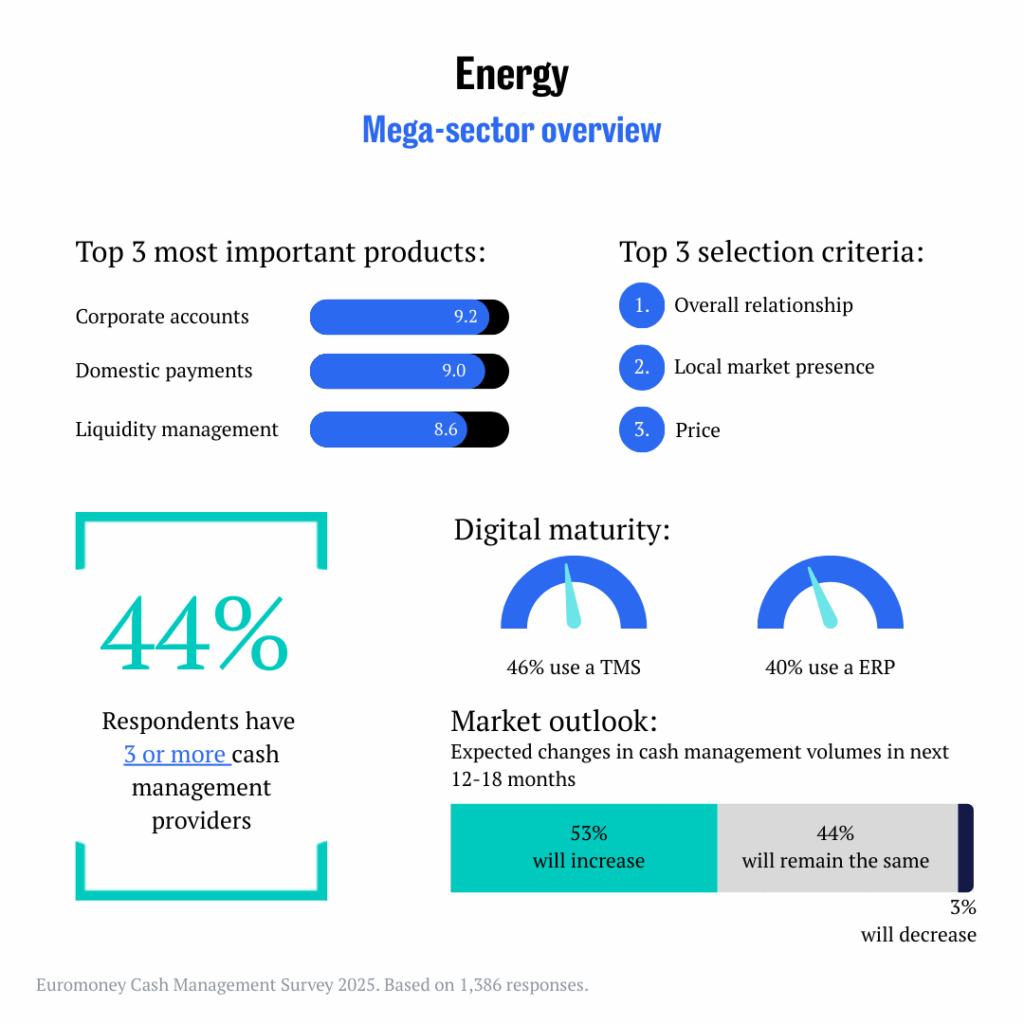
The energy sector, spanning oil and gas, utilities and renewables, has been the segment with the most drastic business and operational changes in the past decade. 2022 delivered a windfall for oil and gas producers as post-pandemic demand collided with supply shocks from geopolitical tensions, especially in Central and Eastern Europe. Crude surged above $100 a barrel, European gas prices hit records and the majors generated cash at a historic scale. From January 2021 to September 2023, the five largest international oil companies produced $613 billion of operating cash flow. About 40% of that went straight back to investors through dividends and buybacks, while much of the remainder paid down debt. By early 2024, leverage was lower, cash reserves higher and treasurers enjoyed a flexibility not seen in decades.
This cash flush comes with a strategic backdrop: the uncertainty of the energy transition. Fossil fuel demand may peak within years, yet the shift to renewables will take decades. Treasurers therefore balance two imperatives: reward shareholders now to maintain support, while keeping larger cash cushions than before to navigate an uncertain future. On the transition side, for treasurers, funding multi-billion, multi-year projects is a central task. With prices still elevated, many can rely on internal cash, though hedging and credit facilities remain vital backstops. A grip on the treasury flows is mandatory, especially as working capital adds further volatility.

The technology sector has one of the most complex treasury profiles in global corporate banking. Big tech firms rank among the most cash-generative companies in the world, which makes efficiency and real-time visibility over liquidity mandatory. Their treasuries are closely aligned with the macro cycle, moving quickly to capture yield or shield against volatility.
Most technology companies maintain a clear handle on their banking relationships, often with disciplined structures that reflect the scale and global nature of their operations. Only 32% of the Euromoney Cash Management Survey participants from this segment have 3 or more providers.
Technology investment itself is a double-edged sword. On the one hand, tech treasuries are among the most advanced globally, acting as first movers in adopting AI-driven forecasting, embracing API connectivity and piloting new technologies from stablecoins to tokenised assets. On the other, the sector’s own relentless capital expenditure, ranging from AI infrastructure, cloud or semiconductors, consumes vast amounts of cash and demands careful planning of liquidity.
Foreign exchange adds further complexity. With operations spanning multiple jurisdictions, hedging is a constant priority, requiring sophisticated software and tools to deliver visibility and control across flows.
This is also one of the few segments where experiments with stablecoins and central bank digital currencies are firmly on the agenda. While still early days, expectations are that technology firms will push boundaries in piloting these instruments as part of their treasury evolution.

Top ranked cash management providers
Euromoney’s MarketMaps rank the global and regional leaders and what makes them stand out.
The benchmark for excellence in 2025
Across the board, the top-ranked banks differentiate themselves through a balance of global scale, technology integration and relationship strength. Corporates consistently highlight the value of liquidity solutions such as cash concentration or notional pooling, which remain core differentiators. From a product perspective, the highest satisfaction of corporates can be seen across domestic payments, followed by merchant services and international payments.
Banks that stand out most are those investing in digital platforms that simplify access and integrate with ERP systems, while also delivering strong security, digital banking functionalities and SWIFT / host-to-host connectivity.
Yet, it is not just infrastructure that sets these institutions apart, clients repeatedly highlight the importance of responsive service and strong relationship managers, describing them as agile, collaborative and quick to resolve operational issues. From a client service perspective, performance of the client service manager, together with local market presence and the quality of team preparation are the drivers for which top banks scored the highest.
Cost competitiveness also features prominently, particularly for banks with strong regional franchises. Those hitting the benchmark for excellence in cash management are able to combine global products and operational excellence with human delivery, enabling treasurers to access sophisticated technology and trusted advisers who understand their business.

HSBC remains the #1 choice for corporates worldwide in cash management. The bank leverages its global network and client servicing model to stand out, with respondents emphasising its ability to combine scale with responsiveness. Treasurers highlighted the HSBCnet platform, consistent delivery and geographic breadth – “global reach, local presence,” with a strong offering in Asia. Service quality and relationship management are repeatedly praised: “responsive and reliable” was how one client summed it up.
Our ambition is led by one goal: to be the business partner of choice for our clients, wherever they are in the world. We are committed to helping our clients navigate changes in the global payment ecosystem by supporting treasury functions as they adapt to a faster, more interconnected payments system,” explains Manish Kohli, head of global payments solutions at HSBC.
In an environment where global consistency matters as much as local expertise, HSBC is positioned as a central partner for corporates operating across borders.
Standard Chartered is also recognised among the leading providers globally. Its heritage in trade and emerging markets underpins strong advisory capabilities, while corporates point to international reach, foreign exchange, collections and pooling as core strengths. Ease of use is a recurring theme: respondents cited “user-friendly systems,” “flexibility and simplicity” and “a single online platform” as differentiators.
“Our strategy is to strengthen our ecosystem by enabling clients by investing in our platforms, service and scaling solutions that cater to our clients’ specific cross border needs,” highlights Mahesh Kini, global head of cash management at Standard Chartered.
Over the past year, Standard Chartered has advanced its cross-border FX payments with the launch of SC Prism FX, co-created innovative client solutions and expanded its digital platforms. Its omnichannel strategy delivers Straight2Bank through web, mobile, API and host-to-host channels, enhancing flexibility for corporates and FIs. At the same time, the bank is deepening its role as an ecosystem orchestrator by investing in new schemes, building digital currency capabilities and partnering with aggregators. As Kini notes, “we are building a strong foundation of digital channels and platforms,” positioning itself at the centre of payment innovation.
J.P. Morgan earns consistent recognition for its technology and integration. “Automation across all their products” and “excellent implementation and collaboration” were typical comments. Clients see it as a bank that understands their needs, combining global reach with the security of a large balance sheet. “Comprehensive offering, large balance sheet, global reach,” was how one treasurer encapsulated its appeal.
Société Générale rounds out the leading providers, noted for service consistency and value delivery across markets. Clients highlighted strengths in notional pooling and remittances, alongside platform stability and centralisation: “a single online platform allows access to our accounts worldwide.” Responsiveness and competitive pricing further reinforce its reputation.
Deutsche Bank remains a strong choice for global corporates, supported by its network, system integration and sophisticated cash concentration solutions. Clients emphasise its comprehensive offering and advisory strength: “understanding our needs” and “advice on various topics” capture how the bank positions itself as more than a transactional partner.
Bank of America is recognised for its CashPro platform, widely praised for simplifying access and operations. “One login to access accounts worldwide” reflects the efficiency corporates value. Implementation, security, mobile functionality and easy payment structures all contribute to its reputation for digital leadership.
Crédit Agricole CIB’s combination of product offering with high-quality service positions the bank as an outstanding provider. Clients point to “flexible offering, mature digital technology and strong risk management,” alongside “excellent document management.” The bank’s international reach is cited, while service quality is described as “highly professional with excellent communication.”
Santander combines relationship depth, digital capabilities and cost competitiveness. Clients describe its platforms as “friendly” and “agile,” and highlight responsiveness and the ability to optimise working capital through combined cash and trade solutions. “Differential service and service offering” was one client’s verdict, underscoring its position as a reliable partner across Europe and Latin America.
BNP Paribas is recognised for scale and leadership in Europe, with payments expertise standing out both domestically and cross-border. Technology integration is a major strength: treasurers noted “well-developed software, easily accessible” and seamless ERP connectivity.
BBVA is valued for communication, responsiveness and tailoring to client needs. “Speed of response for operational issues” was frequently cited, while its global coverage supports corporates operating across Spain, Latin America and beyond. Its ability to deliver timely, customised solutions makes it a trusted partner for international businesses.

Africa’s economies create a very diverse cash management landscape, with high inflation, persistent FX shortages and the rapid spread of mobile money, while both global banks and regional champions compete to provide solutions.
In this environment, relationship banks such as Citi (#1 choice of corporates on the continent), Standard Chartered and Access dominate, providing FX expertise, payments and liquidity management in an otherwise highly risky and difficult market.
Citi leads, combining exceptional client service with advanced technology. Standard Chartered scores highly for its international connectivity, while Standard Bank stands out for its local presence, strong product suite and recognised as the top provider for client service in the region. Access, Absa and Ecobank are also prominent, reflecting their regional reach and ability to deliver digital solutions. Société Générale, BNP Paribas and Attijariwafa remain influential in francophone markets, while Bank of Africa provides regional breadth across smaller economies.
In sub-Saharan Africa, inflation remains elevated – over 30% at times in Ghana and Ethiopia, more than 100% in Zimbabwe, forcing central banks to hike rates to punitive levels. For corporates, local borrowing is prohibitively expensive. Treasurers therefore prioritise internal funding, supplier credit and cash cycle optimisation.
Currency depreciation and FX shortages are big headwinds. The Ghanaian cedi halved in 2022, while Nigeria’s naira was devalued in 2023 but still trades at a premium on parallel markets. Corporates struggle to access dollars to repatriate profits or pay suppliers. Treasurers respond with multi-currency strategies: holding offshore US$ or €, matching local revenues with local expenses and timing FX access through central bank auctions or export proceeds.
East Africa showcases Africa’s fintech leapfrog. Kenya’s M-Pesa is entrenched in both consumer and business transactions, enabling daily sweeps from distributors into bank accounts. Interoperability between mobile networks has deepened this integration, and treasurers now include mobile balances in liquidity reporting. Instant payments are also gaining ground: Kenya, Tanzania and Uganda are expanding real-time switches. Standard Chartered, Citi and Ecobank are particularly active in supporting corporates here with digital rails and cross-border connectivity.
The CFA franc zone (Ivory Coast, Senegal, etc.) offers rare stability thanks to its euro peg. Inflation is low and interest rates moderate, allowing treasurers to plan with more certainty. Growth is strong in some economies, though political instability in Mali, Burkina Faso and Niger complicates operations. Banks like Société Générale, BNP Paribas and Attijariwafa, with deep local franchises, are key providers, valued for their ability to navigate regulatory nuances and sanctions risks.
Fintechs continue to challenge traditional banks, especially in payments. Cross-border settlement is a particular pain point: transactions often route via Europe or the United States, adding cost and delay. The Pan-African Payment and Settlement System (PAPSS) is now live with more than a dozen central banks, enabling local currency cross-border payments. If widely adopted, treasurers could settle a Ghana – Kenya payment directly in cedi and shillings, reducing reliance on dollars. Banks such as Ecobank, with pan-African coverage, integrate PAPSS in their offering, in addition to ancillary services to support corporate navigate a real-time environment.
Africa’s outlook is mixed but improving. If global rates decline, pressure on local currencies and debt burdens is expected to ease. Treasurers will remain focused on liquidity buffers, FX planning and working capital discipline. Mobile money will deepen integration with formal banking and instant payments will expand. PAPSS could gradually transform intra-African cash flows. For corporates, the imperatives are unchanged: secure access to FX, safe local banking partners, and digital tools to accelerate liquidity.

Asia-Pacific is vast and heterogeneous, from advanced economies like Japan and Australia to giant emerging markets such as China and India and the fast-growing nations of Southeast Asia. Treasury practices vary widely, shaped by monetary policies, foreign exchange regimes and rapid adoption of digital payments.
China’s financial cycle in 2024 and 2025 has been the reverse of the West. While the United States and Europe tightened policy, the People’s Bank of China cut rates to support a slowing economy. Deposit and money market yields hovered near 2%, leaving corporates with little incentive to park excess cash. Instead, treasurers focused on conserving liquidity or paying down debt amid weak demand and an emerging property sector crisis. At the same time, China accelerated efforts to internationalise the renminbi. Cross-border RMB credit surged by more than $370 billion since 2021, while treasurers across Asia increasingly handle RMB liquidity, with many maintaining accounts in Hong Kong and hedging through the offshore CNH market.
Among providers, ICBC and Bank of China remain central partners for domestic liquidity, while global banks such as HSBC and Standard Chartered are valued for connecting RMB cash pools with wider global networks.
After decades of ultra-loose policy, Japan finally ended negative rates in 2024, moving to a +0.5% policy rate by early 2025. The weak yen has boosted exporters’ cash flow, but with a squeeze effect towards importers. Japanese banks such as Mizuho, MUFG, SMBC remain core for domestic corporates, while foreign players like J.P. Morgan and Bank of America provide cross-border cash and liquidity management, reflecting their strong technology capabilities.
India continues to grow at 6%–7%, with the RBI keeping rates around 6.5%. Treasury operations are being reshaped by the Unified Payments Interface (UPI), which now handles billions of instant transactions monthly. UPI has transformed collections and vendor payments, reducing cash-in-hand and accelerating liquidity.
Southeast Asia is at the forefront of payments connectivity. Systems such as Thailand’s PromptPay, Singapore’s PayNow and Malaysia’s DuitNow are being linked cross border, allowing corporates to move liquidity regionally in real time. By 2025, ASEAN central banks aim to interconnect all fast-payment systems. DBS, ranked #1 in the region by respondents, has been a leader in driving adoption of instant payments and API-based cash management across Southeast Asia. UOB and OCBC are also prominent in Singapore and the region, focusing on integration with treasurers’ systems.
Being the home of technology giants, treasury priorities in this segment are focused on capital expenditure on facilities and R&D, often funded partly from reserves and partly through dollar bonds. Here, banks like HSBC, DBS, Deutsche Bank and Bank of America play a critical role in structuring cross-border liquidity and FX hedging.
Asia is leading in treasury digitisation. Cloud-based TMS, API connectivity and mobile-first banking are widespread. Treasurers approve payments and monitor liquidity via secure apps. Experiments on the blockchain infrastructure, AI-driven cash forecasting tools from Indian fintechs and China’s digital RMB pilots all point to a region at the cutting edge.
The regional outlook is cautiously optimistic. China’s trajectory is the swing factor: stronger growth would lift exports across Asia, while prolonged weakness could weigh on supply chains. India and Southeast Asia remain growth drivers. FX volatility and US rate differentials will continue to shape cash strategies. For corporates, treasurers will maintain precautionary cash buffers, expand instant payment use and prepare for greater RMB integration. Banks that can combine scale with innovation – led by DBS, HSBC, JP Morgan and Bank of America – are best placed to serve treasurers navigating Asia’s complexity.

Europe’s cash management landscape in 2025 is defined by a sweeping regulatory reform in payments. The EU Instant Payments Regulation, adopted in 2024, mandates all euro-area banks must be able to receive instant SEPA transfers by January 2025 and send them by year-end, processed within 10 seconds and priced no higher than standard transfers. This will accelerate adoption from the current 16%–19% of credit transfers toward universality. Corporates’ benefits are clear: suppliers can be paid instantly on due dates, receivables are credited immediately and cash can be held until the last moment, improving working capital. But treasurers must adapt to new intraday liquidity demands and round-the-clock payment cycles.
Open banking (PSD2/PSD3) and digital money initiatives are advancing too. The ECB has moved the digital euro into its preparation phase, while the EU’s MiCA (markets in crypto assets) regulation sets standards for these types of assets. For treasurers, a wholesale digital euro or tokenised deposits could eventually streamline pooling and cross-border payments, but these remain at pilot stage. For now, blockchain applications are mostly confined to trade finance experiments in select markets.
The Corporate Sustainability Reporting Directive (CSRD) is another driver: from 2024, large firms must disclose ESG metrics. Treasurers are increasingly asked to integrate sustainability into investment policies, for example restricting short-term investments to instruments aligned with ESG principles.
Among the leading providers, ING stands out as the #1 choice, combining exceptional technology with strong client service. Its ability to deliver pan-European solutions consistently, while maintaining close connections to local markets, positions it as a central partner for corporates navigating complex regional structures. Treasurers point to ING’s strength in innovation and responsiveness as differentiators in a crowded market.
UniCredit and Raiffeisen Bank are equally influential in continental Europe, particularly in Central and Eastern Europe where their networks are extensive and their expertise deep. Their strong presence in high-growth markets makes them natural partners for corporates expanding eastwards, where navigating regulation, payments infrastructure and liquidity management requires banks with on-the-ground experience.
Citi’s global network ensures it remains one of the most important cash management providers in Europe. Multinationals prize its ability to integrate regional cash flows into global liquidity structures, while also benefiting from Citi’s technology platform that offers real-time visibility and scalability. This combination of reach and reliability means Citi continues to feature at the top of many treasurers’ banking panels.
BNP Paribas and Société Générale leverage their European scale to stand out. BNP is frequently cited for its payments expertise and seamless ERP integration, while Société Générale is praised for the stability of its platforms and sophistication of its pooling capabilities. Together, they underscore the strength of French banks in providing both domestic and cross-border solutions.
Deutsche Bank and HSBC remain pillars of European cash management. Clients highlight Deutsche Bank’s expertise in cross-border transactions and its ability to integrate with corporate systems, while HSBC is consistently recognised for service quality and global reach. Both banks are considered safe havens for treasurers looking for sophistication alongside stability.
Other players bring regional strength. Crédit Agricole and Erste Group are recognised for balancing strong domestic franchises with cross-border support, particularly in central and eastern Europe. Santander, Intesa Sanpaolo and OTP stand out in Iberia, Italy and central Europe respectively, offering cost-competitive solutions paired with deep local expertise. For corporates with regional footprints, these banks remain essential partners.
The outlook for 2025 is one of cautious adaptation. Rate cuts from the ECB and BoE would ease interest burdens but reduce yield on deposits, forcing treasurers to reassess investment strategies. Growth is expected to remain weak: IMF forecasts eurozone GDP barely above 1%. Energy remains a geopolitical risk, with the conflict in Ukraine continuing to cast uncertainty.
Banks that combine scale, technology and local expertise – from ING and UniCredit to Citi, BNP Paribas and Deutsche Bank – are best placed to serve as long-term partners in this evolving landscape.
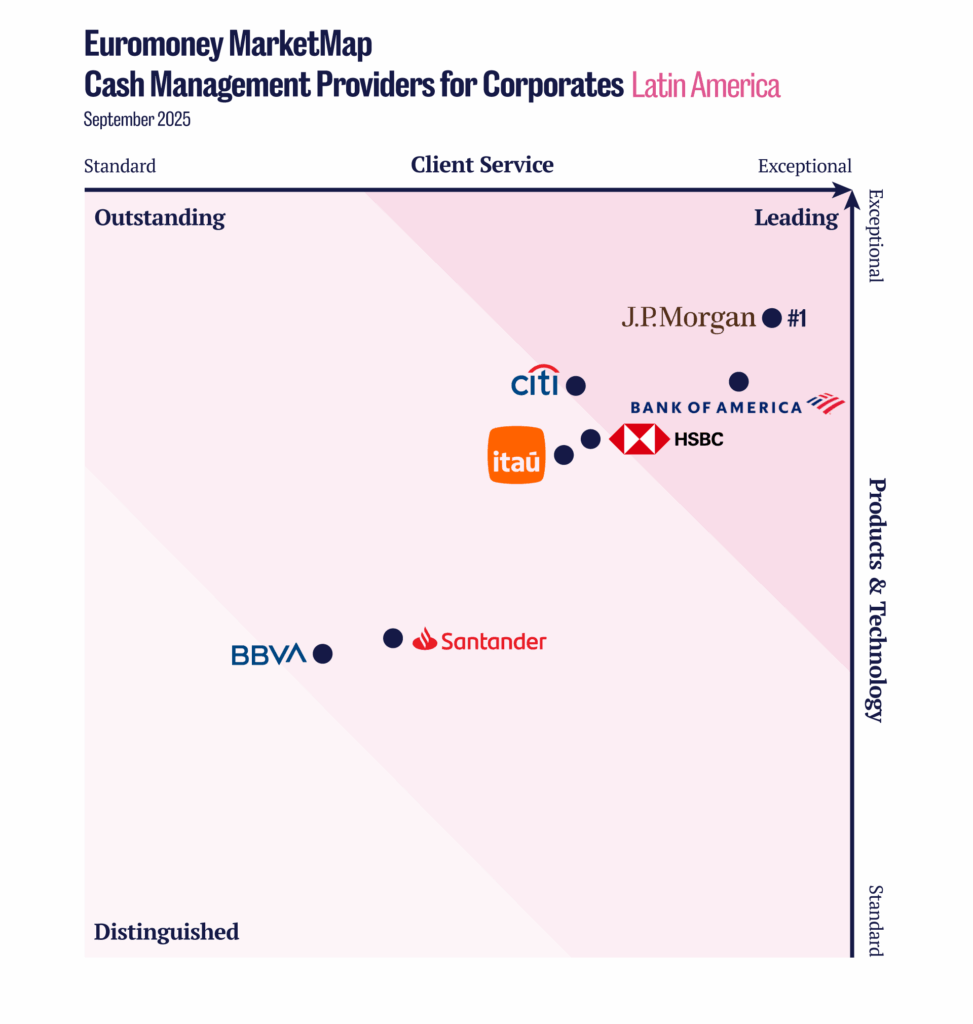
Latin America is shaped in 2025 by high inflation, sharp currency swings and wide disparities in financial stability between countries. The past two years have been a story of divergence: some economies successfully tamed inflation and began easing monetary policy, while others sank deeper into crisis. For treasurers, that means strategies must balance defensive liquidity protection with the ability to capitalise on high-yield opportunities.
Brazil provides a relatively positive example. With inflation under control, Brazil began cutting rates in August 2023, bringing the Selic down to 12.25% by late 2024 and signalling further easing. During the high rate period, corporate borrowing costs exceeded 15%–20%, forcing many firms to delay investment or turn to offshore liquidity and financing.
The payments revolution has been equally transformative. Pix, Brazil’s instant payment system, is now embedded in corporate AR/AP. By 2024, more than 10 million businesses were using Pix to collect customer payments and pay suppliers or gig workers in real time. Treasurers benefit from near-instant cash visibility and intraday liquidity control.
Angelo Russomanno, director of cash management at Itaú Unibanco, sees recurring payments as a powerful lever for efficiency and growth. “Our data shows, for example, that essential service companies – water, energy, gas, sanitation, telecommunications – receive 61% of payments as one-offs and 39% via direct debit or credit card,” he explains. “There is potential for up to a 30% increase in payments when using a recurring payment solution – compared to one-off payments via boleto or QR Code,” he adds.
Pix’ success has influenced regional peers, with Mexico’s CoDi and Peru’s fast payments initiatives seeking to replicate Brazil’s model.
At the other extreme lies Argentina, where hyperinflation above 140% and multiple peso devaluations created a “survivalist” treasury culture. Corporates there convert pesos to dollars or hard assets as quickly as possible, use dollar-linked instruments where permitted and manage cash cycles in days rather than months. With capital controls restricting access to dollars, many firms resort to creative liquidity instruments as an inflation hedge. Multinationals often ring-fence Argentine operations, unable to repatriate cash freely and write down local balances.
Other Andean and Southern Cone economies saw more stability. Colombia, Chile and Peru all endured aggressive rate hikes in 2022 and 2023, followed by easing once inflation receded.
Credit access remains a structural challenge across the region. Large corporates can issue international bonds or borrow from global banks at competitive terms, while SMEs often face loan rates above 20%–30%. This gap has spurred fintech innovation in lending and factoring, with platforms providing finance and working capital solutions. Treasurers at large firms increasingly partner with these fintechs to extend financing to suppliers, strengthening ecosystems and securing longer payment terms.
In this landscape, global and regional banks play a central role. J.P. Morgan is ranked as the leading provider in Latin America, recognised for its exceptional product breadth and technology. Its regional strength lies in integrating local liquidity with global cash structures, giving multinationals a reliable partner in volatile markets. Bank of America and HSBC also stand out for combining robust platforms with strong regional coverage, particularly in Mexico and Brazil, where technology integration and security are highly valued.
Citi remains a trusted choice, especially for multinationals needing both scale and flexibility. Its ability to operate seamlessly across borders resonates in a region where FX, regulation and credit conditions vary sharply.
Local champion Itaú commands strong loyalty in Brazil, where its on-the-ground expertise and innovation in digital channels position it as a natural partner for domestic corporates. In the past year, Itaú Unibanco grew fee and interest revenues on the back of higher card use, transactional volumes and fund management, while ensuing best in class client experience. The bank deployed innovations such as Pix NFC, Pix Automático, BNPL via Pix, ERP integrations and the NCR Brasil acquisition. Advances in APIs, ERP connectivity and generative AI reinforced the bank’s digital transformation, while expanded coverage introduced Banricompras and regional solutions like Connect Cash and Multibanco. “Everything we build starts with our clients. Our client-centric approach means designing solutions that simplify complexity, improve treasury efficiency and enable growth,” explains Davi Faleiros, director of cash management at the bank.
Santander and BBVA continue to leverage their Iberian heritage and deep presence across Spanish- and Portuguese-speaking markets, offering corporates scale across Mexico, Chile, Colombia and Peru.
Looking ahead, inflation is receding and most central banks are set to continue or begin easing cycles in 2025. At the same time, integration initiatives hold promise. Regional discussions on linking instant payment systems and reducing reliance on the dollar for intra-regional trade could eventually streamline cross-border liquidity. The lessons of recent years, from Brazil’s Pix revolution to Argentina’s cash-preservation tactics, underline that adaptability is the core skill for treasurers in Latin America.

In the Gulf Cooperation Council (GCC), higher oil prices since 2022 generated large fiscal surpluses, swelling government accounts and corporate deposits. Even after oil moderated to around $80 a barrel, most GCC states remained comfortably above their fiscal break-even levels. This stability translated into improved government payment cycles, stronger private-sector liquidity and continued infrastructure spending. Mega projects such as Saudi Arabia’s Vision 2030 developments and the UAE’s infrastructure pipeline cleared cash through local economies, sustaining strong inflows for contractors and suppliers. Treasurers in the GCC often found themselves managing excess liquidity, deploying it into debt repayment, expansion or high-yield deposits.
Because most GCC currencies are pegged to the U.S. dollar, the Federal Reserve’s tightening cycle was mirrored locally. Interest rates rose in tandem to around 5%, rewarding corporates with strong cash positions. With inflation contained at 3%-5%, companies could earn real returns on local deposits, a sharp contrast with previous years of near-zero yields. Gulf banks, already well capitalised, benefitted from these conditions and corporate confidence in keeping deposits in local banks remained high.
Banks in the region are positioning themselves as core partners in this cycle. Mashreq leads the rankings, recognised for its technology-driven platforms and responsiveness to corporate needs. HSBC and Citi remain trusted names for multinationals and regional champions, offering integration with global cash structures while adapting to local requirements. Emirates NBD and Standard Chartered also feature strongly, reflecting their ability to bridge international networks with deep GCC coverage. First Abu Dhabi Bank (FAB), Abu Dhabi Islamic Bank (ADIB), Arab Bank and Ahli United Bank continue to serve corporates with strong local ties, often as relationship-driven partners for regional liquidity.
Payments innovation is another theme shaping the region. Saudi Arabia’s “sarie” and the UAE’s IPP are bringing real-time payments into the corporate sphere, while the Gulf Payments Company works to link regional RTGS systems. Cross-border settlement remains slow and reliant on correspondent banks, but initiatives such as a potential GCC digital currency for wholesale settlements could transform liquidity flows.

North America’s cash management environment in 2025 reflects the aftermath of the sharpest monetary tightening in decades and the resilience of corporates navigating it. For corporates, this translates into permanently higher funding costs and the need to balance debt management with the erosion of interest income as yields eventually decline.
The 2023 U.S. regional banking crisis reshaped treasury priorities. The failures of Silicon Valley Bank, Signature Bank and First Republic forced corporates to rethink counterparty risk. Many firms discovered overnight that uninsured deposits were vulnerable, prompting a wave of diversification. Yields near 5% and the safety of government-backed collateral made money market funds (MMFs) a compelling alternative to uninsured deposits. Treasurers updated policies to incorporate MMFs systematically, balancing the benefits of yield and diversification with slightly less on-demand liquidity compared to deposits.
At the same time, new payment rails are reshaping cash management. The Federal Reserve’s FedNow system went live in July 2023, offering 24/7 real-time gross settlement in competition with the private-sector RTP network. Adoption is still building but accelerating, with large banks already embedding FedNow into their corporate portals. For treasurers, instant payments create opportunities for just-in-time settlement, faster receivables and more flexible payroll and refund processes. But they also require new approaches to reconciliation and intraday liquidity, since payments can now land at any hour. Canada is on a similar trajectory, with Payments Canada’s long-awaited Real-Time Rail expected to launch in 2026, promising similar benefits for Canadian corporates.
Despite digital progress, legacy practices remain entrenched. Checks are still used for payments, a major fraud risk. Treasurers are under pressure to migrate toward ACH, instant payments and card solutions, supported by industry initiatives and government modernisation programs. Physical cash usage continues to decline, but for cash-heavy sectors like retail and food service, investment in smart safes and armoured transport remains essential to streamline deposits and reduce shrinkage.
The competitive landscape for cash management in North America reflects these shifts. J.P. Morgan, a leading provider, is praised for combining scale, advanced technology and integration of FedNow and RTP into client platforms. Bank of America has built a strong reputation with its CashPro platform, helping corporates streamline global liquidity and payments. Citi continues to stand out for its international network, enabling U.S. and Canadian firms to connect seamlessly with overseas operations. Deutsche Bank, #1 choice of North American corporates and HSBC also perform strongly, particularly for multinationals with cross-border needs, while BNP Paribas brings a European perspective to U.S.-based treasuries.

Optimistic outlook
The themes shaping the future of cash management.
The shift from a decade of near-zero interest rates to a period of structurally higher borrowing costs has rewritten the rules. Cash once seen as idle is now an earning asset, but the cost of capital has risen in parallel, sharpening the focus on working capital discipline and efficient deployment. The past two years have underscored the divide between firms with strong liquidity strategies and those caught unprepared.
Treasury at the heart of corporate strategy
Treasury has also moved firmly into the strategic spotlight. Once a back-office function, it now plays a central role in safeguarding corporate assets, optimising returns and enabling growth.
“The era of siloed treasury is behind us: clients expect banks to deliver intelligence alongside infrastructure, whether that’s predictive liquidity tools or smart routing of cross-border payments,” highlights Manish Kohli, head of global payments solutions at HSBC. Survey responses point to treasurers being described as the “driving force of the cash culture”, integrating risk management, technology and business strategy.
This expanded mandate requires new skills in data analysis, digital finance and scenario planning, making treasury a hybrid of operator and strategist. Banks recognise this and significant investments are made to support the treasurer in their new role: “we’ve also invested $30 million in building a next-generation liquidity engine, which enables us to launch at least one breakthrough product every quarter,” adds Kohli.
Regional context continues to matter. A treasurer in Europe faces subdued growth but regulatory-driven payment modernisation. In Latin America, inflation and FX volatility still dominate liquidity decisions. Asia blends cutting-edge adoption of instant payments with the realities of RMB risk management, while in Africa fintech and mobile money reshape traditional flows. This diversity reinforces that while core principles – safety, liquidity, yield – are universal, execution must remain context-specific.
2026 and beyond

55% of respondents expect to increase cash management volumes in the next 12–18 months, with liquidity products benefiting the most. 26% of corporate respondents are looking to grow cash concentration flows, 19% notional pooling, 17% virtual accounts and 15% in-house bank (IHB) structures.

Corporates are increasingly moving toward IHB models to centralise treasury, streamline liquidity and reduce reliance on external banks. Traditionally, multinationals used multiple providers across markets for payments, collections and cash management, ensuring local reach but creating fragmentation, complexity and higher costs.
An IHB allows corporates to consolidate flows into a single entity, acting as the bank for subsidiaries. This improves visibility of group liquidity, working capital efficiency and reduces intercompany settlement costs through netting and pooling. It also limits the need for local accounts and enables strategic allocation of cash across jurisdictions.
“Some of the most in demand solutions are ranging from in-house bank structures, Regional Treasury Centre (RTC) set up or relocation, TMS/ERP modernisation (including ISO standards adoption) and set up of centres of excellence (SSC) to enhance the management of accounts receivables, payables and reporting,” explains Mahesh Kini, global head of cash management at Standard Chartered.
Technology underpins this shift. Host-to-host connectivity, SWIFT integration and API-driven tools allow corporates to replicate traditional banking services internally, while ERP and TMS integration support automation of payments, reconciliation and risk management.
The move is also risk-driven: by internalising treasury functions, corporates gain greater control, reduce counterparty exposure, strengthen compliance and oversee sensitive areas such as FX and funding more closely.
Five themes shaping the future of cash management
- Normalisation of interest rates is underway. Central banks are expected to continue gradual cuts through 2025 and 2026, easing borrowing costs but lowering yields on cash investments. Euromoney survey data shows liquidity management is a top three product priority, with 77% of respondents looking at liquidity as the main product impacted by expected increase in future cash management volumes.
- The move to real-time treasury is accelerating. Instant payments are becoming standard in major economies, with corporate use cases multiplying. Treasurers must adapt liquidity management to a 24/7 cycle, not just end-of-day. Intraday dashboards and automated sweeps are becoming essential. From 2024 to 2025, virtual accounts saw the sharpest rise in priority, while corporates are also flagging in-house banking (IHB) as a key future trend.
- Digital currencies remain a hot topic. Stablecoins are still in the experimental phase, but tokenised deposits and central bank digital currency pilots are edging closer to corporate use cases. Meanwhile, the battle for real-time cross-border payments is intensifying, whether through RTGS interlinkages, domestic networks or fintech partnerships.
- Risk management and compliance stay paramount. Payments’ fraud remains a persistent threat, with real-time systems adding complexity. Investment in AI-driven fraud detection and new solutions in this space are expected to accelerate.
- Talent and technology are the final enablers. Treasury is becoming more digital and data-intensive. Cloud-based TMS/ERP integrations are now mainstream, shifting treasurers away from spreadsheets toward real-time, multi-entity platforms. This evolution demands new skills and a more technology-driven mindset.
Cash management in 2025 is more complex, more digital and more central to corporate success than ever. Treasurers must balance tactical efficiency with strategic foresight, treating liquidity as both a defensive shield and a competitive advantage. Liquidity instruments are top of the corporate agenda, while the shift to real-time treasury gathers pace in the background.