State Bank of India (SBI) first launched its flagship mobile app in 2017. Called Yono (You Only Need One), it brought together services carried out by SBI’s subsidiaries in areas including insurance, credit cards and investing, as well as wider lifestyle features, such as shopping.
The project brought with it an important element of transformation, especially in the way it remodelled services around the customer relationship. This helped prevent the sort of market-share losses that other public-sector banks have seen in India, particularly among younger users, the biggest chunk of whom still come to SBI.
The original Yono had a refresh in the early 2020s. But even then, it was becoming clear that the app was nearing the time for a more fundamental overhaul. Internet banking, for example, was still running on a different tech stack. SBI needed to move to a more unified tech platform, and to be able to move quicker and get more control over its front end. Technology was moving on and so were the expectations of customers.
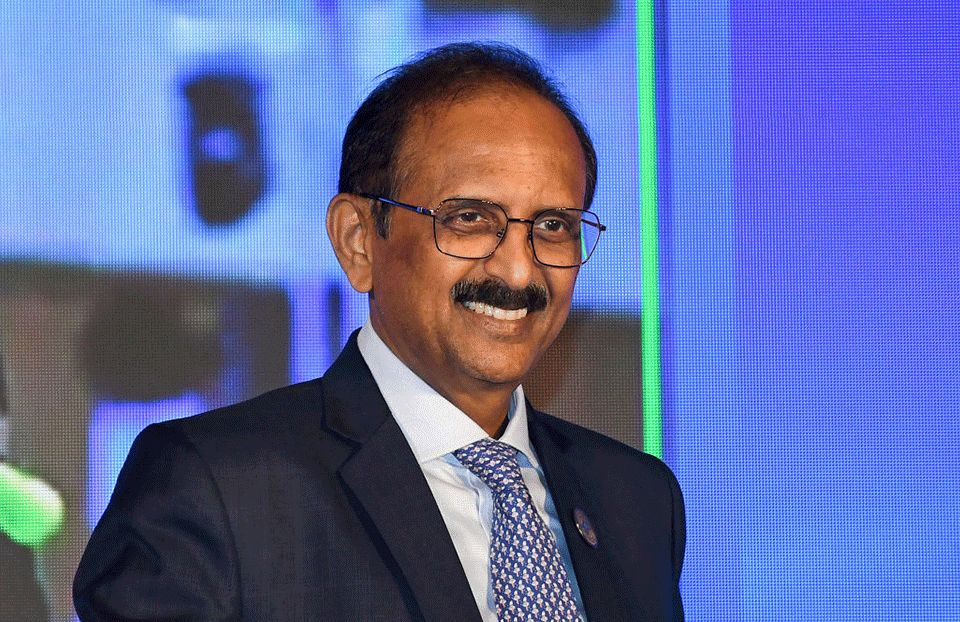
We have built a modern digital foundation that will enable continuous innovation, faster product development, and a consistently better customer experience
Challa Sreenivasulu Setty
Ultimately, the bank wanted to be more capable of hyper-personalising content and communications, leveraging AI. It wanted to do even more to satisfy the younger users coming into the bank in their millions every year. It also wanted to extend digital banking to more of the newly banked population, who often come into the sector later in life – an inflow in the hundreds of millions of customers over the past decade at SBI, as smartphone usage spread rapidly in India.
In doing so, it wanted to expand the number of India’s most spoken languages available in its digital front end beyond English and Hindi, while also better integrating services from fintech companies.
To achieve all of this, it became clear that the app overhaul needed to take place within a wider transformation of the bank: moving away from a monolithic architecture in favour of a cloud-native microservices-based architecture, ultimately based on one of India’s biggest private clouds.
On the front end, it meant harmonising the experience between the app, the website, and a vast physical network, with five million branch visits a day – so that when changes were made, it reflected across channels, reducing redundancy. It would also be more capable of better leveraging marketing technology, something which also meant hiring new talent in digital marketing at the bank.
Yono-isation of the bank
Few at the bank can remember a larger operational overhaul than preparing to move to the new Yono over the past three years – a project of relevance to SBI’s entire customer base of more than half a billion.
“The launch of the new Yono is the visible outcome of a much larger transformation taking place within SBI,” chairman Challa Sreenivasulu Setty tells Euromoney. “We often describe it internally as the Yono-isation of the bank, because it goes far beyond introducing a new mobile application.”
One element of the new platform is smoother integration of the lifestyle propositions, notably shopping, within wider development of the bank’s loyalty programme. As part of that, it has streamlined elements of the old offering, including the number of merchant partners, while directing access to individual merchants through a single partner channel.
But perhaps the most impactful change from a social and economic point of view is the new app’s potential to increase digital engagement by mass customers across India, a large section of whom had not yet used the app. A simplified offering and new technology architecture, availability in 12 languages, and better integration with other channels were key components to achieve such goal.
Understanding (new) customer needs
Part of the new Yono project, therefore, required careful market research into its different sections of customers, to make sure it was not misreading what they needed from the app.
The bank has taken out certain features, including as a result of the lower use of cash in India since the mass adoption of the Unified Payments Interface (UPI) – another transformation for which SBI is partly responsible via the roll-out of Yono’s UPI product, which is also available to people who are not customers of the bank. SBI has also done more to adapt the app to different personas, such as younger, salaried, retired or self-employed customers, moving away from the old one-size-fits-all proposition.
The launch of the new Yono is the visible outcome of a much larger transformation taking place within SBI
Challa Sreenivasulu Setty
Above all, with an ever-growing volume of concurrent logins, building for digital resilience and banking security at scale was vital. Customers used to always-on social media apps could see the value of the bank app, rather than giving up and going elsewhere.
Today, Yono has more than 100 million registered users. Peak load times see more than 27 million logins a day and more than 40,000 logins a minute. Now the bank believes it can double the app’s users in two to three years due to India’s growing wealth and deposit balances, as well as financial and digital education. It is a pace of digital acquisition – around 3 million a month – that could surpass the biggest neobanks elsewhere in the world.
As SBI’s digital transformation culminated in the launch of the new Yono in late 2025, India’s biggest bank has made itself worthy of that future.
“We have built a modern digital foundation that will enable continuous innovation, faster product development and a consistently better customer experience,” says Setty.