Banks in Europe retain a much stronger hold of the mortgage market in the continent than their counterparts in the US. Many, however, often view the product as a mere means to an end – a loss leader on which to hang other products, especially fee generating ones, even when mortgages make up the biggest chunk of their balance sheets.
By contrast, ING’s mortgage strength rests increasingly on service quality, speed and product design, rather than on price alone. For example, its focus on relationships with brokers has paid dividends in the Netherlands. The bank closely monitors broker satisfaction scores and has introduced priority services for its top brokers.
Processing times are one of the clearest pain points for borrowers, particularly in a hot housing market when customers need to secure a sale quickly and at times when the wider system is congested. Customers and brokers need certainty quickly when delays can put a property purchase at risk. ING has been leaning more heavily on technology, especially AI, to differentiate itself on this front. This includes improvements to its digital platform for brokers in the Netherlands, alongside wider investment in agentic AI processing, automated credit decisions and property appraisal.
It’s not our strategy to be the cheapest, but we can win over more customers and brokers by having a faster time to yes
Tom Degen
These investments are already contributing to sharp falls in mortgage approval times, notably in Spain and Belgium. In Germany, ING has launched instant property appraisals and credit assessments as part of a broader scheme to develop instant mortgages.
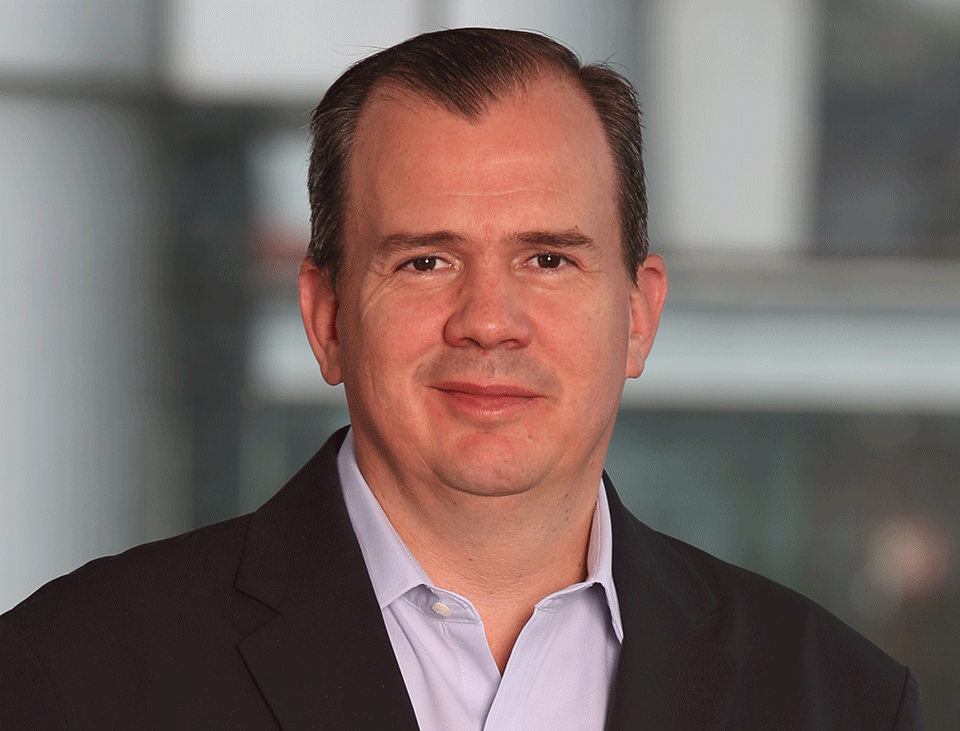
“It’s not our strategy to be the cheapest, but we can win over more customers and brokers by having a faster time to yes,” says Tom Degen, head of mortgages at ING in the Netherlands. “For a customer, and also for a broker, the first thing they want to know is whether this mortgage will be approved. If we can deliver a rapid approval, that is differentiating, and that’s where we have been also investing.”
Superior product development
Sustainability is one important area of development across Europe, including how it monitors the impact of its lending. In Belgium, it financed 2,460 environmental renovations during 2025. In the Netherlands, it launched a new pricing model that automatically lowers the interest rate on a mortgage if the borrower improves the property’s energy label. In Germany, it enhanced its Baufi Energy offering for green mortgage borrowing.
ING has also used product development to expand in segments that are often harder for banks to serve well. It has increased its emphasis on entrepreneurs, expats and buyers of new-build homes – adding more experts in those areas. That has helped the bank broaden its mortgage reach beyond the most standard customer groups in the Netherlands.
In Spain, meanwhile, it gained share of new customers by scaling a new Young Mortgage programme for borrowers under 36 in 2025. The programme offers mortgages with a loan-to-value ratio of up to 95% on ING’s own risk, and up to 100% under regional government programmes. Madrid has been especially important: ING has granted as much as 40% of mortgages under the city’s Mi Primera Vivienda (my first home) programme. This has been a strong driver of growth among younger borrowers at a time when getting on the housing ladder is increasingly difficult.