
Extraordinary opportunities have come to Santander over the past year. It has taken full advantage of them – demonstrating extraordinary financial success, product and business development, and technological transformation.
Those chances came to Santander partly thanks to a good starting position. The group has good bones. But realising the opportunities has allowed it to move to a new era.
Clinching a deal to buy TSB from Banco Sabadell in May 2025 was a definitive sign of its commitment to the UK, catapulting its business in the country from mid-single digit return on equity, realising £400 million of cost synergies, and creating the country’s third-largest current account franchise. Earlier this year, there were already signs of new energy in its UK franchise as it launched a new My First Mortgage product for high-quality borrowers with low deposits.
More recently, the deal to acquire Webster Bank is set to transform its US business to a top-five deposit franchise across key states in the country’s northeast, with top-tier profitability – while also adding further impetus to the growing corporate and investment banking business it has built up in the US over the past five years.
Both deals plan a much higher return on investment than share buybacks following organic capital generation. Equally important is the impact on Santander’s identity.
The deals went public shortly after a May 2025 agreement to sell a 49% stake in Santander Polska early last year to Erste Group – a more obvious owner for that business than Santander.
Targeted regional expansion
Focusing on a smaller number of bigger markets streamlines Santander’s strategic set-up and resolves longstanding questions about its spread. The moves also increase the share of Santander’s loan book and profit base from reserve currency markets, limiting exposure to depreciation risk.
While the bank has done these deals, it has silenced lingering questions over its capital adequacy. Over the past three years, Santander has met and then surpassed its target CET1 range, reaching 13.5% at the end of 2025.
The well timed Polish sale, at 2.2 times book value, added to its capital flexibility. It happened just as Erste had the managerial wherewithal to do the deal; just as Sabadell fought off a hostile takeover bid by BBVA; and just as US bank M&A unfroze under the second Trump administration.

Scale underpins our ability to deliver better value to customers while maintaining strong economics. That’s why customer growth is a critical KPI
Daniel Barriuso
Santander’s share price has far outperformed a generally buoyant European bank market over the past two years and the reason is market credibility. It beat key investor targets in its 2023 to 2025 medium term plan, ranging from revenue growth to fees, costs, return on equity, and growth in book value plus cash dividends per share.
In 2025, Santander saw a fourth consecutive year of record profit, reaching €14.1 billion, up 12% from 2024.
Higher euro rates have generally boosted southern European banks’ interest markets since 2022. But that affects Santander differently, partly due to its businesses in Latin America. Geographic diversification still brings Santander an unusual ability to weather a variety of economic risks, even though it has already seen the benefit of rebalancing its Brazilian business away from riskier consumer credit thanks to reinvigorated products, notably credit cards.
Integrated global scale
Unlike previous decades, however, Santander is no longer offering diversification without integration.
That is why it has put so much emphasis on investing in global business platforms over the past three years – so that even retail banking, by far its biggest business, can benefit from global scale.
This focus on global platforms has put Santander’s business in a structurally better position today. It has helped it deliver consistent double-digit growth in profit, not just from rates but from growth in customers and revenue – and because of cost control that has leveraged technology, rather than simply following the standard European bank playbook of cutting staff and closing branches.
Unlike other large incumbents, Santander’s total customer base has grown in the millions per year on a net basis, rising from 173 million in 2024 to 180 million in 2025. It is now targeting 210 million customers by 2028.
“Scale underpins our ability to deliver better value to customers while maintaining strong economics,” says Daniel Barriuso, a group senior adviser who served as head of retail and commercial banking from 2023 to July 2026. “That’s why customer growth is a critical KPI. Customer growth and engagement are mutually reinforcing. It creates scale, which reduces cost and enables better pricing, which in turn attracts more customers.”
The group’s wealth management and insurance business, and the payments business, are the two smallest but highest returning of its global platforms. Santander Asset Management saw assets under management reach an all-time high last autumn, reaching around €250 billion.
In private banking, it launched global ultra-high net-worth and global family office teams in early 2025, reporting a 14% increase in assets under management to €558 billion in 2025.
Its payments business has notched up growth, and lower costs, as the merchant business migrated to a new cloud-native global platform in 2025.
Corporate growth engine
Global integration is even more obvious in its corporate and investment bank. “We want to be a larger engine of growth for the group, leveraging our global platform to support clients across all segments,” says José María Linares, global head of corporate and investment banking. “No other bank has our combination of integrated global and local capabilities.”
Linares has consequently prioritised consistent and predictable growth, with revenues reaching €8.5 billion last year. The division had a market-leading efficiency ratio, 45.5%, and a return on tangible equity of 19.1%, in 2025. “Being the lowest cost provider is critical,” says Linares. “Efficiency and scale allow us to compete aggressively, while maintaining strong returns.”
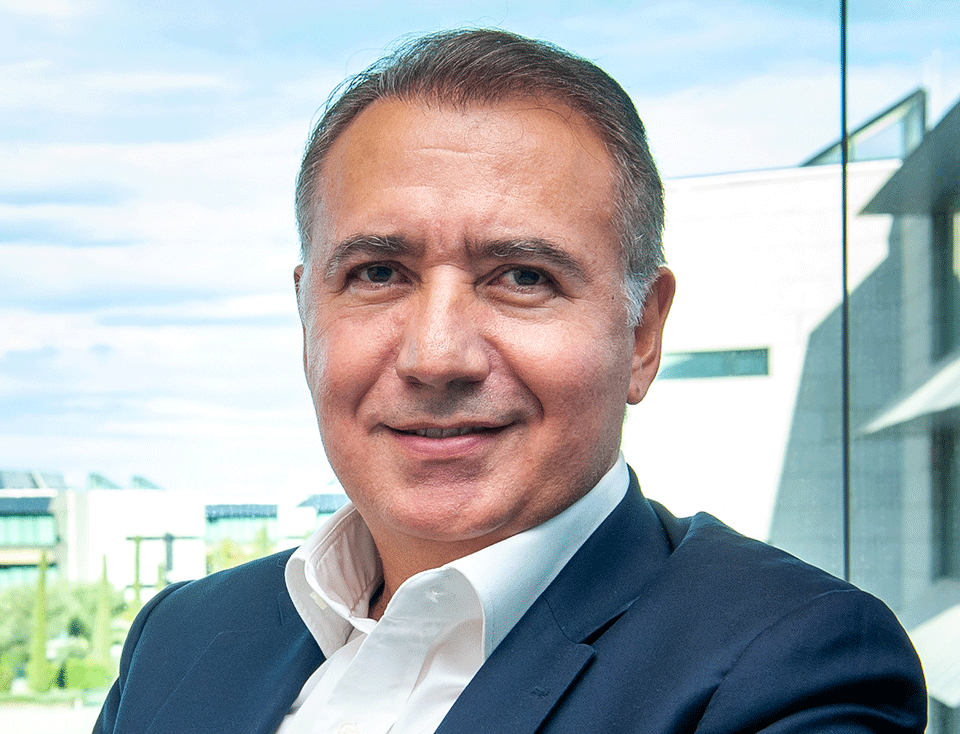
We focus on areas where we have built real strength – energy, energy transition, infrastructure and AI-related sectors – rather than trying to compete everywhere
José María Linares
It has seen especially strong growth in the US, after a 2021 acquisition of fixed income broker dealer Amherst Pierpont in addition to hiring much of the New York Credit Suisse following its 2023 takeover by UBS. The US is now Santander’s single biggest country business within Linares’ division.
“We focus on areas where we have built real strength – energy, energy transition, infrastructure and AI-related sectors – rather than trying to compete everywhere,” says Linares. “Our ambition is to grow while maintaining high returns and efficiency. Growth without profitability is not the objective.”
There is a similar approach in its digital consumer bank. Here too, Santander has focused on building global platforms and deepening relationships. As part of that strategy, it is increasingly integrating its consumer finance business with Openbank, its digital banking brand, starting in Europe. Following earlier rollouts across Europe, Openbank launched in Mexico last year and gained traction in the US thanks to a new partnership with Verizon. The group also gained a banking license in Canada.
Santander’s buy now pay later platform, Zinia, has also rebranded as Openbank Pay, after developing partnerships with Amazon, Vodafone and others, in 2025.
“We’re investing in a multi-product relationship model, focusing on increasing lifetime value rather than one-off transactions,” says Nitin Prabhu, global head of digital consumer bank.
Disciplined efficiency
As in the other businesses, globality is a core advantage, but it maintains just as strong a focus on cost as on growth.
“We issue thousands of loans every day across 26 countries, serving 27 million customers, which gives us both scale and deep insight into customer behaviour,” says Prabhu. “Our approach is to build the business responsibly and profitably, rather than chasing growth through unsustainable competition or pricing.”
Especially in retail banking, revenue growth and profitability gains have come alongside the move to global platforms – and ambitious technological transformation. In retail, its aim has been a digital bank with branches, of which it is proud to maintain more than 7,000 across its international network.
The bank’s digital customers rose to more than 63 million in 2025. Front-end design has been a factor in new business and deposit inflows in Brazil, where the roll out of a new global app preceded launches later in 2025 in Mexico, Chile and Spain, before the UK and elsewhere in 2026.
An intense simplification programme has also seen Santander’s number of products fall by almost two-thirds since 2022.
Meanwhile, on the back end, it was a pivotal year for Gravity – the bank’s in-house core banking cloud technology enabling post-mainframe migration. Starting with Chile, the bank integrated Gravity in Spain, and then Mexico in 2025, before moving onto Brazil in 2026. Gravity has already passed the stage where it was processing 1.3 trillion transactions a year, 70% of Santander’s total. Thanks to Gravity, Santander has now migrated 97% of its IT infrastructure to the cloud.
All this has had clear efficiency advantages – and is crucial to the fundamentally better position in which Santander finds itself now as a retail bank.
Mexico is a good example of how the technological transformation and an early move to the cloud has helped it to increase its deposit base ahead of the market, without additional costs. The rollout of Gravity and OneApp in Mexico, including gen AI upgrades to its customer service, have led to above-market increases in profitability, and a rising net promoter score score.
Physically removing the mainframe in Spain in June last year was symbolic of a wider achievement in fully decommissioning the old system, thanks to Gravity. It has had financial and operational importance, making the bank more agile, resilient, and scalable – allowing much lower marginal cost as the bank adds more customers and transactions to the platform, fuelling revenue growth without automatic cost growth.
“Ultimately, everything we’re doing – technology, simplification, AI, scale – is about improving customer experience while maintaining low cost,” says Barriuso. “That combination is what drives long-term competitiveness.”